US export policy bars G7 partners from accessing Anthropic models Fable 5 and Mythos 5
Berlin, 17 June 2026
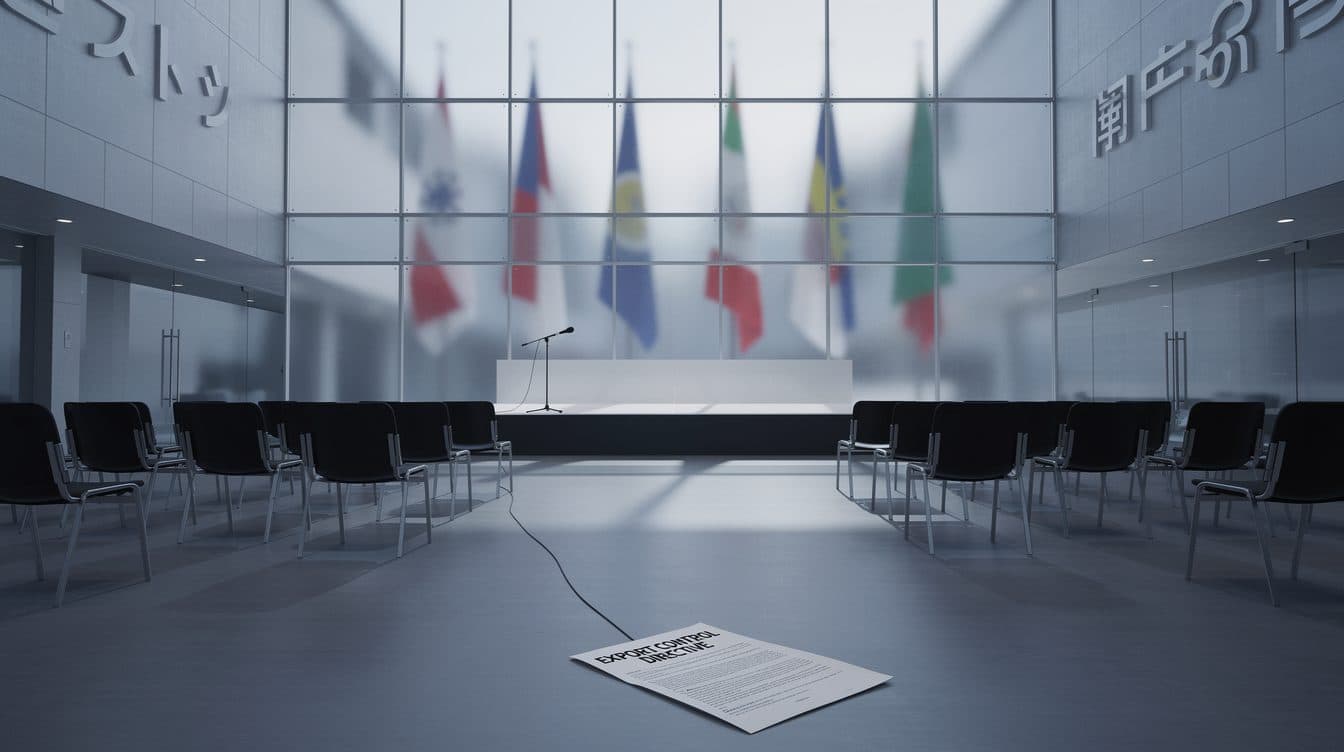
AI-generated image (flux-2/pro-text-to-image via Kie.ai)
Summary
A US government export control directive prohibits foreign nationals from accessing the AI models Fable 5 and Mythos 5 made by Anthropic, including the company's own employees in the United States. Anthropic speaks of a 'missverständnis' and assumes that the US authorities have indications of an exploitable security vulnerability.
Berlin, 17 June 2026
The US government has, through an export control directive, prohibited foreign nationals – including foreign Anthropic employees in the US – from accessing the AI models Fable 5 and Mythos 5 made by US provider Anthropic.
Background of the export policy
The new US government export policy is directed explicitly at two particularly powerful AI models from US provider Anthropic: the systems Fable 5 and Mythos 5. Foreign nationals are no longer permitted to access these models, even if they are employed as staff at Anthropic in the United States. The measure thus reaches deep into the personnel structure of one of the country's leading AI developers.
The export control comes at a time when Washington is handling the export of sensitive AI technology with increasing restrictiveness. According to Anthropic, the background is the suspicion that the US government has obtained knowledge of a method by which the safety mechanisms of Fable 5 could be circumvented – with potential suitability for hacker attacks. The company has publicly described the matter as a 'missverständnis', without disclosing the underlying technical details.
Since a short-term, legally compliant separation of individual user groups was technically not feasible, Anthropic was forced to temporarily shut down both models entirely. All customers worldwide were affected, regardless of their nationality. Access for authorised US persons was to be restored only after more detailed coordination with the authorities.
Impact on G7 states and Europe
The scope of the order thus goes beyond classic export controls for hardware and for the first time also affects access to cloud-based AI from abroad. For the G7 states, whose own AI strategies frequently rely on cooperation with US providers, the measure raises questions about technological sovereignty and the reliability of transatlantic supply chains.
Observers see the step as further evidence that Washington is increasingly classifying AI as a security-relevant key technology. Comparable discussions had previously arisen over chip exports and restrictions on semiconductor deliveries to China. Now the control is being extended to the model level itself.
From the perspective of European governments, the situation is particularly delicate, as many companies and research institutions rely on Anthropic's models to develop or operate their own AI applications. A ban on access for European employees at Anthropic in the US could further exacerbate the already strained personnel situation in the European AI industry and place the build-up of domestic capacities under additional time pressure.
Anthropic's response
Anthropic itself was restrained in initial statements. The company pointed out that it is in close contact with the responsible US authorities and is working toward a solution. At the same time, the company stressed that the security of its systems is the top priority and that the government's concerns are being taken seriously.
The order also raises fundamental legal questions. It remains unclear, for example, on what legal basis the restriction is being imposed on the company's own employees of a US company who hold foreign citizenship, and what implications this has on existing employment contracts. The question of whether existing customer contracts outside the US may continue to be fulfilled has likewise not yet been conclusively resolved.
International reactions were initially muted. The US government has not yet publicly explained the measure; an official statement from the White House is also still pending. In diplomatic circles it is pointed out that an assessment will only be possible once concrete details on the scope of the restriction are available.
Consequences for customers
For the affected users, the blocking means that ongoing projects based on Fable 5 or Mythos 5 must be temporarily interrupted or migrated. Many are switching to alternative models from other providers, which is likely to further entrench the already high market concentration in the area of large AI models.
At the same time, competitors such as OpenAI are coming more into focus, as their models remain available without comparable restrictions. Industry observers see this as a shift in market conditions that in the medium term could also influence pricing and contractual terms throughout the AI sector.
The export policy is part of a series of similar measures with which Washington has more strongly regulated access to key technologies in recent months. Compared with previous chip restrictions, however, the current step goes further because it no longer concerns only components, but finished software products and access to cloud services.
Strategic significance for AI policy
For Anthropic, it remains to be seen how quickly a technical and legal solution can be found that meets both the US government's security concerns and the requirements of international customers. Until then, the issue is likely to shape the debate about the future of AI regulation on both sides of the Atlantic.
The episode also illustrates the strategic significance that AI models have meanwhile attained for national security. Where previously mainly hardware and semiconductors were considered critical goods, software and computing capacity are now coming into focus as independent categories of export-policy controls.
In the longer term, the incident could increase pressure on European players to develop their own AI models and become less dependent on US providers. Whether corresponding investments can be made on a sufficient scale and at sufficient pace will be one of the central questions of the coming years.
The discussion about the precise background is continuing. Anthropic has announced that it will continue the talks with the US authorities and provide information on significant progress. Until then, the blocking of the two models remains one of the most far-reaching AI-related export measures to have become publicly known.
Questions & Answers
Which AI models are affected by the US export policy?
The models Fable 5 and Mythos 5 from US provider Anthropic are affected; foreign nationals – including employees in the US – are no longer permitted to access them.
Why has the US government imposed the restriction?
According to Anthropic, the US government has indications that Fable 5's security measures could be circumvented and the model misused for hacker attacks.
How is Anthropic responding to the export policy?
Anthropic speaks of a 'missverständnis', is negotiating with the authorities and had to temporarily shut down both models entirely, because a short-term separation of individual user groups was technically not possible.