US markets mixed as investors weigh AbbVie-Apogee deal, CRH-Arcosa takeover and US-Iran diplomacy
6/21/2026
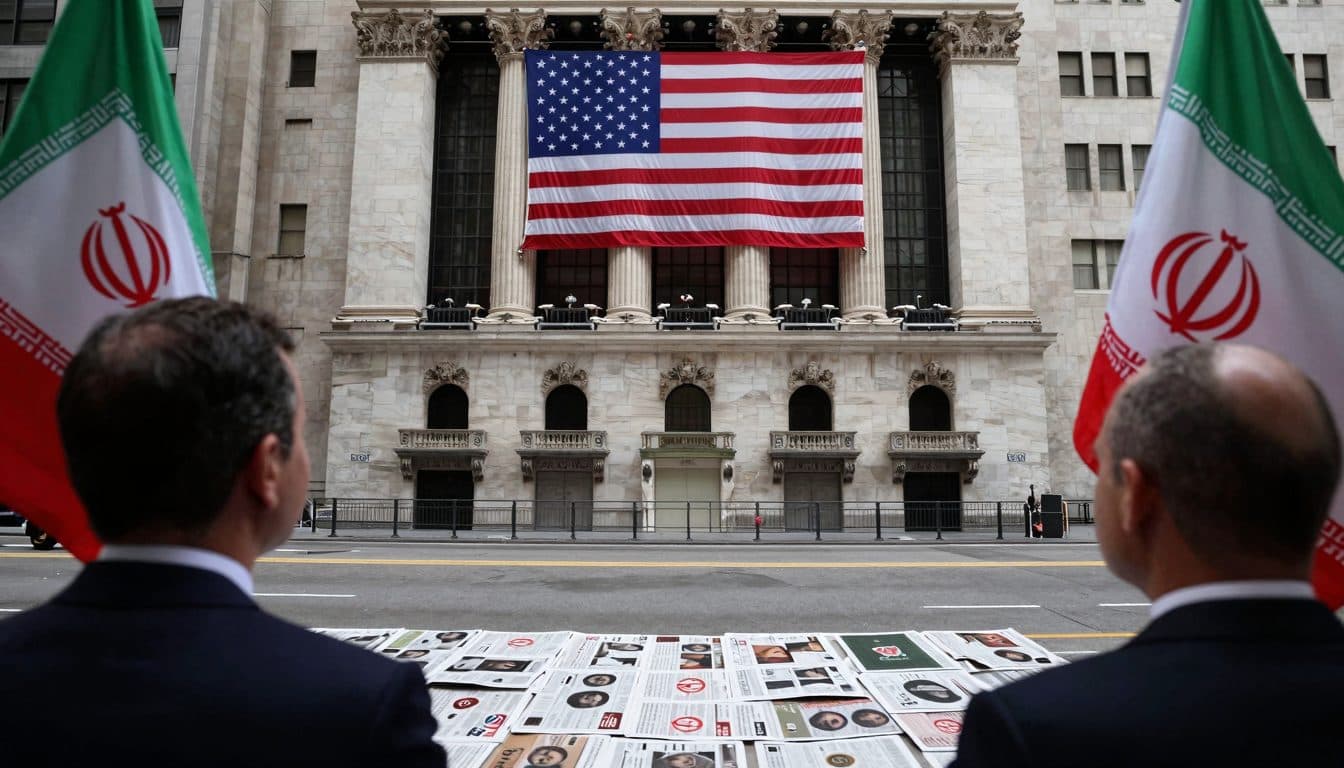
AI-generated image (z-image via Kie.ai)
Summary
US equity markets opened the week in mixed territory as investors weighed two sizeable acquisitions and developments in US-Iran diplomacy. AbbVie's $10.9 billion takeover of Apogee Therapeutics and CRH's deal for Arcosa dominated corporate news, while oil prices fell sharply on hopes of a diplomatic breakthrough.
US stock markets traded mixed on Monday, June 22, 2026, as investors digested two multi-billion-dollar acquisitions and tracked diplomatic progress between the United States and Iran that pushed oil prices sharply lower.
Deal-making dominates the morning
Trading on Wall Street followed a long weekend, with US markets closed Friday for a holiday. The major indices were uneven at midday, with the Dow Jones Industrial Average gaining 0.3 percent to 51,719 points, supported in part by a 3.2 percent rise in Caterpillar shares. The S&P 500 slipped 0.4 percent and the Nasdaq Composite fell 1.3 percent, weighed down by sharp declines in select heavyweight technology names.
The pharmaceutical sector dominated the morning's corporate news after AbbVie announced a $10.9 billion deal to acquire Apogee Therapeutics. AbbVie will pay $135.11 per share in cash, a 49 percent premium over Apogee's Thursday closing price of $90.38. AbbVie shares rose 6.8 percent on the acquisition news, while Apogee shares surged 46.7 percent to $132.60, close to the offer price, indicating that the market expected the deal to be completed. AbbVie's pre-market move was reported elsewhere as a more modest 1.5 percent gain.
The acquisition strengthens AbbVie's pipeline in anti-inflammatory medicines, an area the company has prioritized as it seeks growth drivers beyond its current blockbuster portfolio. The premium price signals AbbVie's willingness to pay for late-stage assets, and the rapid rise in Apogee's share price reflected investor confidence that the transaction will close.
Tech and chipmakers diverge
In the industrial and building-materials space, Irish building-materials group CRH said it would acquire Arcosa for $150 per share in cash. Arcosa shares jumped 7.5 percent to $146 in response, while CRH shares listed in New York slipped 0.6 percent in pre-market trading. Arcosa's market value had recently been close to $7 billion, indicating that the deal values the company at a meaningful premium to recent trading levels.
Tech stocks presented a divided picture. Intel shares rose 2.7 percent pre-market, building on a near 11 percent surge Thursday that followed a chip-manufacturing agreement with Apple and took the stock to a record high. Micron was indicated 4.2 percent higher pre-market as well, extending a strong run for chipmakers exposed to AI demand. Nvidia, by contrast, slipped 0.6 percent, and Alphabet shares dropped 6 percent, pressuring the Nasdaq Composite.
SpaceX extends its post-IPO slide
Alphabet's slide was attributed to the departure of John Jumper, a researcher and Nobel laureate, who announced Friday that he was leaving Google DeepMind to join the AI startup Anthropic. His exit from one of the most prominent AI research teams highlighted the intense competition for top artificial intelligence talent and contributed to a broader rotation within mega-cap technology names.
The biggest single-name drag on sentiment, however, came from SpaceX, whose shares fell more than 5 percent shortly after the open, the third consecutive losing session. The stock slipped roughly $10 to about $175 per share. Pre-market data showed a 4.7 percent decline, putting the shares on course for a third straight down day after losing more than 8 percent combined across Wednesday and Thursday of the prior week.
SpaceX, the space and AI company controlled by Elon Musk, had gone public on June 19 in what observers described as the largest IPO in history. The offering raised $85.7 billion and the stock rose 19 percent on its first trading day, briefly pushing the company's valuation close to $3 trillion and at one point making Musk the world's first trillionaire. By Thursday's close, however, market capitalization had retreated to $2.4 trillion, and by Monday's article time it stood at around $2.2 trillion, with the company slipping to seventh place in the global rankings behind TSMC and Amazon.
The company moved to address the share-price weakness on Monday through a mandatory filing announcing its intention to issue senior unsecured notes to qualified institutional investors. The proceeds, the filing indicated, are intended to help repay a $20 billion bridge loan that constitutes the bulk of SpaceX's roughly $29 billion in total liabilities. The bridge loan matures in September 2027 and had been used to repay debts of xAI, Musk's AI startup that SpaceX acquired in February. The company did not disclose the exact size or terms of the planned bond issuance.
Diplomacy pulls oil lower
Despite the recent slide, SpaceX shares remained roughly 30 percent above the $135 IPO price, and the company reported $100.8 billion in liquid funds as of June 19. A large portion of those funds is earmarked for capital-intensive projects, including data centers in space, the Starship super-heavy launch vehicle, and a chip fabrication facility dubbed "Terafab" in Texas, while additional long-term liabilities relate to AI infrastructure, according to IPO documents. KeyBanc initiated coverage on Monday with a Sector Weight rating, arguing that the price already largely reflects the growth potential, while Zephirin started with a Buy rating and a $310 price target. Oppenheimer set a $250 price target. By KeyBanc's models, the SpaceX share trades at roughly 29 times estimated 2027 revenue and approximately 71 times expected EBITDA, a notable premium versus most competitors. Pitchbook's Franco Granda warned, "Anleger sollten den Zeitplänen des Konzerns skeptisch gegenüberstehen." For 2025, SpaceX reported a loss of $4.9 billion on revenue of $18.7 billion.
Beyond corporate news, attention turned to US-Iran negotiations. According to Li Xing of Exness, "both countries were aiming to reach a deal within 60 days." Saxo Bank noted that progress in the talks, including efforts to secure passage through the Strait of Hormuz despite ongoing diplomatic challenges regarding Lebanon, eased concerns about energy supply disruptions and fears of a broader inflation shock. The previous week's US Federal Reserve meeting had indicated that US interest rates are likely to remain high for longer, reducing the attractiveness of non-yielding assets, analysts said.
Energy markets responded to the diplomatic news. Brent crude fell 4 percent to $77.38 per barrel, while WTI traded at $73.59, down 3.0 percent on the day. Gold recovered from interim losses, rising 0.4 percent to $4,177 per fine ounce, and silver was priced at $65.31 per ounce, up 0.6 percent. Platinum edged up 0.2 percent to $1,667.01. The yield on 10-year US Treasuries rose by 6 basis points to 4.51 percent, and the dollar index added 0.1 percent as markets continued to bet on tighter monetary policy from the Federal Reserve.
Asia, currencies and index changes
Currency markets were little changed. The EUR/USD exchange rate stood at 1.1428, EUR/JPY at 184.65, EUR/CHF at 0.9246, and EUR/GBP at 0.8627 in late New York trading. Bitcoin traded at $64,610.51, up 1.3 percent on the day. Outside the United States, the semiconductor sector was also in demand in Asia at the start of the week. SK Hynix overtook Samsung Electronics to become South Korea's most valuable company, driven by the AI-related chip boom. SK Hynix, a key supplier of High-Bandwidth-Memory products used in Nvidia's AI accelerators, reported in April a fivefold increase in quarterly profit due to rising demand. Training large language models generally requires the combination of Nvidia graphics processors with HBM, underlining the strategic link between the two companies.
Index reshuffles were also in focus. Flex and Marvell Technology will be added to the S&P 500, while Campbell's and Pool will be removed. New additions to the Nasdaq-100 will be Astera Labs, Coreweave, Nebius, Rocket Lab and Teradyne, while Charter Communications, Cognizant, Insmed, Verisk and Zscaler will be removed. Pre-market, IG saw the Nasdaq 100 0.1 percent firmer at 30,449 points, and IG estimated the Dow Jones Industrial 0.2 percent higher at 51,645 points. By Thursday, the Nasdaq 100 had closed sharply higher in a relief bounce. The prior session's closing levels were DJIA 51,564.70, S&P 500 7,500.58, Nasdaq Composite 26,517.93, and Nasdaq 100 30,406.19.
Questions & Answers
What is AbbVie buying and at what price?
AbbVie is acquiring Apogee Therapeutics for $10.9 billion, paying $135.11 per share in cash, a 49 percent premium over Apogee's Thursday closing price of $90.38.
Why did SpaceX shares fall on Monday?
SpaceX shares fell more than 5 percent on Monday for a third straight losing session, with analysts pointing to a planned senior unsecured note issuance and concerns that the post-IPO rally had outrun fundamentals.
How did US-Iran talks affect oil and gold prices?
Diplomatic progress between the US and Iran, including efforts to secure passage through the Strait of Hormuz, pushed Brent crude down 4 percent to $77.38 a barrel and WTI down 3.0 percent to $73.59, while gold recovered 0.4 percent to $4,177 per ounce.
US markets mixed: AbbVie-Apogee, CRH-Arcosa, Iran talks | allfacts360