
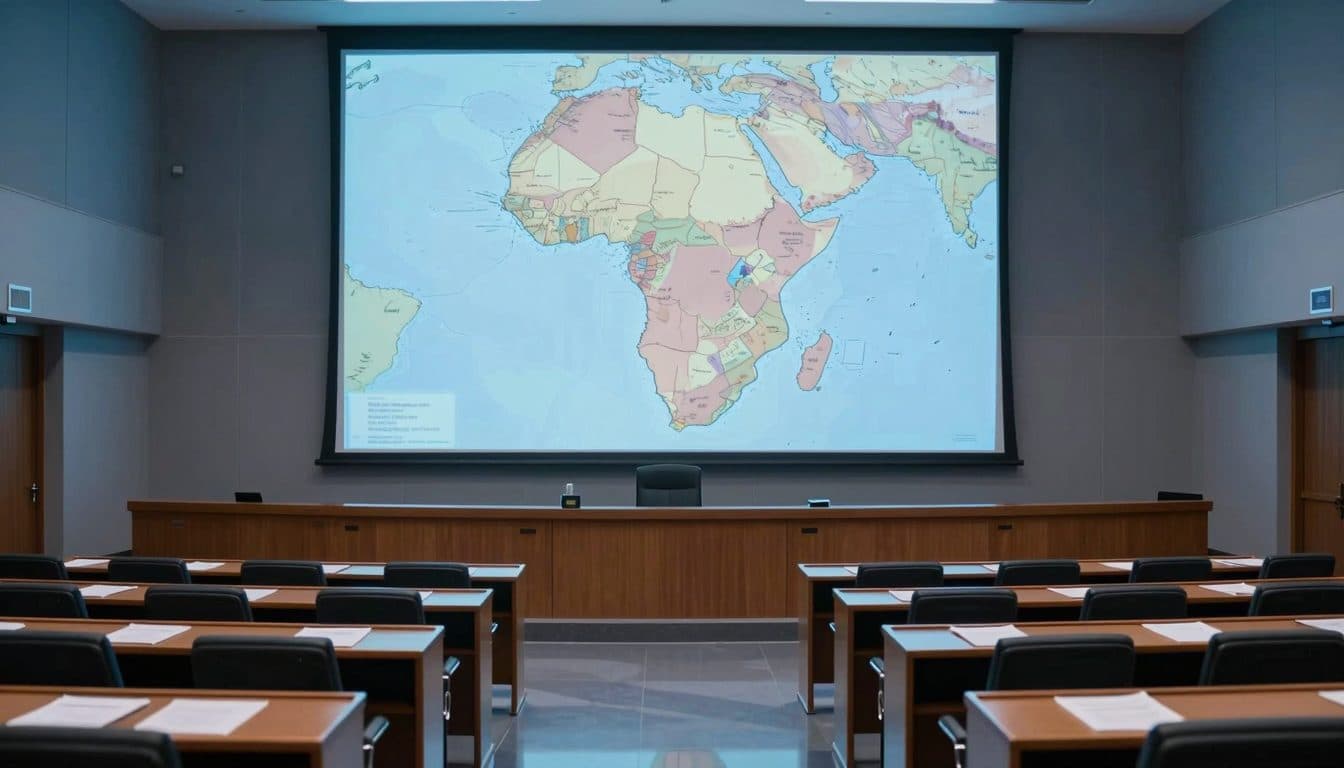
Washington, July 30, 2026
The US State Department has embarrassed itself internationally by displaying an erroneous map of the African continent during an official presentation.
According to observers, the blunder occurred at an event with reference to the African continent, during which programs such as PEPFAR and military cooperation with Nigeria were also discussed. On the slide shown, several African states were incorrectly located, resulting in a distorted picture of the regional geography. The exact errors on the map are being intensively discussed on social networks.
Criticism from expert observers
Matt Petit of the Atlantic Council sharply criticized the blunder, writing on LinkedIn: "Whoever made and approved this slide did not know where the countries in Africa are and did not bother to double-check their work." With this assessment, he summed up the outrage of many observers. The post was shared by numerous individuals from the fields of foreign policy, geosciences, and diplomacy.
The incident is particularly grave because the US simultaneously has several hundred soldiers stationed in Nigeria and funds numerous civilian programs in sub-Saharan Africa. A correct depiction of the geography would have been the basis of serious policy in this context. The error raises questions about the ministry's quality controls.
Military and civilian presence in Africa
Initial reactions from the US State Department were not yet available at the time of reporting. Observers assess the blunder as avoidable damage to the department's image that could have been prevented by a simple review of the slide before the presentation. Earlier incidents involving erroneous maps in official contexts had also drawn international ridicule, such as at a G7 summit in 2024 as well as during a FIFA promotional appearance for the soccer World Cup.
International observers see the error as an indication of sloppy workflows within the agency. The episode reinforces the perception that even in sensitive areas of foreign policy, basic standards of care are not being maintained. Several diplomats pointed out that African partners are likely to have noted the blunder closely.
Diplomatic consequences and damage to image
The department is facing repeated criticism because it is simultaneously being discussed how Washington wants to shape its foreign policy toward African states in the future. The US is active in numerous countries south of the Sahara, maintains economic relations with Mozambique, and cooperates on the PEPFAR program to combat HIV and AIDS. An incorrect map undermines the credibility of such programs.
Beyond Africa, the incident also raises questions, for example with regard to the communication of international alliances such as the G20. Observers point out that other governments, for instance in the run-up to the Olympic Games in Rio de Janeiro, have worked in a similarly sloppy manner – a pattern of negligent quality assurance in official documents. The episode exemplifies how small errors in public communication can have a major diplomatic impact.