US stock exchanges under pressure ahead of the weekend:… | allfacts360
US stock exchanges under pressure ahead of the weekend: AI concerns and quarterly reports weigh on Nasdaq and Dow
New York, 17 July 2026
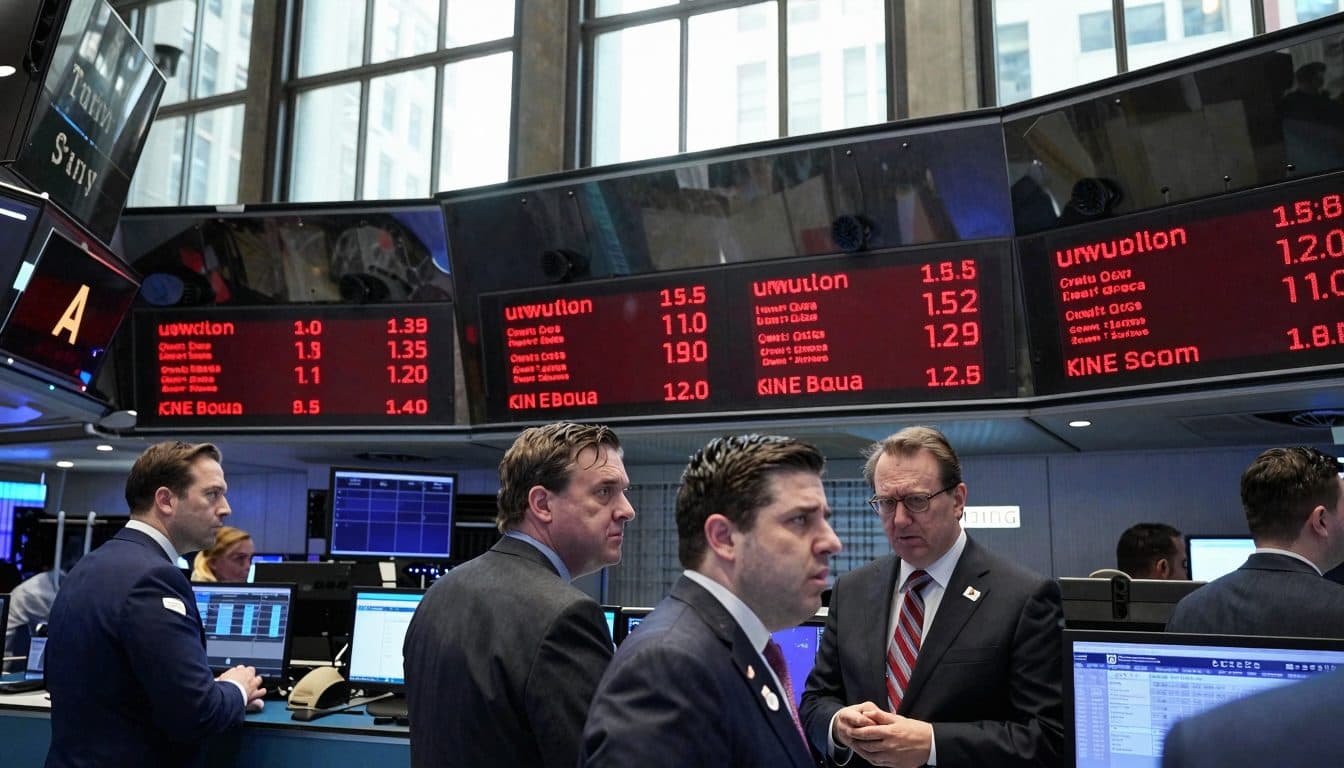
AI-generated image (z-image via Kie.ai)
Summary
The US equity markets are heading toward significant weekly losses on Friday.
New York, 17 July 2026
The US equity markets are heading toward significant weekly losses on Friday. The triggers are concerns about a Chinese AI leap as well as disappointing quarterly figures from individual companies. The Nasdaq 100 is trading nearly two percent lower in pre-market trading, while the Dow Jones is down around 0.6 percent.
The US equity markets are facing significant weekly losses on Friday because concerns about the technological lead of American AI companies and disappointing quarterly signals from individual companies are weighing on prices.
Broker IG priced the Nasdaq 100 roughly one hour before the start of trading 1.9 percent lower at 28,478 points. This points to a weekly loss of around 4.5 percent for the technology-heavy and economically sensitive index. The Dow Jones Industrial was expected by IG to be 0.6 percent lower at 52,228 points, which translates to a weekly decline of around 0.8 percent.
Trigger: Chinese AI model unsettles Wall Street
The trigger for the uncertainty is a new language model from China. The start-up Moonshot AI, backed by tech giant Alibaba, presented its model "Kimi K3," which according to its own statements plays in the same league as the top models of US competitors OpenAI and Anthropic. "Kimi K3" is causing a stir in the industry and is fueling concerns in the US about the dwindling technological lead.
Observers are already drawing parallels to the so-called "DeepSeek moment" in early 2025, when a Chinese model first shook US dominance assumptions and caused tech stock markets worldwide to collapse. The memory of that shock shows how sensitively Wall Street reacts to signals from the Chinese AI sector.
Quarterly reports intensify the downward pressure
The former AI boom stocks subsequently came under pressure in pre-market trading. NVIDIA lost 2.6 percent, Applied Materials 5.0 percent. The shares of the aerospace and AI company SpaceX also shed 4.3 percent; at 6 pm Swiss time on Friday, SpaceX shares were therefore trading at more than 5 percent below the previous day's closing price at under $125.
Quarterly reports additionally weighed on trading. Intuitive Surgical shares plunged 9.5 percent in pre-market trading. The company, which specializes in robot-assisted surgery, had maintained its target for the global growth of procedures performed with the "Da Vinci" system for 2026, even though the second-quarter results had exceeded average analyst estimates.
Competitor Staar Surgical also came under pressure: shares fell 8.5 percent in pre-market trading after the medical device provider had indicated net revenue for the second quarter. This meant two medical technology stocks lost significantly, additionally dampening sentiment.
In recent months, the Netflix stock had already lost more than 40 percent of its value. The ongoing sell-off in streaming and tech stocks shows that investor risk appetite has been declining for weeks and profit-taking is spreading.
Perspective: Nasdaq still clearly in the plus since the beginning of the year
The recent price losses must, however, be put in perspective: since the beginning of the year, the technology index is still up 14 percent. The great AI euphoria lifted the Nasdaq from just over 23,000 points at the end of March to over 30,000 points by the end of May; since then it has remained in this region.
A particularly interesting example of the recent hype is the traditional company Corning, which has been manufacturing glass and ceramic goods for 175 years and was at times known primarily as a manufacturer of a special glass for iPhones. Recently the price has fallen significantly again, but Corning is still worth 73 percent more than at the beginning of the year.
Tech companies' billion-dollar investments support the narrative
The investment plans of the major tech companies remain ambitious, however. The Google group intends to invest around $200 billion in new infrastructure in 2026, particularly in AI data centers. Such announcements support the longer-term narrative, even if they put pressure on earnings expectations above the margin in the short term.
On Friday, the pessimists set the tone: the Nasdaq 100 fell by more than 2 percent shortly after the start of trading, but was able to recover somewhat by noon US East Coast time. The midday recovery suggests that some investors are using the price declines as an entry point.
Among the analyst houses, however, a constructive basic stance toward the US market predominates. JP Morgan Chase & Co. had repeatedly rated the Dow Jones as "Overweight," most recently on 26.04.24. Goldman Sachs Group Inc. had also rated the Dow as "Neutral" on 11.05.21. The recommendations show that major houses fundamentally see the long-term upward trend as intact.
Analysts see the upward trend as fundamentally intact
RBC Capital Markets had issued a "Sector Perform" rating on the Dow on 30.01.20. The range of valuations makes clear that analysts interpret the current phase of weakness as a correction within an intact upward trend.
On the derivatives market, speculative investors can participate disproportionately in price movements via knock-out products. Such leveraged products are, however, associated with high risks and are suitable only for experienced market participants who want to specifically exploit short-term fluctuations.
Outlook: Correction or trend reversal?
Overall, the situation on Wall Street remains tense. The combination of geopolitically motivated AI concerns, mixed quarterly signals, and the memory of the "DeepSeek moment" has increased volatility. Whether the correction will develop into a larger downward movement or whether investors will use the weakness to buy will become clear in the coming trading days.
Questions & Answers
What is "Kimi K3" and why does the model unsettle US investors?
"Kimi K3" is a new AI language model from the start-up Moonshot AI, backed by the Alibaba group, which according to its own statements can compete with the top models from OpenAI and Anthropic. In the US, the model raises concerns that the technological lead of American AI firms could be dwindling, similar to the "DeepSeek moment" in early 2025.
Which companies lost the most in pre-market trading on Friday?
The largest pre-market losses were recorded by Intuitive Surgical with minus 9.5 percent and Staar Surgical with minus 8.5 percent after disappointing quarterly signals. Among AI and tech stocks, Applied Materials lost 5.0 percent, SpaceX 4.3 percent, and NVIDIA 2.6 percent.
How large are the weekly losses on the Nasdaq and Dow?
For the Nasdaq 100, a weekly loss of around 4.5 percent is indicated, while the Dow Jones Industrial must reckon with a weekly decline of about 0.8 percent. Despite these losses, the Nasdaq is still up around 14 percent since the beginning of the year.