USA and Iran Begin Negotiations on Ending the Conflict in Switzerland
Lucerne, 21 June 2026
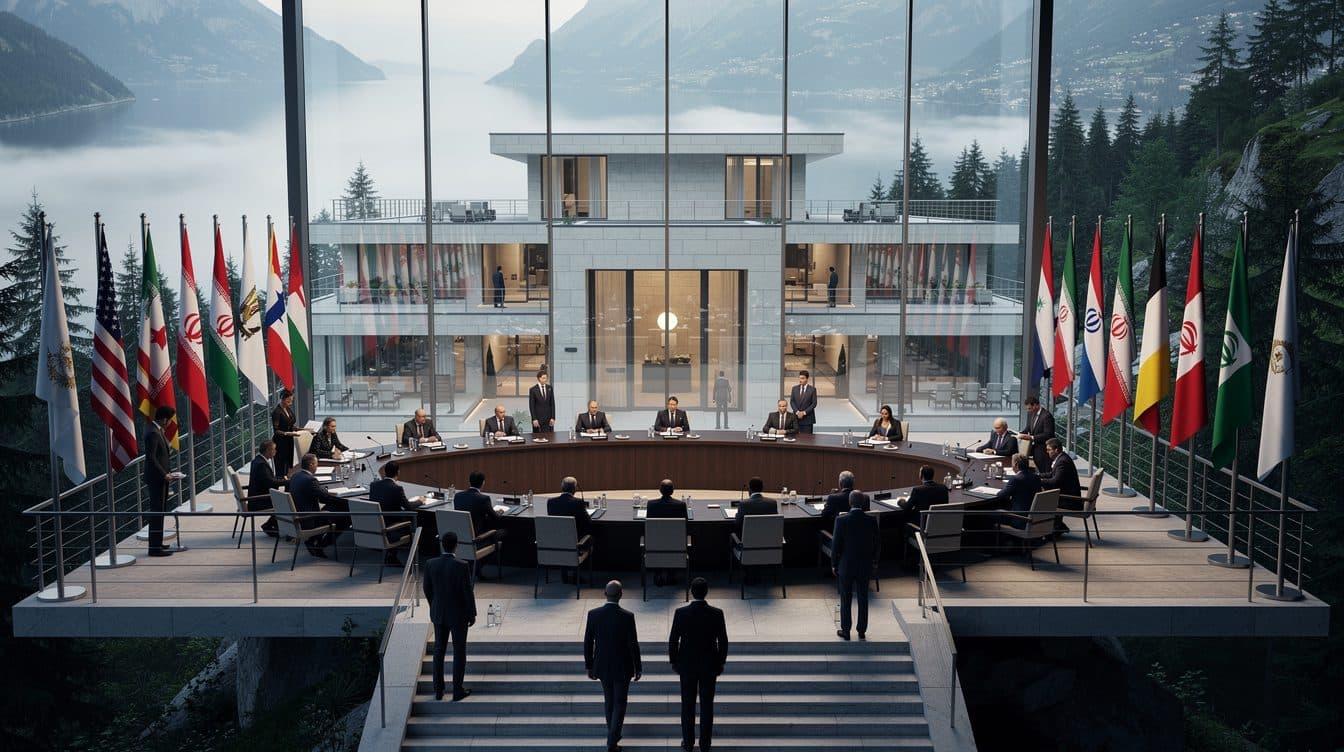
AI-generated image (flux-2/pro-text-to-image via Kie.ai)
Summary
At the Swiss luxury resort Bürgenstock, delegations from the USA, Iran, and mediators from Qatar and Pakistan have begun negotiations on ending the Iran conflict. JD Vance described the talks as historic and spoke of significant progress in the first hours.
Lucerne, 21 June 2026
At the luxury resort Bürgenstock in central Switzerland, four delegations from the USA, Iran, Qatar, and Pakistan began negotiations on a lasting end to the Iran conflict on Saturday, which according to JD Vance already achieved "große Fortschritte" in the first hours.
Opening at the Bürgenstock
Shortly after 2:30 p.m., the four delegations sat down at a table together. According to JD Vance, the opening went promisingly. "Allein in den vergangenen Stunden haben wir bereits große Fortschritte erzielt, und ich gehe davon aus, dass wir weitere Fortschritte machen werden", said Vance to journalists at the negotiation venue. In his opening speech, he spoke of a "historischen Treffen" and described the negotiations as "historisch".
Vance emphasized that Donald Trump had instructed the delegation to "ein neues Kapitel aufzuschlagen, um unsere Beziehung zum iranischen Volk zu verändern, und ihm eine ausgestreckte Hand anzubieten". He called for turning "eine neue Seite aufzuschlagen" in the Middle East. At the same time, he formulated clear conditions: if the leadership in Tehran were ready to "auf ihre Rolle als Faktor regionaler Instabilität zu verzichten", and if it were ready to "dauerhaft auf jede Ambition zur Erlangung von Atomwaffen zu verzichten", then the United States would be ready to "ihre Beziehungen zu diesem Land grundlegend zu verändern". "Wir sehen jetzt eine gemeinsame Zukunft, in der alle zusammenarbeiten können, um Frieden und Wohlstand zu fördern", said Vance.
Conditions and Demands from the US Side
The negotiations began four days after presidents Donald Trump and Massoud Pezeshkian signed a framework agreement to end the war in the Middle East in Versailles on Wednesday. The framework agreement provides for negotiating a final agreement for lasting peace within 60 days, including on handling Tehran's controversial nuclear program. In addition, the conflict parties had agreed on a 60-day ceasefire.
Qatar's Mediation and the 60-Day Deadline
Before his departure, Vance also expressed self-criticism regarding the length of his stay: "Ich kann nur ein oder zwei Tage dort sein", he said. He acknowledged that a ceasefire is always "etwas kompliziert", particularly with regard to Lebanon. According to the mediating state of Qatar, which is also participating in the talks, there is hope that the meetings will lead to a "umfassenden und dauerhaften Einigung führen zu allen Punkten im Rahmenabkommen" that Washington and Tehran have agreed on.
Trump Threatens in Parallel on Truth Social
Parallel to the diplomatic signals from Switzerland, Donald Trump sharpened his tone. On his online platform Truth Social, he wrote that Iran must "unverzüglich verhindern, dass seine hochbezahlten, an ihn angeschlossenen Gruppen im Libanon Probleme verursachen". Otherwise, the USA would "erneut sehr hart angreifen, so wie wir es letzte Woche getan haben, wenn nicht noch härter" Iran. "Andernfalls werden wir den Iran wieder sehr hart angreifen, so wie letzte Woche, nur härter", the post read.
Lebanon Remains the Biggest Disruptive Factor
The ongoing fighting in Lebanon is developing into the most dangerous disruptive factor in the negotiations. Despite the agreed ceasefire, at least 20 people were killed in Israeli attacks in Lebanon on Saturday, according to Lebanese figures. Israeli Defense Minister Katz stated that one could continue to "Maßnahmen zur Beseitigung von Bedrohungen ergreifen". Following deadly attacks on Israeli troops, the army had most recently "mit großer Härte reagiert" and "eine sehr große Zahl von Hisbollah-Kämpfern ausgeschaltet", it continued. "Der Schutz des Lebens unserer Soldaten und Bürger hat oberste und uneingeschränkte Priorität", said Katz.
From the Iranian side, the opening also proceeded cautiously optimistic. As the news agency IRNA reported, the Iranian side stated that it could "falls notwendig, schriftlich festhalten, dass wir nicht beabsichtigen, eine Atombombe zu bauen". At the same time, Tehran rejected demands for a new ceasefire modeled on the Gaza deal. Iran would not accept another ceasefire that was riddled with holes like "Schweizer Käse" and in which Israel simply continued to act at will, an Iranian representative told CNN.
Swiss Role and Outlook
According to observers, the concern about disruptive actions and incidents at the negotiation venue was noticeably lower than two years ago, when around 100 heads of state had gathered at the Bürgenstock for the Ukraine peace conference. The Swiss Foreign Ministry stated that the talks showed "dass die diplomatischen Kanäle offen bleiben und dass die geduldige Arbeit der Diplomatie auch in komplexen Situationen Raum für Vertrauen schaffen kann".
In terms of content, 14 agreed points are to be fleshed out over the coming days at the Bürgenstock, including the future shape of the Iranian nuclear program, the situation in Lebanon, and regional security issues. The Strait of Hormuz, one of the most important routes for global oil trade, also remains a tension-laden factor according to regional sources.
At the Swiss resort immediately after the opening, Vance also spoke of progress in ensuring the ceasefire in Lebanon. "Wir haben in den vergangenen Stunden große Fortschritte erzielt", he declared. "Dies betrifft auch die Sicherstellung der Waffenruhe im Libanon." His goal was to "durch Diplomatie gemeinsam den Nahen Osten zu verändern".
The USA and Israel had attacked Iran on the 28th; Hezbollah had retaliated on the 2nd. The exact timeline of this escalation, which led into the current negotiations, has so far only been partially publicly accounted for by the conflict parties. What is certain is that the fighting of the past week first opened the way for the current round of talks.
Time is running out: if no final agreement is reached within the 60-day deadline, the end of the ceasefire threatens, along with possible new escalation. According to his own account, Trump had authorized the US delegation to find a diplomatic solution to a multitude of problems, but at the same time left no doubt about the willingness to use military force.
With regard to the geopolitical dimension, observers assess the negotiations as one of the rare attempts in recent years to address the conflict between Washington and Tehran not solely through sanctions and pressure, but through direct diplomacy. Whether the beginning at the Bürgenstock actually leads to a lasting solution, according to the assessment of all involved, now depends above all on the question of whether the agreed 14 points can be given binding shape within the coming two months.
The news was broadcast on 21.06.2026 on the Deutschlandfunk program and is being picked up by several international agencies. By the editorial deadline, no confirmations of individual concrete agreements from the negotiation round had been received.
Questions & Answers
Who is negotiating with whom at the Bürgenstock?
Four delegations are negotiating at the Bürgenstock: the USA, Iran, and the mediating states of Qatar and Pakistan. JD Vance is leading the American delegation.
What conditions is the US side attaching to an agreement?
The USA demands that Iran permanently renounce nuclear weapons and abandon its role as a regional destabilizing factor. In return, the USA wants to fundamentally change its relations with Iran.
How much time do the negotiating partners have to reach an agreement?
The framework agreement signed on Wednesday in Versailles provides for a deadline of 60 days within which a final peace agreement is to be in place.
USA-Iran Negotiations Bürgenstock: Vance Speaks of Historic | allfacts360