USA and Iran Sign Memorandum of Understanding – Negotiations on Final Agreement Underway
Berlin, 18 June 2026
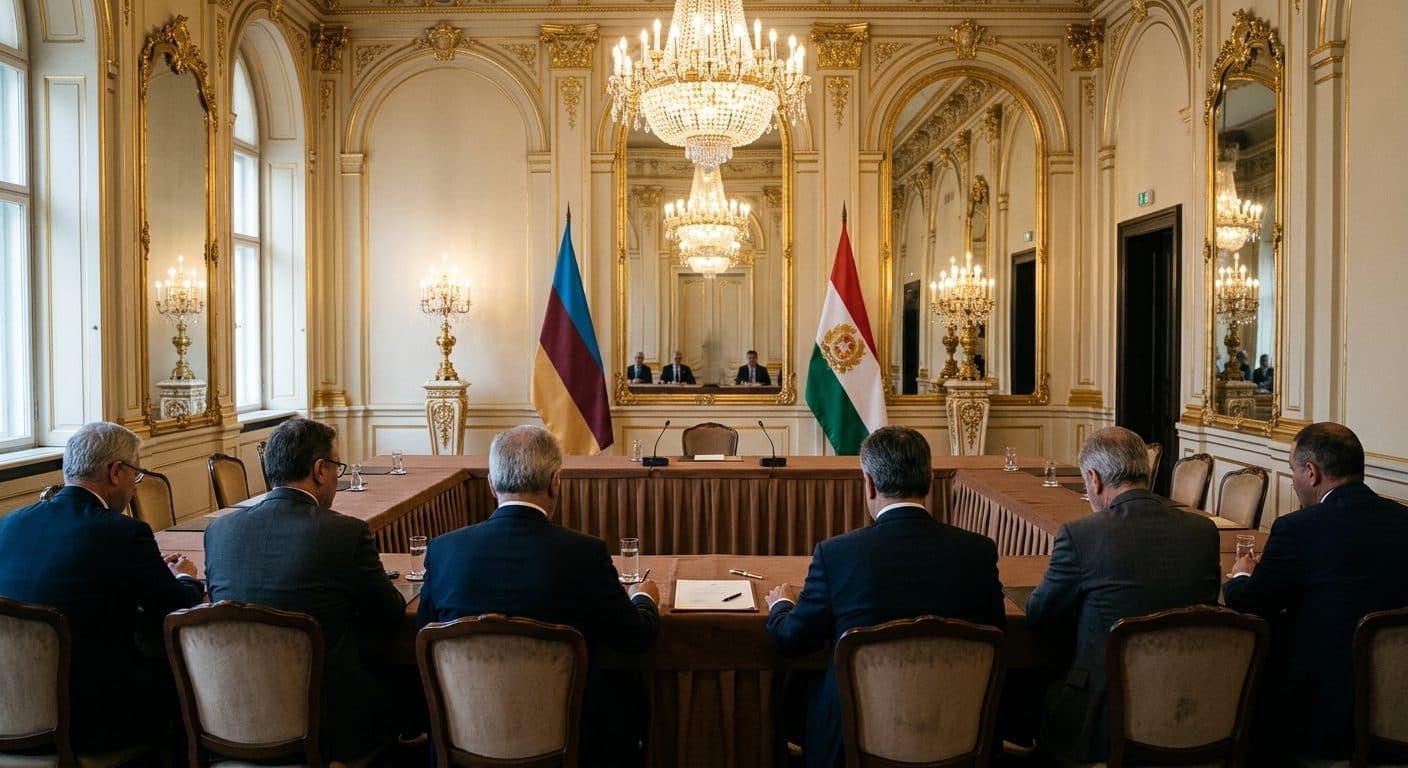
AI-generated image (google/gemini-3.1-flash-image-preview via OpenRouter)
Summary
The USA and Iran signed a memorandum of understanding for an end to the war on the sidelines of the G7 summit in Évian. Within 60 days, further negotiations on a final peace agreement are to follow, which provides, among other things, for a private investment fund of 300 billion dollars.
Berlin, 18 June 2026
The USA and Iran have signed a memorandum of understanding on the sidelines of the G7 summit in the French city of Évian, paving the way for an end to the war and further negotiations on a final peace agreement.
Signing on the Sidelines of the G7 Summit
The signing of the memorandum of understanding was announced on Wednesday. US government officials confirmed to news agencies that the document had been signed. Pakistani Prime Minister Shehbaz Sharif declared on the platform X that the agreement would take effect immediately. Pakistan, as a mediating state, had accompanied the negotiation process between Washington and Tehran.
Already on the sidelines of the G7 summit, Donald Trump had announced a signing. "The deal we made on Sunday with Iran will be signed shortly – tomorrow or maybe the day after," Trump said in Évian. According to previous information, the formal signing could take place on Friday at the Bürgenstock in Switzerland. Trump also stated that he "could" stay in Europe for the signing.
The Memorandum of Understanding provides for an "immediate and permanent end of the war on all fronts, including in Lebanon." Both sides and their allies are to "cease all hostile actions against each other" and "refrain from violence against each other" from the moment of signing. The text has since become largely known; an Iranian news agency published the full wording.
Contents of the Memorandum
According to the text, the Islamic Republic of Iran reiterates that it "will never produce nuclear weapons." The USA and Iran had agreed that the question of highly enriched uranium and "all other mutually agreed nuclear-related issues, including Iran's nuclear needs" would be addressed "appropriately" in the final agreement. According to the text, the USA commits to lifting "all types of sanctions," including those from UN Security Council resolutions and the International Atomic Energy Agency (IAEA), as well as "all unilateral US sanctions" against Tehran.
In addition, the USA commits to releasing "frozen or restricted assets" of Iran during the talks on a final agreement and making them "fully available" for use by the Iranian central bank. Further economic sanctions are to be lifted if Tehran and Washington agree on a final peace agreement after a 60-day negotiation phase.
Reconstruction Fund Worth Billions
The memorandum of understanding holds out the prospect of a reconstruction and development fund for Iran amounting to "at least 300 billion dollars" (nearly 260 billion euros). As Reuters reported, citing a person familiar with the matter, this fund is a purely private investment instrument. "We're not investing, we're not putting in even ten cents," said an insider. The US Treasury Department is also to issue exemption licenses for the export of Iranian crude oil as well as petroleum products and derivatives.
On the central conflict over shipping through the strait, concrete steps were agreed: Tehran would "immediately reopen the Strait of Hormuz," and the USA would promptly lift the naval blockade of Iranian ports, the Pakistani Prime Minister announced. According to the text, the US naval blockade directed against Iran is to be "fully" lifted within 30 days of the signing of the framework agreement. Iran, for its part, is to take "immediate steps" to ensure that commercial vessel traffic through the Strait of Hormuz in both directions normalizes to pre-war levels within 30 days. The fee-free passage applies only to the 60-day negotiation window.
Shipping Through the Strait of Hormuz
It is also mentioned that Iran must "remove technical hurdles and neutralize mines." As the portal "Axios" reported, an early signature is under discussion because it would also open the Strait of Hormuz earlier than planned. According to the website "TankerTrackers," several Iranian oil tankers recently left the sea area – Iran's "first crude oil exports in two months."
Until the final agreement is reached, both sides are to maintain the current "status quo" – Iran with regard to its nuclear program and the USA by not imposing new sanctions or reinforcing its troops in the region. Negotiations on the final agreement are to take place within a period of no more than 60 days. A memorandum to be signed on Friday is to structure the process for the coming 60 days.
Reactions of the G7 States
The G7 states expressly welcomed the framework agreement. In their statement, they saw a "historic opportunity" to keep the leadership in Tehran from possessing nuclear weapons. The agreement could "bring peace and security for all in the region," the statement said. The G7 states expressly praised Trump's role in their statement. In addition to Macron and Trump, the heads of state and government of Great Britain, Italy, Canada, and Japan, as well as the EU leadership, took part in the consultations in Evian.
Emmanuel Macron qualified the US President's new threats and also called on Iran to keep its promises. Host Macron said the meeting had been "objectively a success," after all the group had unanimously adopted nine declarations. Harmony prevailed even after the summit, when Macron and his wife Brigitte received Trump on the occasion of the 250th anniversary of the Declaration of Independence – at the place where, in 1783, the treaty was signed that sealed the independence of the United States.
Position of Germany and Italy
Friedrich Merz said in an ARD interview that everyone, "including the Israeli government," had been asked to show restraint and end the dispute. "We understand Israel's security interest, but it must not go so far that an entire state in the neighborhood is destabilized," said the Chancellor. However, Merz emphasized at the G7 summit that a German contribution was "subject to a whole range of prerequisites that have not yet been met." Giorgia Meloni called on Israel to be a "positive actor in the peace process."
Russian Foreign Minister Sergej Lawrow declared that "all parties involved in the armed conflict, including Israel," must abide by the agreement. Lebanese President Joseph Aoun declared that the negotiation process with Israel was independent of the framework agreement between Iran and the USA. On Tuesday evening, the Iranian military threatened that if the Israeli army did not stop its "aggression" in southern Lebanon, it would have to "expect a harsh response from the powerful armed forces of the Islamic Republic of Iran."
Threats and Warnings
Trump warned Iran on the sidelines of the G7 summit against violations of the framework agreement. "If I don't like it, then we'll shoot at them (the Iranians) again," Trump said. "If they don't behave, we will drop bombs on their heads," he added. "Because they have behaved badly for 47 years," Trump said, referring to the time since the Islamic Revolution of 1979. At the same time, however, he said the framework agreement was "perhaps not the kind of document I should sign."
"I didn't want to experience an economic catastrophe. If things had continued like this, that could have happened," Trump said. "The restoration of free passage through the Strait of Hormuz will be a tremendous advance," he said. According to Trump, the interim agreement is not a final arrangement: "It's a memorandum of understanding. This is a very good agreement," he said. While no one knows exactly what is recorded in it, "but it is very solid, and most people seem to be very satisfied."
Lessons from the Crisis
As a lesson from the crisis in the Middle East, the G-7 appealed to oil-importing countries to set up adequate and effective oil reserve systems. To reduce the risk of blackmail by countries like China, the G-7 states also want to achieve upper limits for the import of certain raw materials. The goal, according to a joint statement, is to reduce dependence on individual suppliers outside the G-7 and their partner countries for rare earth metals and permanent magnets to below 60 percent by 2030. The G-7 states had also reached common positions on the Ukraine war.
The G-7 states support the path taken. "We support the implementation of the agreement and are ready to contribute to it," the statement said. Trump declared the agreement to be a "very good agreement." The USA and partners are to secure funding of at least 300 billion US dollars for the reconstruction fund. Negotiations on this are to last for a maximum of 60 days. The framework agreement between the USA and Iran is to be signed by both sides on Friday in Switzerland.
The USA and Iran signed a memorandum of understanding for an end to the war on the sidelines of the G7 summit in Évian. Within 60 days, negotiations on a final peace agreement are to follow.
What economic concessions does the agreement provide for?
The memorandum of understanding provides for a private investment and reconstruction fund of at least 300 billion dollars. The USA also commits to lifting all sanctions and releasing frozen Iranian assets.
What regulations does the agreement make regarding the Strait of Hormuz?
Iran is to reopen the strait immediately, and the USA is to fully lift its naval blockade of Iranian ports within 30 days. The fee-free passage applies to the 60-day negotiation
USA-Iran: Memorandum of Understanding Signed – 60 Days | allfacts360