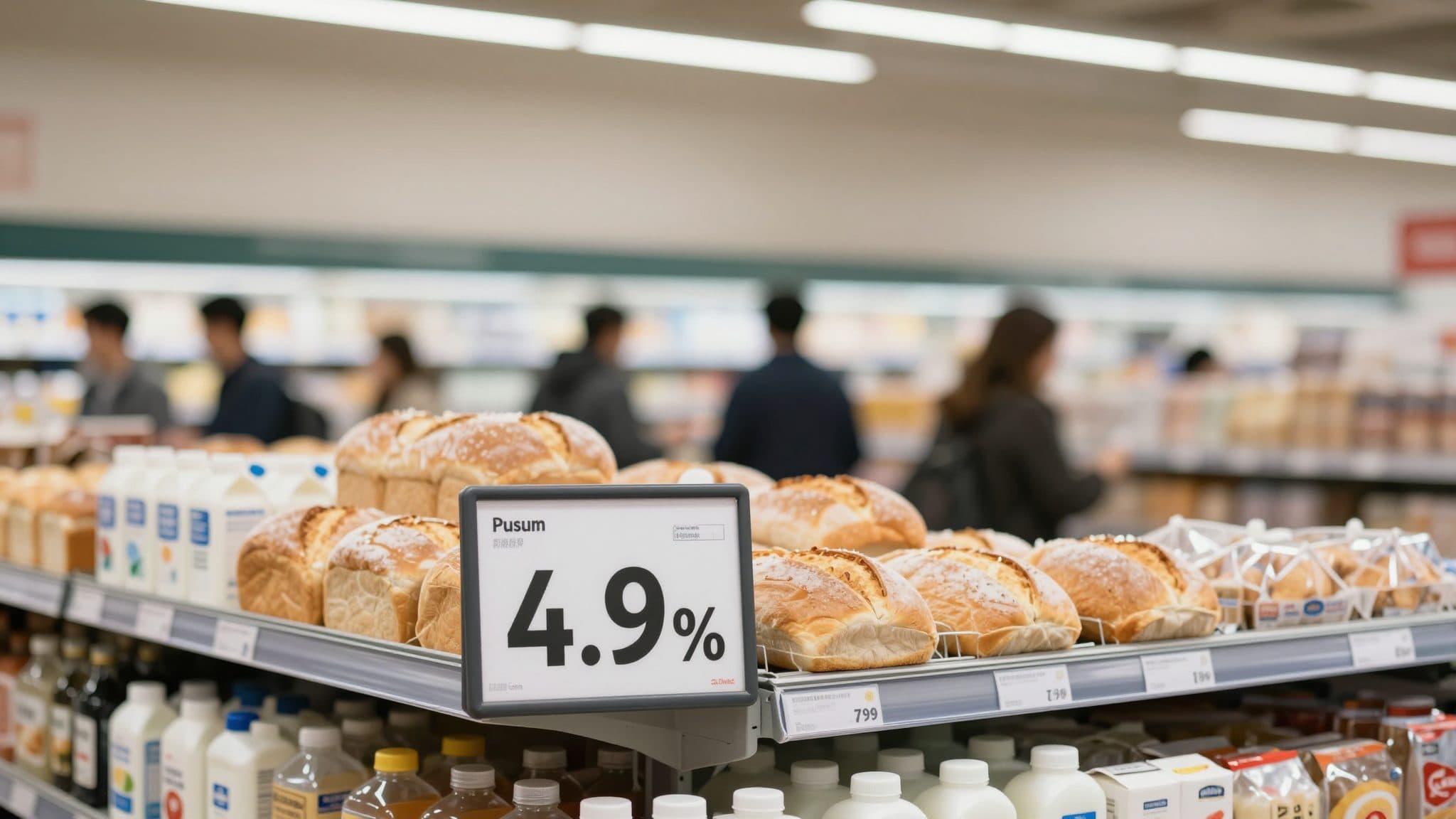
VAT reduction on basic foodstuffs takes effect: Retail reports high conversion costs
Vienna, 02 July 2026
AI-generated image (z-image via Kie.ai)
Summary
Since 1 July, Austria has applied a VAT reduction from ten to 4.9 percent on selected basic foodstuffs. The retail sector invested around six million euros in the technical conversion, and association representatives speak of an enormous organisational challenge.
Vienna, 02 July 2026
In Austria, the value-added tax on selected basic foodstuffs was reduced from ten to 4.9 percent on Wednesday, 1 July, while retailers and small businesses complain about the associated organisational and technical burden.
According to available information, the reduction is unlimited in duration and affects a wide range of products – from bread and milk to eggs, leaf spinach, and natural yoghurt. As a spokesperson for the Federal Competition Authority (BWB) explained, the authority is keeping a close eye on the food retail sector: "Die dabei gewonnenen Erkenntnisse sowie die entwickelte Methodik bilden nun die Grundlage für eine mögliche Prüfung der Weitergabe der Mehrwertsteuersenkung auf Lebensmittel", a spokesperson for the authority said.
Supermarkets such as Billa, Spar, and Hofer assure that the reduction will be passed on to customers in full. Billa Austria chief Erich Szuchy stated: "Bei allen betroffenen Produkten setzen wir die Mehrwertsteuersenkung vollständig auf den Cent genau im Verkaufspreis um und runden bei jedem Artikel ab. Das gilt selbstverständlich auch für unsere vielen Aktionen". At Billa, around 4,000 products and approximately 90 million bread rolls per year are affected by the measure nationwide; at Spar, around 16,000 products; at discounter Hofer, currently around 230.
Supermarkets pledge full pass-through
During a market inspection in Vienna, the problems in small retail became particularly evident. A fruit vendor at the Naschmarkt in Mariahilf, who has been running the business with his sons for more than 50 years, invested around 15,000 euros to replace his ten-year-old cash register with a new one capable of processing the 4.9 percent tax rate. "Um rund 15.000 Euro habe er seine zehn Jahre alte Registrierkasse um eine neue ersetzen müssen, die Steuersätze von 4,9 Prozent verarbeiten kann", it was reported.
A small grocer at Yppenplatz was informed about the new rules in mid-June by the Vienna Chamber of Commerce. He estimates that converting his cash register and prices will take two to three months. "Mitte Juni sei er von der Wiener Standesvertretung über die neuen Steuerregeln für Grundnahrungsmittel informiert worden", he said. He complained that he earns less overall than a salesperson at H&M, just as he complained about the rising number of thefts and drug dealings in front of his shop.
Frustration among small market stallholders
At the Brunnenmarkt, a free-range egg currently costs 40 cents, while a salt pretzel stick (Salzstangerl) comes to 1.23 euros and a Kornspitz or Laugenstangerl to 1.14 euros – prices that are taxed differently depending on the topping and grains. A market visitor summed up the indignation while buying strawberries: "Geht's noch depperter?" Another vendor at the Kutschkermarkt criticised the regulations as bureaucratic nonsense: "Wer denkt sich so was aus? Die Leute werden für dumm verkauft."
Small bakeries are particularly affected: a bread roll (Semmerl) can be taxed differently depending on the topping; classic bread falls under the reduced rate, but a croissant with a fat content of more than five percent does not – it is classified as a luxury product for tax purposes. Leaf spinach is also favoured, but creamed spinach is not; natural yoghurt falls under the reduced rate, fruit yoghurt often does not. Detailed specifications based on customs tariff numbers and fat and sugar content in dry matter make the classification complex. "Gerade handwerkliche Bäckereien stehen vor der Herausforderung, den Fettgehalt ihrer Produkte exakt nachzuweisen", explained Rainer Will.
Bureaucratic detailed rules burden bakeries
The managing director of the Trade Association (Handelsverband) puts the total cost for the industry at around six million euros in investment alone for the technical implementation. Will emphasised: "Unser Ziel war, dass die Preisreduktion vom ersten Tag an vollständig an die Kundinnen und Kunden weitergegeben wird. Das ist gelungen, war aber eine enorme Herausforderung." At the same time, he rejected demands directed at the industry: "Die aktuellen Zahlen zeigen, dass der Lebensmittelhandel nicht der Inflationstreiber ist."
In food retail, the reduction has already taken effect: many bakeries in Döbling now charge 47 cents instead of 50 cents for a bread roll. The Budget Service estimates the average household relief at slightly more than seven euros per month; the Trade Association arrives at around six euros per month, or between 45 and 100 euros per year. If the relief were actually passed on, inflation could be reduced by 0.15 percentage points by June 2027, according to calculations.
Market observers, however, see not only advantages. The reform costs the national budget around 400 million euros in lost revenue. One customer criticised: "Die Maßnahme koste den Staat viel Geld, beschere Unternehmern zusätzlichen Aufwand wie Ärger und bringe den Konsumenten so gut wie nichts." The Trade Association also warns of a planned national parcel levy that would burden domestic retailers and online companies and could jeopardise investments and jobs.
BWB keeps an eye on pass-through
The BWB is closely monitoring developments. Should it also initiate a sector inquiry in the food sector, this would happen at the earliest several months after the reduction took effect. The authority accepts reports and complaints in cases of suspected violations; every incoming complaint is carefully reviewed and, if appropriate indications arise, pursued further. The legal basis is clear: according to the BWB, companies are legally obliged to pass on the reduction.
The reduction followed the abolition of VAT on feminine hygiene products at the turn of the year, where there were again, according to the BWB, repeated indications of a possible systematic failure to pass it on. The insights gained there and the methodology developed are now to serve as a basis for a possible review of food price pass-through. Errors in classification could lead either to back tax payments or to incorrect pricing.
Overall, it is clear: the food retail sector has passed on the price reduction from day one at the checkout, but feels enormously burdened by the granular regulations – for instance, milk to take away versus milk consumed on site, bread depending on grains, or Skyr depending on production method. Will summed up the dilemma: "Natürlich freut sich jeder über eine Ersparnis. Gleichzeitig muss man aber den enormen organisatorischen und finanziellen Aufwand berücksichtigen."
Questions & Answers
Which products are affected by the VAT reduction in Austria?
Affected are selected basic foodstuffs such as bread, milk, eggs, leaf spinach, and natural yoghurt. The reduced tax rate of 4.9 percent has applied since 1 July on an unlimited basis; classification is based on customs tariff numbers and detailed rules such as fat or sugar content in dry matter.
How much does the tax reduction actually bring households?
The Budget Service estimates the average relief at slightly more than seven euros per month; the Trade Association puts it at around six euros. If the reduction is actually passed on, inflation could be dampened by 0.15 percentage points by June 2027, according to calculations.
Why is the reform criticised by retailers?
Retailers complain about the complex classification rules – such as different taxation of natural and fruit yoghurt or of bread depending on topping – as well as the technical effort. The Trade Association puts industry investment at around six million euros; individual market stallholders also report high costs for new cash registers.
VAT reduction on food in Austria: effort and criticism | allfacts360