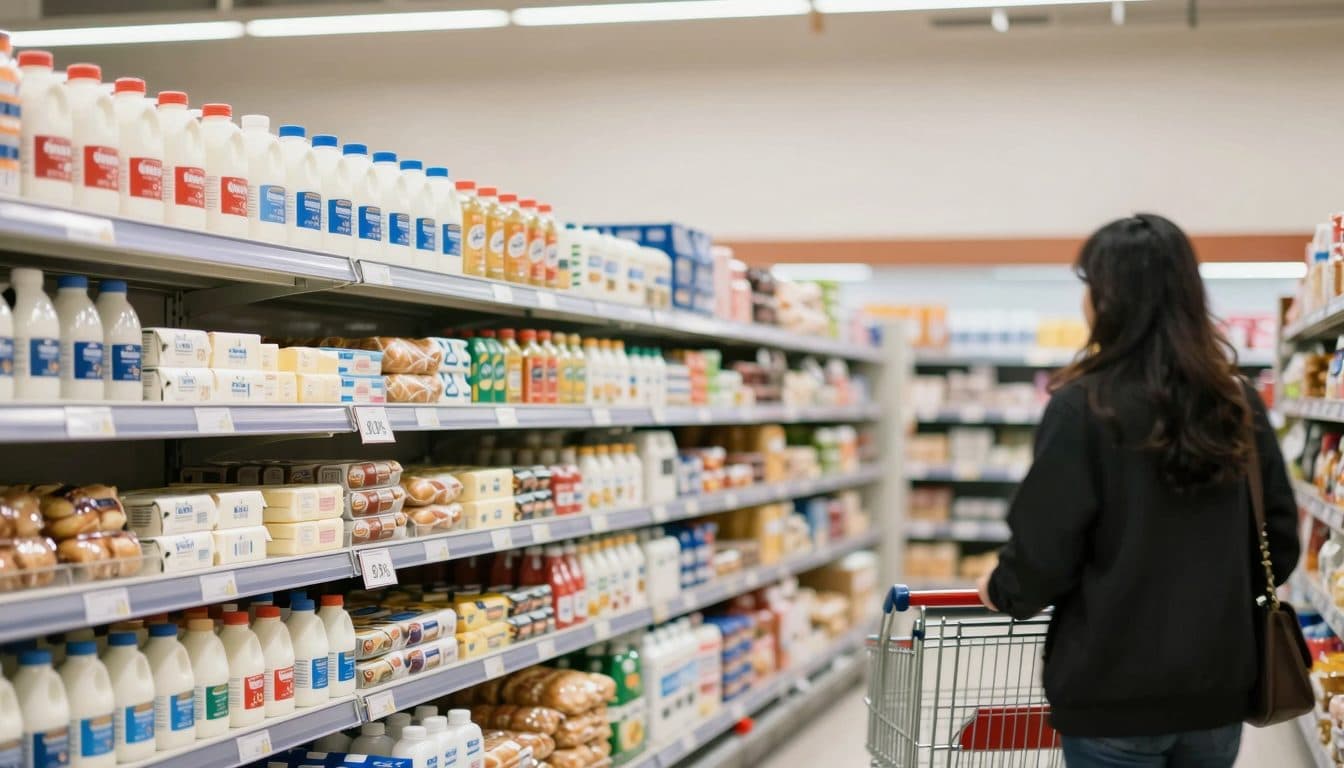
VAT Reduction on Staple Foods Takes Effect in Austria
Vienna, July 2, 2026
AI-generated image (z-image via Kie.ai)
Summary
As of Wednesday, a reduced VAT rate of 4.9 percent applies to a range of staple foods in Austria. The government expects this to deliver around 100 euros in additional purchasing power per household on average by year-end and to reduce inflation by approximately 0.2 percentage points.
Vienna, July 2, 2026
In Austria, the reduction of VAT on a range of staple foods took effect on Wednesday, July 1, 2026, lowering the previous tax rate on certain products to 4.9 percent.
Background on the VAT Reduction
According to the applicable regulation, the reduction covers fresh milk, yogurt, butter, eggs, fresh and frozen vegetables, certain types of fruit, rice, wheat flour, semolina, uncooked and unfilled pasta, bread, and table salt. According to Billa, the measure covers more than 4,000 products in total.
The rate of 4.9 percent was chosen because the EU regulations for reduced tax rates in Austria are already exhausted at 13 and 10 percent: "Da die EU-Regelungen für ermäßigte Steuersätze in Österreich bereits mit 13 und 10 Prozent ausgeschöpft sind, durfte der neue Satz nicht bei oder über 5 Prozent liegen, um die europarechtlichen Vorgaben für zusätzliche Ausnahmen zu umgehen."
Consultation and Passage in the National Council
In April and May, the implementation was marked by intense discussions over the delineation of products, based on the "Combined Nomenclature." In mid-May, and following an intensive review process in which criticism was voiced over both the complexity and the social targeting, the National Council finally passed the measure. The target date remained July 1, 2026.
The separation of takeaway and on-site consumption—for example, "takeaway" at 4.9 percent versus "on-premises consumption" at 10 percent—means considerable bureaucratic effort for retailers and the food service industry. For certain bread products, the preferential rate also only applies if the fat and sugar content in the dry matter does not exceed five percent in each case — bakers still do not have a binding implementing regulation to this day.
What the Practical Test Shows
A KURIER test purchase on the effective date showed that the reduction was indeed passed on at the supermarket examined: "Die sechs Äpfel kosteten nur mehr 2,66 statt 2,79 Euro, Ersparnis 13 Cent." Organic hay milk was "mit nur mehr 1,89 Euro um zehn Cent billiger als am Vortag," summer butter "schlug nur mehr mit 2,66 Euro zu Buche, wir ersparten uns also 13 Cent." Crispbread, on the other hand, is not covered by the reduced VAT, so its price remained unchanged between June and July.
Market leader Spar and challenger Billa rely on customer information rather than discounts and are advertising the products to which the tax reduction applies. On a liter of Spar-S-Budget whole milk, customers save seven cents, the same amount on a kilo of store-brand spaghetti; for the store-brand bread roll, Spar charges two cents less, and the same applies to cherry tomatoes. At the second-largest food retailer, Billa, the company promises to pass on the mandated price reduction "auf den Cent genau" (to the exact cent), including on promotional items.
Through its loyalty program "Lidl Plus," Lidl has even waived the full tax portion on the favored staple foods for two weeks: "Lidl Plus gibt es für Nutzer der ‚Lidl Plus App' darüber hinaus ab heute einen zweiwöchigen Entfall der kompletten Steuer." At the discounter, this is a voluntary promotion in addition to passing on the reduction.
Billa chief Erich Szuchy stressed that the relief should reach customers in a tangible and verifiable way: "Bei allen betroffenen Produkten setzen wir die Mehrwertsteuersenkung vollständig auf den Cent genau im Verkaufspreis um und runden bei jedem Artikel ab. Das gilt selbstverständlich auch für unsere vielen Aktionen. Unser Ziel ist es, die Entlastung unmittelbar und nachvollziehbar an unsere Kund:innen weiterzugeben."
Impact on Inflation and the Budget
For delicatessen items such as Wurstsemmeln and Leberkässemmeln, the regular 10 percent rate continues to apply. Nevertheless, according to Billa, there is no difference in the retail price between the roll from the self-service machine and the freshly prepared delicatessen roll: "Die durch den weiterhin höheren Mehrwertsteuersatz entstehende Mehrbelastung trägt BILLA freiwillig selbst." A "Ja! Natürlich" Kaiser roll currently costs 0.45 euros and will cost 0.429 euros going forward.
The government justifies the reduction in part with an expected decline in inflation: "Durch die Maßnahme soll die Inflation um rund 0,2 Prozentpunkte sinken." At the time of passing the measure, the government said citizens could save around 100 euros per year; the budget service of the federal government assumes households will have just over seven euros more per month on average, "bis zum Jahresende ein willkommenes Plus von etwa 100 Euro in der Haushaltskasse." The food retail sector is meanwhile using the government's small tax cut for advertising campaigns.
Other Changes in Austria
For consumers, the end of the month will not be consistently cheaper: the budget is missing 400 million euros because of the tax sweetener. In about a month, the Federal Competition Authority will examine whether the tax reductions are being passed on everywhere.
Further changes take effect in parallel. For online shopping from non-EU countries, the previous 150-euro exemption threshold is abolished; for shipments with a goods value under 150 euros, a flat customs charge of 3 euros per product category will apply from July, in addition to the existing import VAT. This primarily affects customers of e-commerce platforms such as Temu, Shein, AliExpress, and international marketplaces such as Amazon. Within the EU, taxes and customs do not generally apply, with the exception of coffee, alcohol, and tobacco products.
Under Vienna's major parking model, old parking tickets at the old rate lose their validity; only tickets with the current rate may be used. Wiener Linien's core zone tariffs were already adjusted at the beginning of the year; within the core zone, nothing changes. The Verkehrsverbund Ost-Region is raising prices for certain tickets in the "Region" fare area in stages, on July 1 and September 1, by an average of 3.5 percent.
In real estate listings, the final energy demand must be indicated from July 1 in addition to the heating energy demand; the government is thereby implementing an EU requirement for greater transparency about future energy costs. Organizers of large events with 300 or more guests will in future be required to have a mandatory safety and awareness concept along with a responsible person; the requirements for waste avoidance and environmental protection are being significantly tightened.
Anyone wishing to acquire a dog, reptiles, amphibians, or certain parrots for the first time will need to plan more time for training in future; the so-called proof of competence (Sachkundenachweis) will become mandatory. In the classic "Lotto 6 aus 45," the supplementary game LottoPlus will, as of July 8, automatically be combined with two draws per round — double the chances, but also higher costs.
In Germany, numerous changes also take effect on July 1: more than 21 million retirees will receive on average 4.24 percent more in pensions from July; for a monthly pension of around 1,000 euros, that means about 42.40 euros more per month. For around 100,000 retirees, the increase means they will, for the first time, become subject to taxation, as in 2026 only 84 percent of pension income is actually assessed for income tax, rising to 100 percent from 2058. The current basic allowance is 12,348 euros per year for a single retiree; jointly assessed retiree married couples receive an allowance of 24,696 euros.
What Changes in Germany in July
The contribution to health and long-term care insurance is deducted by the tax office, as are doctor's and pharmacy bills or a new pair of glasses, "allerdings nur, wenn eine zumutbare Eigenbelastung überschritten wird." Minijobs are "grundsätzlich steuerfrei und sind auch gar nicht in der Erklärung anzugeben." From 2026, employees of retirement age can earn up to 2,000 euros per month tax-free under the so-called Aktivrente.
With the one-click tax return via the "MeinElster+" app, an initial user group of around 11.5 million people nationwide has access to a pre-filled tax assessment — initially for childless singles and retirees. Advisor Bärbel Metzger warns: "Sie werden oft kalt erwischt, wenn plötzlich Post vom Finanzamt kommt." The key question is, "ob der zu besteuernde Betrag höher ist als der Grundfreibetrag."
Also from July, the new Grundsicherungsgeld will replace Bürgergeld and introduce tightened rules and stricter sanctions, up to total sanctions; the grace period during which recipients were allowed to retain more assets is eliminated, and anyone exceeding the allowances must first use those assets for their livelihood. The Bürgergeld benefit amount remains unchanged.
Visitors to Cologne Cathedral can enter for 12 euros from July — according to ZDF reporter Nathalie Hasselbart, the financial reserves have been exhausted.
Austria VAT Reduction as of July 1, 2026 | allfacts360