Vienna "Time-Out" Shared Home for Offenders Below Criminal Responsibility Age Begins Operations
Vienna, July 22, 2026
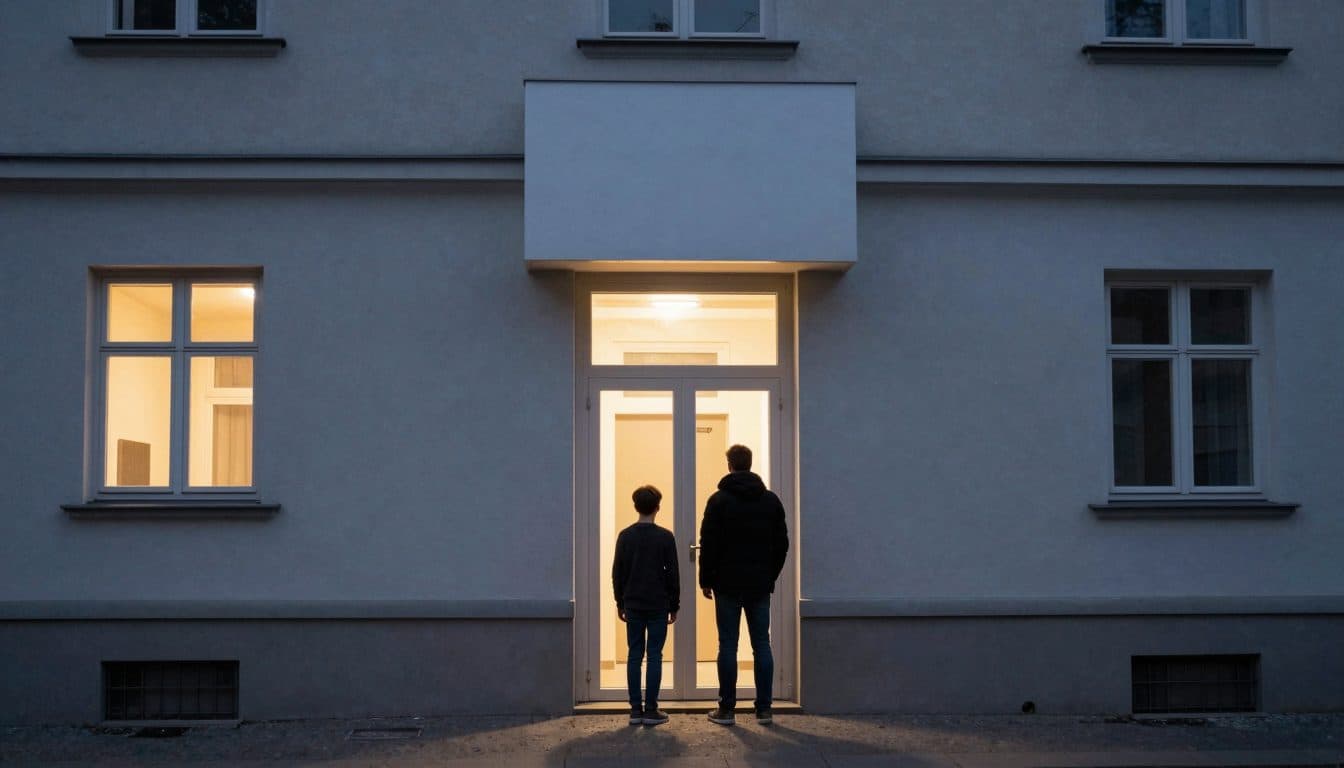
AI-generated image (z-image via Kie.ai)
Summary
After multiple delays, the controversial time-out shared home in Vienna-Simmering for repeat offenders under 14 who are below the age of criminal responsibility has begun operations. According to a parliamentary inquiry response, the costs for the facility with two places have risen to around one million euros per year.
Vienna, July 22, 2026
After multiple delays, the so-called time-out shared home in Vienna-Simmering for repeat offenders under 14 who are below the age of criminal responsibility has begun operations; according to information from the office of Vice Mayor Bettina Emmerling (NEOS), an initial 13-year-old child has already moved in, with another to follow shortly.
The planned facility in Vienna-Simmering is aimed at children between eleven and 13 years old who have repeatedly committed serious crimes such as robbery or burglary but cannot be prosecuted under criminal law due to their age. The time-out shared home has two care places; a stay can last up to twelve weeks. The legal basis is the Vienna Children and Youth Welfare Act in conjunction with the Residential Placement Act. Emmerling stressed to the APA that the goal is to show the children prospects for a way out: "Den Kindern sollen Perspektiven eines Auswegs ihrer bisherigen kriminellen Laufbahn aufgezeigt werden und sie sollen durch eine intensive pädagogische Begleitung wieder an positive Entwicklungswege herangeführt werden."
Concept and Target Group
Vice Mayor Emmerling described the measure as the next step in a five-point plan: Due to acute danger to self and others, "wurde die nächste Stufe des Fünf-Punkte-Plans umgesetzt, nämlich die Unterbringung in der Auszeit-WG". Previously, an orientation assistance program had failed to produce lasting success. "Trotz Zuschaltung der Orientierungshilfe sei im Vorfeld keine nachhaltige Durchbrechung des negativen Verhaltens gelungen", critics quoted the city's reasoning. According to MA 11, admission currently requires a medical diagnosis of a mental illness as well as evidence of danger to others or self; in addition, no milder means may be available.
Emmerling used the occasion to press the federal aspect and sharply criticize the SPÖ-led Justice Ministry. "Dass sich seit über einem Jahr eine Arbeitsgruppe im Justizministerium mit dieser Frage, bisher ohne Ergebnis, beschäftigt, sorgt im Sinne der Bevölkerung für Unverständnis", Emmerling criticized to the APA. She demanded: "Es müssen endlich Taten folgen, damit geschlossene Einrichtungen langfristig und österreichweit möglich sind." Emmerling wants to "die Bevölkerung vor jugendlichen Intensivtäterinnen schützen und Gewaltspiralen durchbrechen" and sees the federal government as responsible for legally enabling the rapid nationwide placement of repeat offenders.
Criticism of the Federal Government and Demand for Nationwide Regulation
From the Vice Mayor's office, it was said on Wednesday that around a week ago a 13-year-old child had moved into the shared home; a second child was to "in Kürze folgen". Specific case details would not be given "aus Gründen des Kindeschutzes". A spokesperson said the stay so far was proceeding as planned and that all of Vienna's legal options had been exhausted. The originally planned opening in May had been postponed three times, most recently to July. The City of Vienna had most recently justified the delay with necessary structural adaptations: "Die Verzögerung ist ausschließlich auf die erforderlichen baulichen Adaptierungen zurückzuführen." In the sensitive start-up phase, "jedes Detail im Ablauf und im Betreuungskonzept durchgeplant sein" musste, "damit die Maßnahme ab dem ersten Tag greift".
On Wednesday, however, it was denied that this explanation was the actual reason for the postponement. According to APA information, it was made clear on Wednesday that rather the lack of a nationwide legal framework for such facilities had caused the delayed start. Justice Minister Anna Sporrer had previously announced, according to Kronen Zeitung, that she would present a legal basis by autumn. Emmerling did not respond publicly to the denial allegation; from her office, it was said they would not comment further on the matter itself.
Delay and Launch
The project's costs are another point of contention. According to a parliamentary inquiry response, reported on by "Mein Bezirk" among others, the time-out shared home costs around 995,000 euros per year – originally, 800,000 euros had been budgeted. This puts a care place in the double-digit range of around half a million euros per year, before an additional staffing cost factor is added. FPÖ floor leader Maximilian Krauss spoke of a "Kosten- und Planungsfiasko": "Das ist typisch NEOS: großspurige Ankündigungen, fehlende Planung und am Ende explodierende Kosten." The project had been "großspurig angekündigt", he complained.
There is also criticism within the Vienna Children and Youth Welfare Office (MA 11) as well as at Vertretungsnetz, the Ombudsman Board, and staff representatives of the City of Vienna. Experts doubt that a stay of up to twelve weeks can have a lasting effect. Critics complain that there can therefore be no talk of a genuine "Ultima Ratio" – that is, the last possible means. Emmerling, on the other hand, had emphasized that the project was intended as a last resort when other aids had failed; she also pointed to the pedagogical support. "Wenn unmündige Minderjährige Straftaten begehen, muss der Staat aber sehr konsequent reagieren", Emmerling said.
Cost Development
With the commissioning of the time-out shared home, the legal debate is not over. Vertretungsnetz had repeatedly pointed out the special need for protection of the children concerned and warned against mixing welfare and security logic. The city refers to the clear legal framework provided by the Residential Placement Act and the medical diagnosis as a prerequisite. Observers also view the start of operations as a political signal to the federal government to quickly present the announced nationwide regulation. Emmerling announced she would maintain pressure on the Justice Ministry.
According to the city, only a very small number of places is planned for the time-out shared home; at the same time, the facility is designed for a maximum of twelve weeks per stay. This means that, on an annual average, only a handful of children can rotate through the facility purely arithmetically. The city argues that it is precisely the short, intensive care that should help break the children out of negative patterns. The opposition sees this primarily as symbolic politics.
Criticism from Experts and the Opposition
At the same time, the City of Vienna faces a further stress test regarding the placement of young repeat offenders. Austrian prisons are already heavily utilized, according to the Justice Ministry; possible expansions of the model are also being discussed in Upper Austria, for example. Emmerling had also made clear that the Vienna concept is only an interim solution until a nationwide legal framework takes effect. She sees Vienna as a pioneer and calls for imitators.
Emmerling had also emphasized that the time-out shared home is only part of a broader concept. She referred to preventive measures in advance, such as the orientation assistance that precedes the residential stay. Only when this fails does the shared home come into play as the next stage. "Gegebenenfalls müsse man die Betroffenen in die Obhut des Staates nehmen, 'weil offenkundig ganz viel schiefgelaufen ist'", Emmerling had already said in advance, thereby reaffirming the thrust of her approach.
Outlook and Political Consequences
The political dispute over costs and concept is likely to continue. The FPÖ announced parliamentary initiatives to review the use of funds. The NEOS defended the project as a necessary step to prevent repeat offenses. Emmerling emphasized that she would advocate strongly for a uniform nationwide approach. The coming weeks will show how the occupancy of the shared home develops and whether the hoped-for pedagogical effects materialize.
Observers expect the time-out shared home to also be the subject of the next session of the Vienna City Council and the National Council. The SPÖ and the Justice Ministry point to the ongoing work on a nationwide solution, which is to be presented by autumn. The Ombudsman Board said it would monitor the project. Emmerling announced she would report regularly on progress.
Questions & Answers
Who is Bettina Emmerling and what role does she play in the debate?
Bettina Emmerling is Vienna's Vice Mayor and city councillor for the NEOS; she has politically driven forward the time-out shared home and defended the launch to the APA, while at the same time criticizing the SPÖ-led Justice Ministry for the lack of a nationwide legal framework.
What is the time-out shared home and who is it intended for?
The time-out shared home is a residential facility in Vienna-Simmering with two care places for children between eleven and 13 years old who have repeatedly committed serious crimes, are below the age of criminal responsibility, and for whom other aids have not worked.
How expensive is the time-out shared home and why is it controversial?
According to a parliamentary inquiry response, the shared home costs around 995,000 euros per year; originally, 800,000 euros had been budgeted; critics such as the FPÖ and parts of MA 11 see this as a cost and planning fiasco and doubt the pedagogical benefit.
Time-Out Shared Home Vienna: Facility for Repeat Juvenile | allfacts360