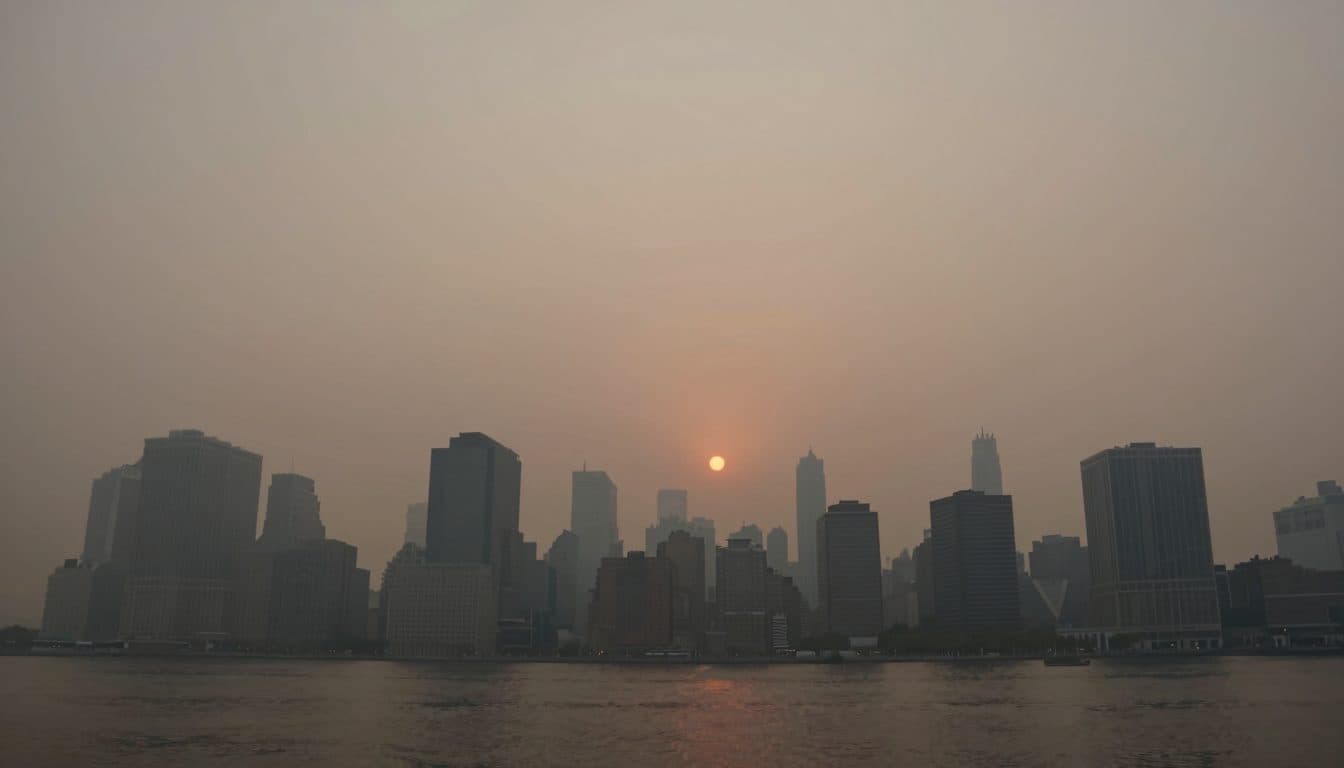
Wildfire Smoke and Heat Wave: New York in a State of Emergency Ahead of World Cup Final
New York, 16 July 2026
AI-generated image (z-image via Kie.ai)
Summary
Wildfires in Canada and Minnesota are driving massive smoke clouds over New York City, while a heat wave grips the city. Authorities declared a "Code Red"; Governor Kathy Hochul advised residents to stay home, wear masks, and use air filters.
New York, 16 July 2026
Wildfires in Canada and Minnesota have carried smoke clouds all the way to New York City, where a heat wave with temperatures of up to 40 degrees is occurring in parallel and authorities have declared a "Code Red."
The air over New York City is currently anything but clear. Dense smoke clouds, caused by wildfires in Canada and Minnesota, are drifting over the East Coast of the United States and dimming the sky over the metropolis. At the same time, a pronounced heat wave is gripping the region, prompting authorities to declare a state of alert in light of the combination of smoke and heat.
Canada's environmental agency already classified Toronto's air quality index at 10+ as a "very high risk." The measurement service IQAir provides corresponding figures. New York is following suit: in the U.S. metropolis, air quality is likewise classified as unhealthy according to consistent reports. Visibility dropped, the smell of burning wood lingered over streets, and sensitive population groups complained of respiratory issues.
Measures by the Authorities
Governor Kathy Hochul addressed the public with concrete behavioral guidelines. She called on residents to leave their homes as little as possible, use air filters, and wear masks. In doing so, she responded to a situation in which smoke particles and high temperatures are simultaneously impacting health. A website with tips on coping with the heat was also set up for citizens, providing information on protective measures and points of contact.
The heat wave is forecast to drive temperatures up to 40 degrees Celsius. New York, already one of the hottest metropolises in the country in summer, is facing a stress test for its power grids, hospitals, and public transportation. Cool locations, air conditioning, and adequate fluid intake are at the center of official recommendations. Schools and authorities are reviewing adjustments to operations to protect vulnerable groups.
Situation in Canada
In Canada itself, the situation is hardly less tense. According to government figures, around 835 fires were burning nationwide on Wednesday, 112 of which were classified as out of control. An area of 1.9 million hectares has already burned — a dimension far exceeding the average of previous years. The province of Ontario, home to Toronto, is among the particularly affected regions.
Greg Evans, a professor at the University of Toronto, assessed the situation with a view to the future. "Ich erwarte, dass dies in den kommenden Jahrzehnten häufiger vorkommen wird, daher müssen sich Städte und Einwohner in Zukunft darauf einstellen," he said. He thus pointed to a trend favored by climate change: longer dry phases, easier ignitability of forests, and consequently more frequent smoke events carried over hundreds of kilometers.
Health Risks
The fact that the smoke clouds are reaching the northeastern U.S. precisely now also has to do with large-scale air currents. In higher atmospheric layers, the particles are transported over thousands of kilometers and descend under certain weather conditions. New York, which has high-performance air monitoring networks, registers the smog earlier and more precisely than many other cities.
Health authorities distinguish several risk groups. Children, elderly people, pregnant women, and individuals with asthma, COPD, or cardiovascular diseases are considered particularly vulnerable. For them, authorities recommend minimizing time outdoors and avoiding physical exertion. Veterinarians also advise against walking dogs in the blazing sun or in heavily smoke-affected parts of the city.
Weather Change in Sight
Thunderstorms and rain in New York were forecast for Saturday. Meteorologists expect that the precipitation will at least partially clean the air and lower temperatures. Until then, the burden remains high, but the prospect of a weather change gives authorities and the public a window for recovery.
However, this week is by no means only about the weather situation. On Sunday at 9:00 p.m. CEST, European champion Spain faces defending champion Argentina at MetLife Stadium in East Rutherford in the final of a football World Cup. The final thus falls in a phase in which heat and smoke are placing particular strain on the city. Whether the match will be affected by this was still open at the time of publication. Neither FIFA nor local authorities had announced a postponement.
World Cup Final Under Difficult Conditions
The city is simultaneously preparing for one of the biggest sporting events of the year. Tens of thousands of fans are expected at the stadium and in the public viewing areas around Manhattan. Heat protection, water stations, and medical care are part of the planning. Organizers now face the additional challenge of dealing with smoke and possible weather changes.
Canadian emergency services, meanwhile, are battling the flames under difficult conditions. Dryness, wind, and partly inaccessible terrain are hampering firefighting efforts. Coordination between federal, provincial, and municipal authorities is running at full speed. International assistance has been requested; some neighboring countries have provided firefighting aircraft and personnel.
Operations and International Assistance
For New York, the current situation represents a double test: a heat wave that alters daily life, and smoke from wildfires that originated hundreds of kilometers away yet shapes the city's breathable air. Municipal authorities are relying on public education, technical aids such as air filters, and a broad-based information campaign to keep health consequences as low as possible.
In the long term, experts such as Greg Evans point to structural adjustments. Cities must become more resilient to heat waves, expand greenery, shading, and cool public spaces, strengthen early warning systems for poor air quality, and secure points of contact for vulnerable groups. Early warning systems for wildfire risks in Canada are also to be expanded in order to enable earlier evacuations.
For the coming days in New York, the rule is: stay indoors, wear a mask, drink plenty of fluids, and watch for signs of heat strain. Authorities are monitoring the development of air quality hourly and updating their warnings via the dedicated website and official channels.
The weekend will show whether the announced weather change occurs and the situation eases noticeably. Until then, the region remains in crisis mode — meteorologically as well as in terms of health policy.
Questions & Answers
Why is air quality in New York currently so poor?
Wildfires in Canada and Minnesota have generated massive smoke clouds that have drifted hundreds of kilometers to New York City. Canada's environmental agency classified air quality in Toronto at 10+ as a "very high risk"; New York is following suit.
What are authorities advising New York residents?
Governor Kathy Hochul called on people to stay home as much as possible, use air filters, and wear masks. Additionally, a website with tips on coping with the heat was published.
Does the smoke and heat situation affect the World Cup final?
At the time of publication, it was unclear whether the situation would affect the final between Spain and Argentina on Sunday at 9:00 p.m. CEST in East Rutherford. A postponement had not been announced.
New York Wildfires: Smoke and Heat Ahead of World Cup Final | allfacts360