Yad Vashem Munich Leipzig Holocaust Education Centers 2026 | allfacts360
Yad Vashem to Open First Holocaust Education Centers Outside Israel in Munich and Leipzig
●Updated · 24 new developments since 05/28/2026
Berlin, 28 May 2026
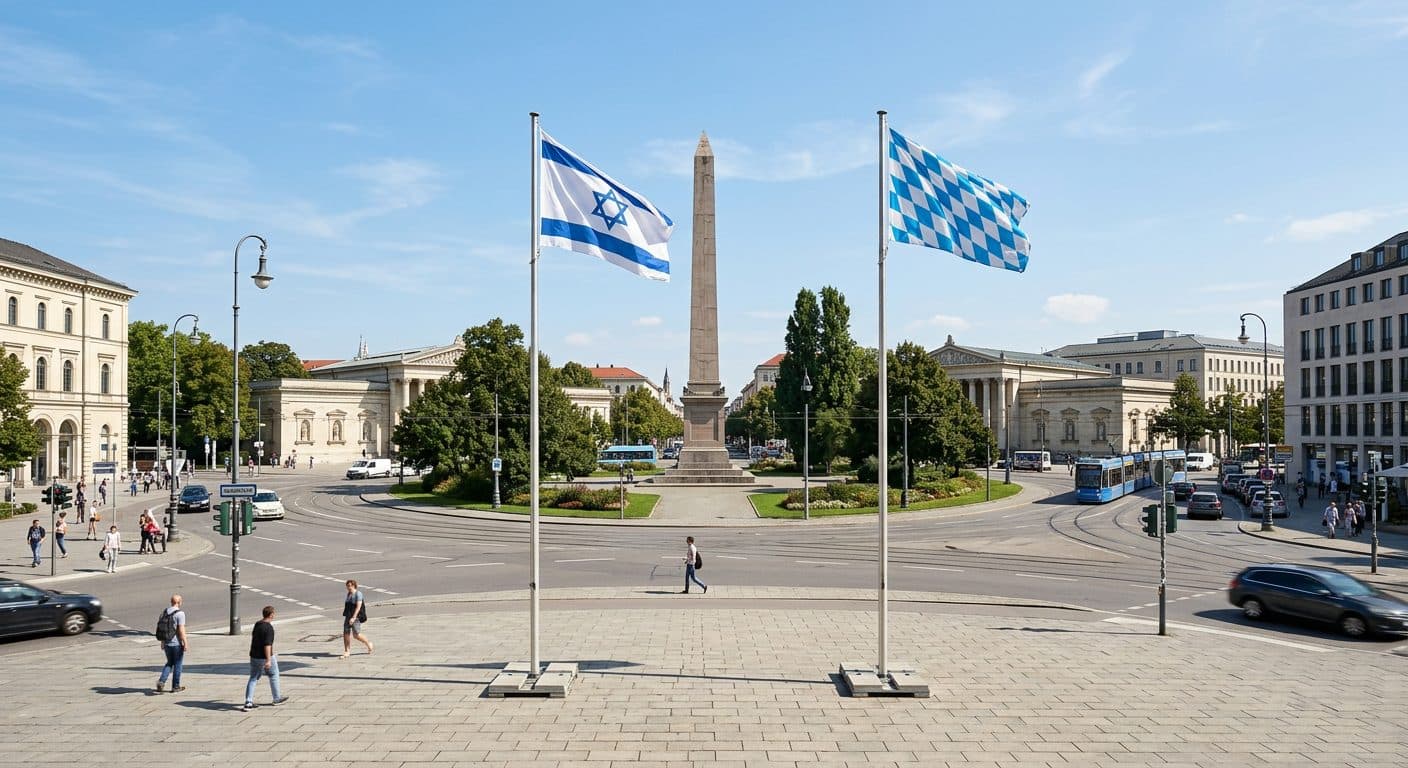
AI-generated image (google/gemini-3.1-flash-image-preview via OpenRouter)
Summary
Israel's Yad Vashem memorial will establish its first educational centers outside Israel in Munich and Leipzig. The initiative aims to strengthen Holocaust remembrance amid rising antisemitism and historical distortion.
Berlin, 28 May 2026
Yad Vashem, Israel's Holocaust memorial institution, announced plans to open educational centers in the German cities of Munich and Leipzig — its first such sites outside Israel.
What's new since 28 May 2026
The main center will be located at Karolinenplatz 4 in Munich, a site once occupied by the Nazi Party's court, and is expected to open within three years. A smaller branch in Leipzig will focus on interactive learning for educators and young people.
Dani Dayan, chairman of the Yad Vashem Directorate, said the choice of Munich carries deep symbolic weight. "The choice of Munich, the birthplace of the Nazi Party, carries deep symbolic significance and reflects the importance of confronting this history where it began," he stated.
Dayan added that the decision comes "at a critical time when instrumentalization or denial of the Holocaust and antisemitism are on the rise." The center aims to serve as a nationwide platform for audiences across Germany and neighboring countries.
Munich's Historical Significance
The Munich facility will be housed in a building at Karolinenplatz 4, where the Nazi Party's court once stood. Nearby, on Brienner Strasse, was the "Brown House," the party's headquarters. According to the NS Documentation Center, nearly 6,000 employees worked for the party leadership in more than 60 buildings in the Maxvorstadt district.
The Nazi Party was founded in Munich in 1920, and Adolf Hitler attempted a coup from the city in 1923. Supporters later called Munich the "capital of the movement." The city was also the site of the 1972 Olympic massacre, in which Palestinian terrorists killed eleven Israeli athletes and a German police officer.
Bavarian Minister-President Markus Söder called the decision an "honor" for his state. "We stand by our historical responsibility: the atrocities of National Socialism must never be repeated," he said. Söder also gave a personal "promise of protection," saying Bavaria would be "a good home" for Yad Vashem.
Charlotte Knobloch, president of the Jewish Community of Munich and Upper Bavaria, praised the choice. She described Munich as a "hub of Jewish life in Europe" offering "perfect conditions" and called the center a "necessary counterweight" to political extremism.
Political and Community Reactions
"Jew-hatred cannot be overcome without knowledge of history," Knobloch said. Gady Gronich, general secretary of the Conference of European Rabbis, added: "Especially in a time of growing antisemitic threats, education is the decisive key. Whoever understands history protects the future."
The idea for a German educational center originated from a proposal by Dayan during a meeting with then-Chancellor Olaf Scholz in 2023. In September 2025, Dayan and Federal Education Minister Karin Prien announced plans for a branch in Germany, with Bavaria, North Rhine-Westphalia, and Saxony as possible locations.
After comprehensive feasibility studies, Munich was chosen for its historical significance, educational landscape, infrastructure, and "high security standard," Yad Vashem said. The institution already maintains cooperation agreements with all 16 German states.
The Leipzig Branch and Its History
The Leipzig branch will be located in the Ariowitsch House on Hinrichsenstrasse 14. The building served as a Jewish retirement home from 1931, funded by the Ariowitsch family and designed by architect Emil Franz Hänsel. In 1942, more than 100 residents and staff were deported to the Theresienstadt concentration camp.
The Jewish community regained the building in 1946, and it operated again as a retirement home until 1997. Renovation work for the new center in Leipzig's Waldstrassenviertel began in 2006.
Saxony's Minister-President Michael Kretschmer called the decision "a great honor and at the same time an obligation." The Leipzig center is intended to serve as "a bridge to Eastern Europe" and cooperate with Poland and the Czech Republic in remembrance work.
Federal Education Minister Karin Prien stressed the importance of Holocaust education for young people. "Knowledge of what was is important to prevent evil in the future," she said, adding that young Germans know "too little about the Shoah and the systematic murder of millions of Jews under National Socialism."
Educational Mission and Funding
Yael Richler-Friedman, pedagogical director of Yad Vashem's International Institute for Holocaust Education, said the center would bring "a larger picture into the dialogue of remembrance culture in Germany," focusing on "voices of the victims rather than the perpetrators."
The Bavarian government has provided a "financial assurance" for the project. The culture budget for 2026 and 2027 allocates more than 200 million euros, including 93 million for operating costs over 15 years, 50 million for building maintenance, and 16.7 million for security upgrades.
Yad Vashem stated that the center will "strengthen its worldwide engagement in Holocaust education and remembrance work" at a time when "distorted representations of the history of the Holocaust are increasing worldwide and antisemitism continues to spread."
The institution emphasized that the center will reinforce the Jewish perspective in German remembrance culture. "Working together with our German partners, this center will help ensure that the truth of the Holocaust is preserved and passed on to future generations," Dayan said.
Questions & Answers
Why did Yad Vashem choose Munich for its first educational center outside Israel?
Munich was selected for its historical significance as the birthplace of the Nazi Party, its strong educational landscape, infrastructure, and high security standards.
What will the Leipzig branch focus on?
The Leipzig branch will offer interactive learning spaces primarily for educators and young people, and aims to serve as a bridge for remembrance work with Eastern European countries like Poland and the Czech Republic.
How is the project being funded?
The Bavarian government has provided a financial assurance, with over 200 million euros allocated in the 2026–2027 culture budget for operating costs, building maintenance, and security upgrades.