Administrative court declares entire Ruhr Regional Plan invalid
Münster, 12 June 2026
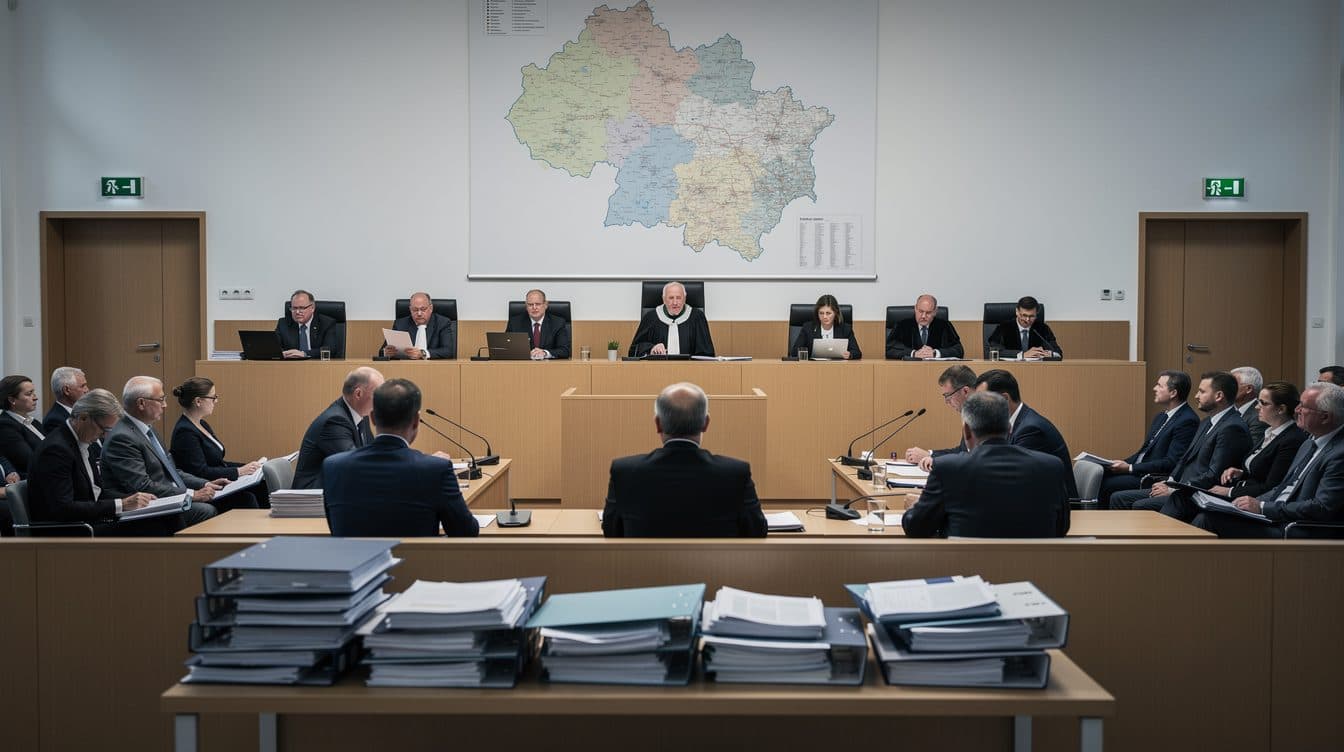
AI-generated image (flux-2/pro-text-to-image via Kie.ai)
Summary
The Oberverwaltungsgericht (Higher Administrative Court) in Münster has declared the entire Ruhr Regional Plan (Regionalplan Ruhr) invalid, a key instrument…
Münster, 12 June 2026
The Oberverwaltungsgericht (Higher Administrative Court) in Münster has declared the entire Ruhr Regional Plan (Regionalplan Ruhr) invalid, a key instrument for 53 municipalities and 5.1 million inhabitants. The ruling overturns plans for 140,000 housing units, 195,000 jobs, and 17 new sand and gravel quarries in the Kreis Wesel. Appeal before the Federal Court was not admitted.
The Oberverwaltungsgericht (OVG) for North Rhine-Westphalia, based in Münster, has declared the entire Ruhr Regional Plan (Regionalplan Ruhr) invalid, the central instrument for the region's long-term spatial development.
What has changed since the previous update
Update of 12 June 2026: the Oberverwaltungsgericht (OVG) in Münster has announced the outcome of the ruling on the Ruhr Regional Plan, with which the plan, adopted in 2022 by the regional parliament of the Regionalverband Ruhr (RVR) and entered into force in 2024, has been declared entirely ineffective. Compared to the previous update, which merely noted the opening of the hearing and the submission of a "brilliant" document by the industry lobby, the court's final decision is now available, including the reasoning and statements of the presiding judge.
Content and scope of the Ruhr Regional Plan
The decision concerns a plan that, with its 150 binders of planning documents, is considered one of the most complex ever drawn up in the region. The plan governs, among other things, the construction of 140,000 housing units over the next twenty years, the designation of commercial areas that could create up to 195,000 jobs, and the identification of areas for wind energy production and local recreation.
During the hearing, held in Hall I of the OVG in Münster starting at 10:30, Hüwelmeier harshly criticised the quality of the planning process. "Bei der Planung habe es gravierende Fehler gegeben", he stated, as reported by Deutschlandfunk. The judge added that "Dass ein älterer Bericht für eine Zukunftsprognose geeigneter sein soll als ein aktueller, ist erstmal nicht selbsterklärend", criticising the use, in the plan, of outdated data for future projections.
Hüwelmeier's criticisms
After reading the operative part, the judge stated: "Der RVR steht jetzt vor den Scherben seines Handelns". He also acknowledged, with a different kind of comment, that overall the plan was "recht ordentlich" made, but then clarified: "Das ist kleinlich, das ist uns auch bewusst", in reference to the procedural objections raised by the parties. The ruling did not admit an appeal before the Federal Administrative Court (Bundesverwaltungsgericht).
The parties' positions: municipalities versus the extractive lobby
The main lawsuit had been brought by several municipalities and residents of the Kreis Wesel, who had opposed the expansion of gravel quarries in the Lower Rhine (Niederrhein) region. The plaintiffs argued that the expansion of extraction activities was excessive and destroyed the landscape. In a position statement, the Kreis Wesel had described the consequence as "die unumkehrbare Vernichtung unserer hochwertigen niederrheinischen Kulturlandschaft und Heimat".
A raw materials company and the industry lobby "Zukunft Niederrhein" had also joined the proceedings, requesting, on the contrary, a further expansion of gravel extraction. The industry initiative, represented by its managing director Sascha Kruchen, had argued: "Ohne Sand und Kies gibt es weder bezahlbaren Wohnungsbau noch eine funktionierende Infrastruktur noch die Umsetzung vieler Projekte der Energiewende und des Klimaschutzes". An industry spokesperson had added: "Eine Industrieregion kann es sich nicht leisten, bei einem unverzichtbaren Grundrohstoff auf die Lagerstätten vor der eigenen Haustür zu verzichten".
Consequences for gravel extraction in the Lower Rhine
The plan, which also regulates the extraction of raw materials, had envisaged the opening of 17 new excavation areas for sand and gravel exclusively in the Kreis Wesel. The area around Kamp-Lintfort, Neukirchen-Vluyn, Rheinberg, and Hünxe is one of the richest in gravel in Germany. With the invalidation, the 17 planned extraction areas are now effectively suspended and the Regionalverband Ruhr will have to redraft the plan.
The regional plan serves as the central instrument for the long-term spatial development of the Ruhr, which comprises 53 municipalities and 5.1 million inhabitants. The invalidation therefore also affects the process for the creation of commercial areas with an estimated employment capacity of 195,000 people and for the construction of 140,000 housing units over two decades.
Effects on housing construction and production areas
The OVG did not admit an appeal of the ruling, effectively making the invalidation final unless there are further procedural developments. The question remains open regarding the practical effects on administrative proceedings already initiated and on extraction applications submitted on the basis of the annulled plan.
For the plaintiff municipalities and the residents of the Kreis Wesel, the ruling represents a significant victory after years of litigation. For the extractive industry and the Regionalverband Ruhr, the need now arises to comprehensively revise the planning instrument, in a context where, according to data cited by the press, the prices of sand and gravel have increased by 90% over the past ten years due to growing scarcity of supply.
The technical and legal complexity of the case is also evidenced by the volume of documents: the 150 binders of planning files produced by the RVR constitute the documentary basis on which the court ruled. Judge Hüwelmeier pointed out that the procedural shortcomings and the use of outdated data undermined the legitimacy of the entire plan, not only the individual contested provisions.
The declaration of invalidity of the entire Ruhr Regional Plan marks a significant precedent in spatial planning in western Germany. The consequences extend well beyond the extractive sector, affecting the housing, economic, and energy transition policies of the entire Ruhr region.
Outlook and next steps for the Regionalverband Ruhr
The Regionalverband Ruhr will now have to launch a new planning process, which could require years of preparatory work and further negotiations with the 53 municipalities concerned. In the meantime, the region finds itself without a long-term planning instrument in key sectors such as housing, production areas, and the energy transition.
The interested parties will now have the opportunity to evaluate any further legal remedies, although the non-admission of the appeal limits the margins for challenge before the Federal Court. The case could open a broader debate on the technical quality of regional plans in Germany and on the importance of up-to-date data bases in planning proceedings.
Questions & Answers
Which court declared the Ruhr Regional Plan invalid?
The Oberverwaltungsgericht (OVG) for North Rhine-Westphalia, based in Münster, declared the entire Ruhr Regional Plan invalid in a ruling issued on 12 June 2026.
What are the main consequences of the ruling for the Ruhr region?
The invalidation overturns the plans for 140,000 housing units and 195,000 jobs envisaged in the plan, as well as the 17 new sand and gravel extraction areas in the Kreis Wesel. Appeal before the Federal Court was not admitted.
Why had the municipalities of the Kreis Wesel challenged the plan?
The municipalities and residents of the Kreis Wesel had challenged the plan because they considered the expansion of gravel quarries in the Lower Rhine excessive and destructive to the landscape, defining it as an "irreversible destruction of our valuable Lower Rhine cultural landscape and homeland".