After fatal house collapse in Görlitz: Scrap dealer reports police searches for stolen material
Leipzig, 09 June 2026
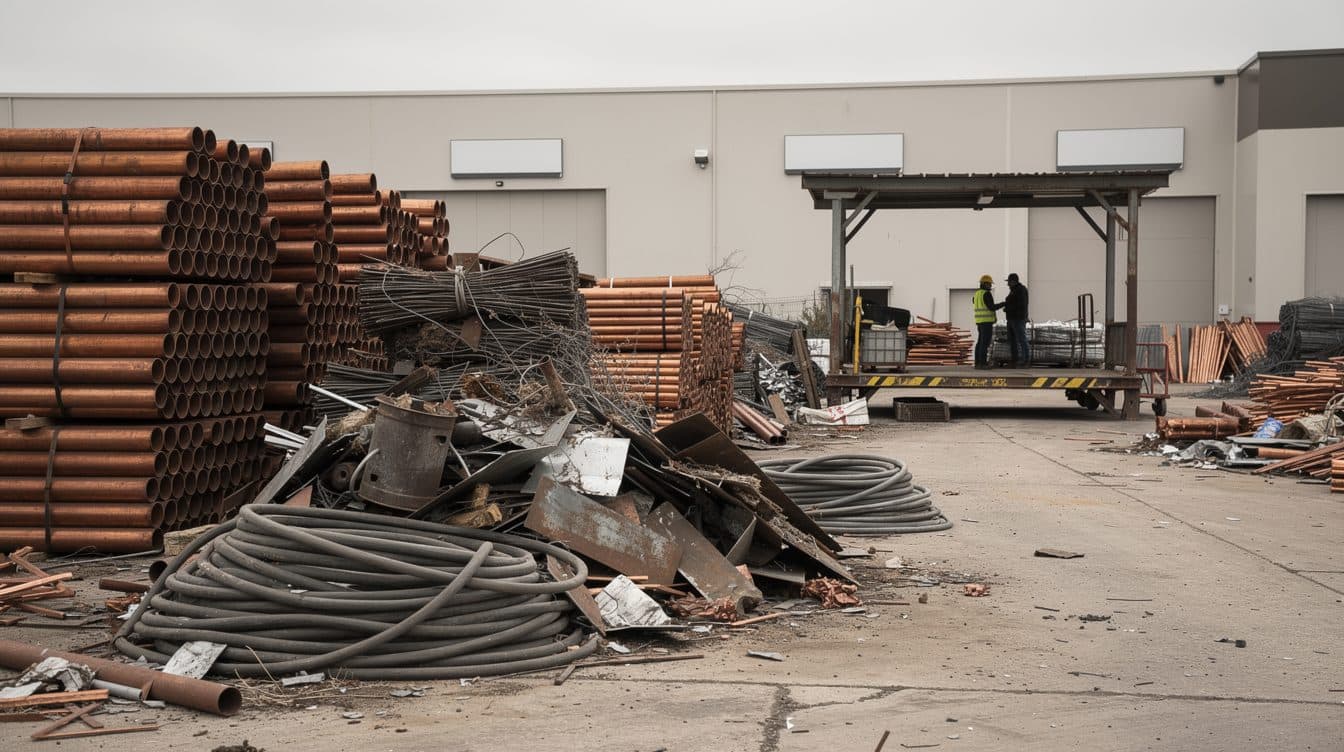
AI-generated image (flux-2/pro-text-to-image via Kie.ai)
Summary
Following the fatal house collapse in Görlitz, the theft of non-ferrous metals such as copper is once again in the spotlight. Leipzig scrap dealer Steffen Heyer reports that police repeatedly come to him searching for stolen material. Industry associations in the construction and electrical sectors, however, currently see no acute problem in central Germany.
Leipzig, 09 June 2026
The Leipzig scrap dealer Steffen Heyer reports that police repeatedly come to him searching for stolen material, while the theft of non-ferrous metals is once again in the spotlight following the fatal house collapse in Görlitz.
Background: Police search scrap dealers
The Leipzig scrap dealer Steffen Heyer has experienced repeatedly in recent years that police investigators come to his business to look for stolen metals. As he described in conversation with MDR AKTUELL, officers regularly combed through his premises when there were tips pointing to stolen goods. Just recently, copper surfaced that was later returned to its rightful owner as evidence. „Er erinnerte sich etwa an einige Kupferrohre, die als Beweismittel wieder zum Besitzer zurückgekommen sind", the report states.
According to Heyer, the Saxon State Office of Criminal Investigation (LKA Sachsen) also worked on the issue over an extended period with its own special commission. „In der Vergangenheit habe er auch mit einer Sonderkommission des LKA Sachsen für Metalldiebstähle zusammengearbeitet", he explained. The goal of the special commission had been to identify structures in the background, because individual perpetrators are generally not capable of transporting larger quantities of copper or cable away. Without organized structures on the buyer's side, the crimes would hardly be worth committing.
The background to the renewed debate is the fatal house collapse in Görlitz, in which three people lost their lives. According to current investigations, two men, while searching for valuable metals, allegedly sawed through cables and may have damaged a gas line in the process. „Nach bisherigen Ermittlungen sollen zwei Männer auf der Suche nach wertvollen Metallen Kabel abgesägt und dabei möglicherweise eine Gasleitung beschädigt haben." Three weeks after the disaster, evidence pointing to a criminal act is mounting, according to n-tv, and new video footage is said to show one of the suspects fleeing.
Investigation into the Görlitz house collapse
Despite the dramatic incident in Görlitz, industry associations in the construction and electrical sectors currently see no acute crisis in central Germany. „Nach Angaben von Verbänden der Bau- und Elektrobranche ist Buntmetalldiebstahl in Mitteldeutschland unterdessen derzeit kein akutes Problem." Isolated cases, however, keep recurring, for example at construction sites along railway lines or near transformer stations.
The fact that thefts are an attractive business also has to do with the price. According to industry figures, scrap dealers pay up to ten euros per kilogram of copper. Even smaller quantities, delivered by private individuals or from household clearances, can be worthwhile for the perpetrators. According to two Leipzig collection points, however, most deliveries come from the construction industry or from household clearances – that is, from legal sources.
Price of copper and role of collection points
Scrap dealers themselves are fundamentally obliged to record the personal details of their customers. In cases of suspicion, the data would be passed on to the police, Heyer explains. „Die Soko habe empfohlen, die Annahme durchzufurchen, 'auch wenn das erstmal augenscheinlich gestohlene Ware ist; die Personalien festzuhalten – was wir ja sowieso immer machen'." This is meant to prevent leads on perpetrators from being lost when dealers reject goods prematurely.
Parallel to the police work, operators of critical infrastructure have joined forces to form their own security partnership. Under the name „Sicherheitspartnerschaft kritische Infrastruktur und Metalldiebstahl" (Sipam), Deutsche Bahn, Mibrag and Telekom pool their experience. „Hier haben sich viele große Unternehmen wie die Deutsche Bahn, Mibrag oder Telekom zusammengeschlossen, um gemeinsam gegen Metalldiebstahl vorzugehen." However, they did not wish to provide MDR AKTUELL with further details about their security strategy.
Sipam: Alliance of infrastructure operators
Investigators in Saxony view the alliance's work as an important building block. Heyer emphasizes that without the interaction of police, network operators and scrap dealers, many cases would remain in the dark. Tips from the public have also led in the past to perpetrators being identified and stolen materials being seized.
The house collapse in Görlitz has once again put the issue of non-ferrous metal theft in the spotlight. Even though the industry does not describe the situation in central Germany as acutely widespread, the case shows what consequences a single theft can have – from damaged gas lines to interrupted telephone lines to personal injury.
Regarding the scrap trade itself, Heyer calls for stricter checks of proof of origin. „Materialien sollten anschließend erst dann weiterverkauft werden, wenn die Herkunft ermittelt beziehungsweise für legal erklärt wurde." In his view, even the suspicion that a regular customer repeatedly delivers larger quantities should be reason enough to report to the police.
From the trade's perspective, the question also arises as to whether purchase prices are not too high. As long as copper can be resold at a profit, there is an incentive to get hold of stolen goods. Some dealers are therefore calling for binding upper limits or stricter documentation requirements for initial purchases.
Demands from the scrap trade
The Görlitz public prosecutor's office continues to investigate the house collapse of June 2026. Whether the two suspected perpetrators would remain in custody was initially unclear. The evaluation of the new video footage, which is said to show a suspect fleeing, is still ongoing. Police had also interviewed eyewitnesses and residents in the area around the house.
For residents in the Görlitz district where the house collapsed, everyday life has changed. Many report that they had heard noises at night and seen suspicious persons without previously reporting this. Local initiatives are now calling on the public to report anything unusual to police earlier in the future.
Consequences for residents and investigations
The debate over non-ferrous metal theft is not new in central Germany. In previous years, Deutsche Bahn and energy suppliers had already reported significant damage from cable theft. The renewed attention sparked by the Görlitz case could now provide the impetus for stricter rules in the scrap trade.
In the end, Heyer says, much depends on scrap dealers themselves cooperating with the police. Anyone who accepts stolen goods is committing a criminal offense – and in the worst case, endangering human lives, as the Görlitz case has shown.
Questions & Answers
Who is Steffen Heyer?
Steffen Heyer is a scrap dealer in Leipzig who reports that police repeatedly come to him searching for stolen material. According to his own account, he worked in the past with a special commission of the LKA Sachsen set up to deal with metal thefts.
Why is the issue of non-ferrous metal theft currently in the spotlight?
A house in Görlitz collapsed, killing three people. According to current investigations, two men, while searching for valuable metals, allegedly sawed through cables and may have damaged a gas line.
What is Sipam?
Sipam stands for „Sicherheitspartnerschaft kritische Infrastruktur und Metalldiebstahl". The alliance includes, among others, Deutsche Bahn, Mibrag and Telekom, who have joined forces to take joint action against metal theft.
Görlitz house collapse: Scrap dealer on non-ferrous metal | allfacts360