After Fedorov's Dismissal: Protests in Ukraine and Power Struggle Over Military Leadership
Kyiv, 20 July 2026
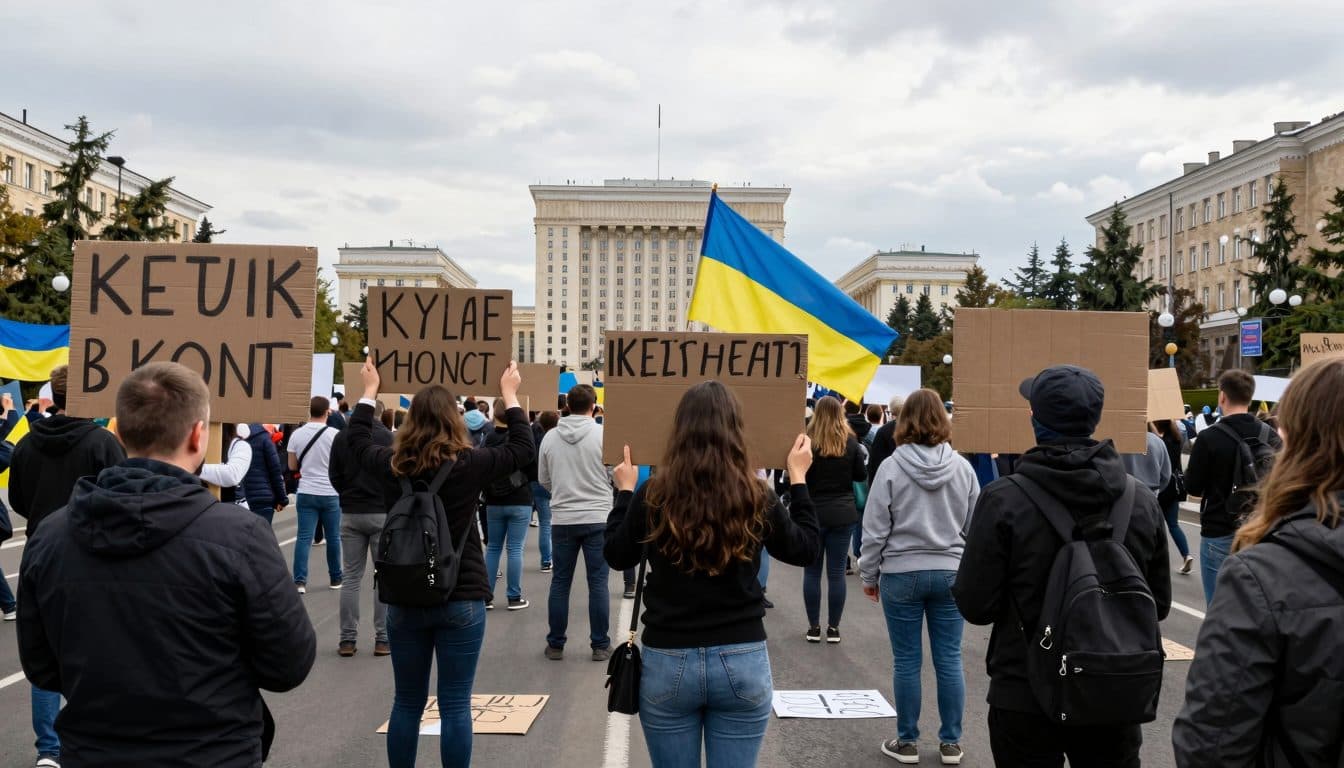
AI-generated image (z-image via Kie.ai)
Summary
Following the dismissal of Defense Minister Mykhailo Fedorov, protests have been taking place in Kyiv and other Ukrainian cities since 16 July. President Volodymyr Zelensky appointed Yevhenii Khmara as acting Defense Minister, justifying the move with an irreconcilable conflict between Fedorov and army chief Oleksandr Syrsky.
Kyiv, 20 July 2026
Following the dismissal of Defense Minister Mykhailo Fedorov, thousands of people in Ukraine are demonstrating for his return to office and demanding the resignation of Commander-in-Chief Oleksandr Syrsky, while President Volodymyr Zelensky has named Yevhenii Khmara as his successor.
The situation in the Ukrainian capital has been tense for days. Since 16 July, people have been taking to the streets in Kyiv and other major cities across the country to protest against the removal of Defense Minister Mykhailo Fedorov. The demonstrators are demanding not only his reinstatement but also the departure of army chief Oleksandr Syrsky. This is escalating a conflict that has been simmering for months at the top of Ukraine's security architecture, in the middle of a war.
President Volodymyr Zelensky responded to the crisis by appointing Yevhenii Khmara as acting Defense Minister via presidential decree. Zelensky publicly justified the move by citing an unresolvable conflict between Fedorov and Syrsky. According to the president, both sides had stood irreconcilably opposed to each other. "I respect both sides, I know their strengths and weaknesses, and I really want them to strengthen Ukraine. But that is how it is. And in such a situation there is only one way out – either one side or the other," Zelensky said, according to the Ukrainian broadcaster Suspilne.
Background of the Power Struggle
Fedorov himself had cited the break with Syrsky as the reason for his dismissal. He accused the Commander-in-Chief of "blocking initiatives" and of being unwilling to discuss problems. On social media, Syrsky briefly thanked his former cabinet colleague, writing: "I wish him to continue remaining on the Team Ukraine." Beneath the public words remains a deep rift between civilian and military leadership.
According to experts, the background to the conflict is a structural problem. Mykola Bielieskov, an expert at the Ukrainian foundation "Come Back Alive," described the dispute as systemic and not merely personal animosity. Without a fundamental solution, the conflict between military and civilian leadership will persist in latent or acute form, Bielieskov warned. Political scientist Oleh Saakian, co-founder of the "National Platform for Resilience and Cohesion," likewise sees Zelensky caught between two camps: the military wing around Syrsky and the technological wing around Fedorov.
With this personnel decision, Zelensky is fundamentally shifting the balance of power within the Defense Ministry. The 61-year-old Syrsky, credited with important successes for the country – as commander of the Ground Forces and since 2024 as Commander-in-Chief – including repelling the major offensive on Kyiv and recapturing large parts of Kharkiv province, is now himself under pressure. His grim demeanor and his origins in Russia – he is an ethnic Ukrainian – are viewed critically by the public.
Fedorov and Syrsky: Two Lines in the War
The dismissed Fedorov, by contrast, is seen as a representative of a new generation. The 35-year-old embodied an approach that put drone technologies and digitalization at the forefront as drivers of reform. In the first phase of the war, he held various commands before reportedly being sidelined in 2025, allegedly at Syrsky's behest.
With Khmara as the new Defense Minister, the ministry's line is shifting more strongly back toward the military, according to political scientist Ihor Reiterovych of the National Taras Shevchenko University of Kyiv. Reiterovych interpreted the personnel change as an attempt to optimize cooperation between the ministry and the armed forces, particularly with Syrsky. Prior to his appointment, Khmara headed the Center for Special Operations "A" and had been acting head of the Security Service of Ukraine (SBU) since January.
Khmara Between Military and Technology
Zelensky lobbied for the new appointee with reference to his experience: "Khmara has gained extensive, in many respects unprecedented experience in conducting technological offensive operations. This is what our defense should focus on in this war," the president said. Once all legally required formalities are fulfilled, he will submit Khmara's candidacy to parliament for confirmation.
Critics see risks in the choice. Former SBU official and military expert Ivan Stupak told DW that Khmara is a specialist in intra-military affairs. However, Stupak fears that under the new minister, innovations in digitalization, cooperation with Silicon Valley, and with the US technology company Palantir could diminish. On a positive note, Stupak highlighted: "Khmara is a soldier, he wears a uniform, he knows the rules of the game and can speak with the generals in a language they understand."
Politically, the situation remains fragile. The next regular plenary session of the Ukrainian parliament is not scheduled until mid-August. Until then, Khmara must run affairs as acting minister. The ongoing protests, the unresolved power dynamics between the president, the army chief, and the ministry, as well as the open personnel question at the Defense Ministry, are weighing on Ukraine's prosecution of the war at a time when Russia is maintaining pressure on the front.
The conflict between Fedorov and Syrsky had been building for months. While Fedorov stood for a more digitally and technologically oriented modernization of the armed forces, Syrsky relied on classical military command structures. Fedorov's dismissal was therefore also interpreted by observers as a directional decision in dealing with the armed forces. With Khmara, the ministry now has a leader who, as Zelensky emphasized, is meant to connect both worlds – the military and the technological.
Questions & Answers
Why was Mykhailo Fedorov dismissed as Defense Minister?
According to Fedorov himself, there was a conflict with Commander-in-Chief Oleksandr Syrsky. President Volodymyr Zelensky explained that both sides had been unable to reach agreement, which had become a problem for him personally.
Who is Yevhenii Khmara and what experience does he bring?
Khmara was appointed acting Defense Minister by President Zelensky. Previously, he headed the Center for Special Operations "A" and had been acting head of the Security Service of Ukraine (SBU) since January.
What are the protesters in Kyiv and other cities demanding?
Since 16 July, people have been demonstrating in Kyiv and other Ukrainian cities for Fedorov's return to office and demanding the resignation of army chief Syrsky.
Ukraine: Protests After Fedorov's Dismissal – Zelensky | allfacts360