Zelensky Fires Syrsky: Drapatyi New Army Chief | allfacts360
After Protests: Zelensky Fires Army Chief Syrsky and Appoints Drapatyi as New Commander-in-Chief
Kyiv, July 21, 2026
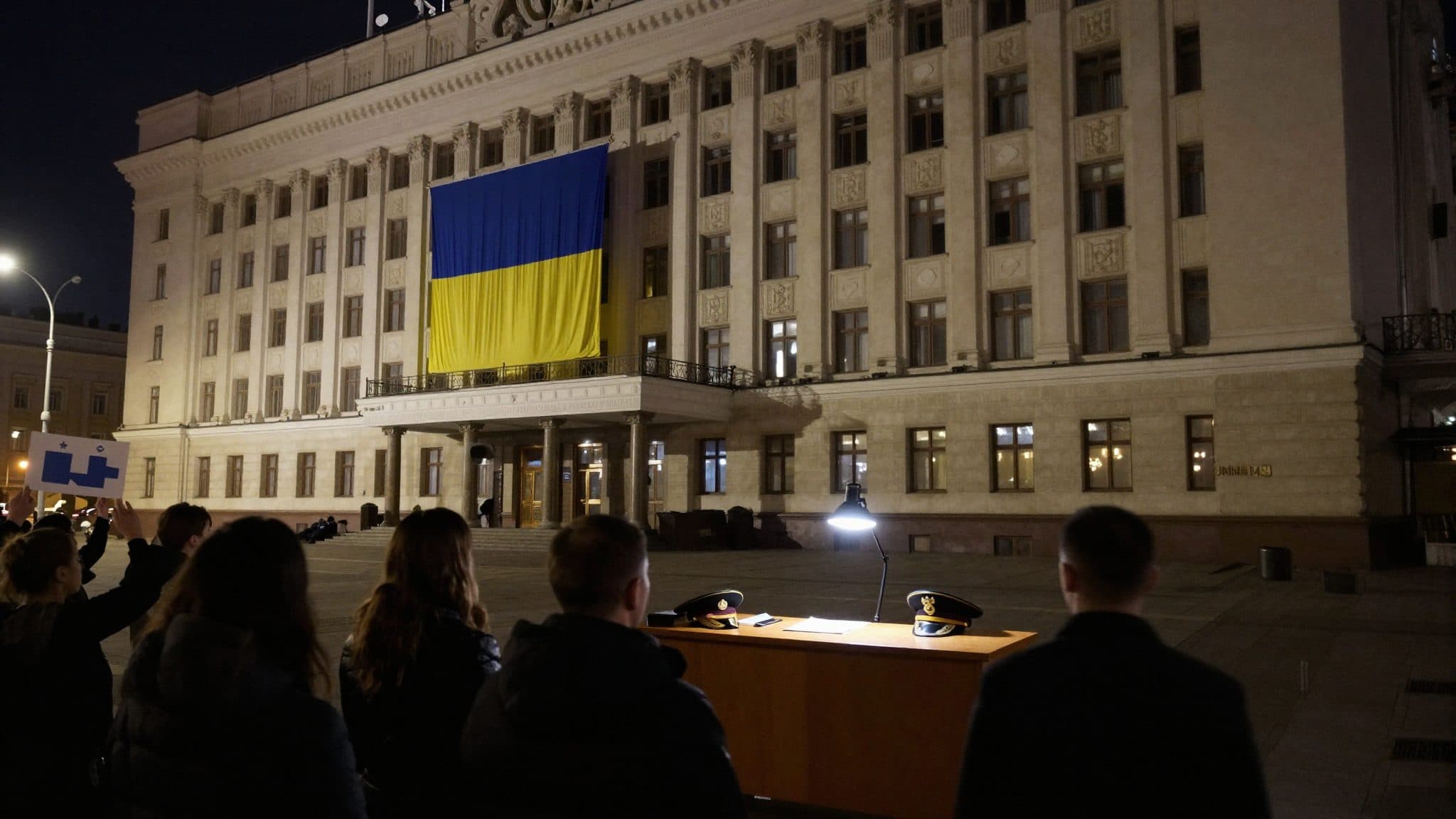
AI-generated image (z-image via Kie.ai)
Summary
After days of protests, Ukrainian President Volodymyr Zelensky has dismissed the previous commander-in-chief, Oleksandr Syrsky. The new chief of the armed forces will be Mykhailo Drapatyi; the Defense Ministry is being led on an interim basis by intelligence officer Yevheniy Khmara.
Kyiv, July 21, 2026
Ukrainian President Volodymyr Zelensky has dismissed Oleksandr Syrsky, who had served as commander-in-chief of the Ukrainian armed forces since February 2024, and appointed Mykhailo Drapatyi as his successor, while the Defense Ministry is being led on an interim basis by intelligence officer Yevheniy Khmara.
Background: Pressure from the Street
The decision was made on Tuesday evening, after Zelensky announced it publicly via his Telegram channel. It comes at the end of an internal political crisis that had escalated since the dismissal of the popular Defense Minister Mykhailo Fedorov the previous week. For six days, several thousand people, mostly young, had demonstrated in Kyiv and other Ukrainian cities against Fedorov's removal and also demanded the ouster of army chief Syrsky.
Syrsky had been commander-in-chief of the Ukrainian armed forces since February 2024. The 60-year-old career soldier, born in Russia and trained during the Soviet era, had previously distinguished himself particularly in the defense of Kyiv and the successful counteroffensive in the Kharkiv region in 2022. Despite ongoing criticism of his performance in office, Zelensky initially stood by him but changed course under pressure from the street.
Syrsky's Departure and Drapatyi's Appointment
On Saturday, Zelensky said in his daily video address that he was listening to what people were saying in the streets. On the X platform, he also wrote that he had been holding talks with military figures for days because of the ongoing protests against Fedorov's dismissal. He said he had also spoken at length with Fedorov himself and with Syrsky. On Tuesday evening, his spokesman Dmytro Lytvyn said there had been another conversation with Fedorov.
At the same time, Syrsky was not uncontroversial in military circles but also enjoyed open support. After his dismissal, Zelensky expressly thanked the departing general and honored his military service. Former NATO general Erhard Bühler warned of the consequences of the publicly conducted debate for Ukraine's defense effort: the publicly played-out debate harms Ukraine in its defensive struggle.
Fedorov's Unsettled Role
Zelensky appointed Mykhailo Drapatyi as successor. The announcement was also made on Tuesday via Telegram. Drapatyi takes over command of the armed forces at a phase in which Ukraine has been defending itself against the Russian invasion for more than four years. On the front, there had been territorial gains the previous week: the Ukrainian armed forces liberated several destroyed villages in the Dnipropetrovsk region around Berezove, Ternove, Komyshuvakha, and Maliivka, largely driving Russian forces out of the Dnipropetrovsk region.
The future role of the 35-year-old Fedorov, who had previously headed the Ministry of Digital Transformation, established in 2019, and had led the Defense Ministry since January, remains unsettled. Zelensky announced that Fedorov should receive a dignified position in which he could continue working on Ukraine's technological development, without initially specifying this further. After his dismissal, Fedorov himself publicly aired his conflict with Syrsky, which had been sparked by a strategic question of warfare.
The Defense Ministry has been led on an interim basis by intelligence officer Yevheniy Khmara since Friday. However, Zelensky must still submit Khmara's candidacy to parliament and have it confirmed by the deputies. Fedorov was regarded as an advocate of Ukrainian drone strikes on Russian targets, which won recognition in the West, and was described as a reformer.
Heavy Russian Air Strikes
The personnel changes come amid a phase of particularly heavy Russian attacks. On the night of July 17, Ukrainian drones hit two logistics warehouses of Russian online retailer Wildberries in the Tambov and Moscow regions, killing a total of eight people and injuring more than 60. Russia responded on July 18 and 19 with retaliatory strikes against at least two Ukrainian logistics depots. Russia also carried out a large-scale air raid on Kyiv on July 18 and 19, employing one of the highest numbers of ballistic missiles ever used in a single attack.
According to Kyiv, 25 ballistic missiles as well as ten "Zircon" hypersonic missiles and ten other missiles were fired at Kyiv, supported by 125 drones. Across Ukraine, twenty people were killed and more than 140 were injured. Kharkiv, Izium, and a number of other cities were also heavily hit.
On the onshore battlefield, the armed forces engaged in a documented drone race: On July 15, the commander of Ukraine's drone forces, Robert Brovdi, released a video showing a Ukrainian drone hitting and bringing down an Mi-28N "Night Hunter" attack helicopter. According to the footage, the drone struck the helicopter's tail rotor, causing the Mi-28N to crash. This is the first fully documented case of a heavy attack helicopter being shot down by a drone. On the same day, a Ukrainian Sargan-3000 maritime drone hit an FSB patrol boat called "Izumrud" in the port of Gelendzhik on the Black Sea and sank it. The ship was torn in two by the explosion and sank exactly where it had been anchored.
On July 17, the Ukrainian Security Service SBU announced that it had succeeded in striking the Engels-2 air base in Russia's Saratov region with long-range attack drones and destroying a Tu-95MS strategic bomber stationed there. On July 18, PlanetLabs satellite images were released confirming the destruction: the satellite image clearly shows a Tu-95 bomber broken between its tail assembly and fuselage with extensive burn marks. The bomber is beyond repair.
Symbolic Strikes and Drone Warfare
Gelendzhik carries particular political symbolism because it is home to the opulent palace that the late Alexei Navalny claimed belonged to Putin. The Ukrainian Security Service evidently chose the port as a target in part with an eye to its political significance. Ukraine claimed that Wildberries had been involved in the delivery of sanctioned components as well as dual-use goods to Russian combat units, and that the strikes were therefore justified.
The news picture of the week was also shaped by incidents at sea and in the region. A Russian warship, identified by British media as the frigate "Neustrashimy" of the Russian Baltic Fleet, conducted a live-fire exercise in the English Channel about 40 nautical miles south of Plymouth on Monday, lasting about half an hour and taking place in international waters. Russia also banned anchoring in parts of the Azov and Caucasus ports on the Kerch Strait if no air defense is present. Shipping in the region has been restricted since Friday due to repeated Ukrainian attacks on tankers and merchant vessels; about a quarter of Russian grain exports pass through the route via the Sea of Azov.
The humanitarian situation remains serious. The UN Human Rights Office recorded nearly 2,000 deaths and nearly 8,000 injuries in Ukraine in the first half of the year; the number of civilian casualties rose by 37 percent compared to the same period the previous year. Ukrainian attacks on Russian territory killed 250 people in the first half of the year and injured nearly 1,600, an increase of 121 percent compared to the previous year. Individual attacks in recent days also illustrate the escalation: in a drone strike on the city of Sumy on Monday evening, at least six people were injured, including four children, and a drone hit caused a major fire in a shopping center. In a Russian attack on Kherson, one person was killed and others were injured. President Zelensky reported two deaths and several injuries in a Russian attack on a multi-story apartment building in Zaporizhzhia. Russian forces attacked a civilian car with a drone in Ruska Lozova in the Kharkiv region, killing two women; the driver survived. Russia attacked Naftogas gas production facilities in the Kharkiv region for a third consecutive day.
Internationally, Ukraine continues to receive financial support. The IMF approved an additional disbursement of US$690 million (around €604 million) under its assistance program. The Kremlin, meanwhile, said it had "no hope" of an improvement in relations with Britain under new British Prime Minister Andy Burnham. Kremlin spokesman Dmitry Peskov said: "One of his first acts in office was to express support for Ukraine and thereby show that he will do everything in his power to continue the war."
International Reactions and Humanitarian Situation
SPD Bundestag member Andreas Schwarz described the work of the Ukrainian army after a visit near Kyiv as "pragmatic and digital." The data platform "Delta" is the "digital nervous system of the Ukrainian army." Schwarz also pointed to the dependence on Elon Musk's Starlink satellites as a problem for Ukraine. Both sides of the conflict have been making extensive use of online retailers and courier services since the start of the full-scale Russian war of aggression to order additional equipment and goods, sometimes even entire drones or components. Russia itself has already attacked several facilities of the state Ukrainian postal service "Ukrposhta" as well as the private postal service "Nova Poshta" during the war.
The presidential office was apparently surprised by the intensity of the protests. András Rácz, Associate Fellow in the Security and Defense Program at the German Society for Foreign Policy (DGAP) in Berlin, and Christian Mölling, Senior Advisor at the European Policy Centre, are among the experts who