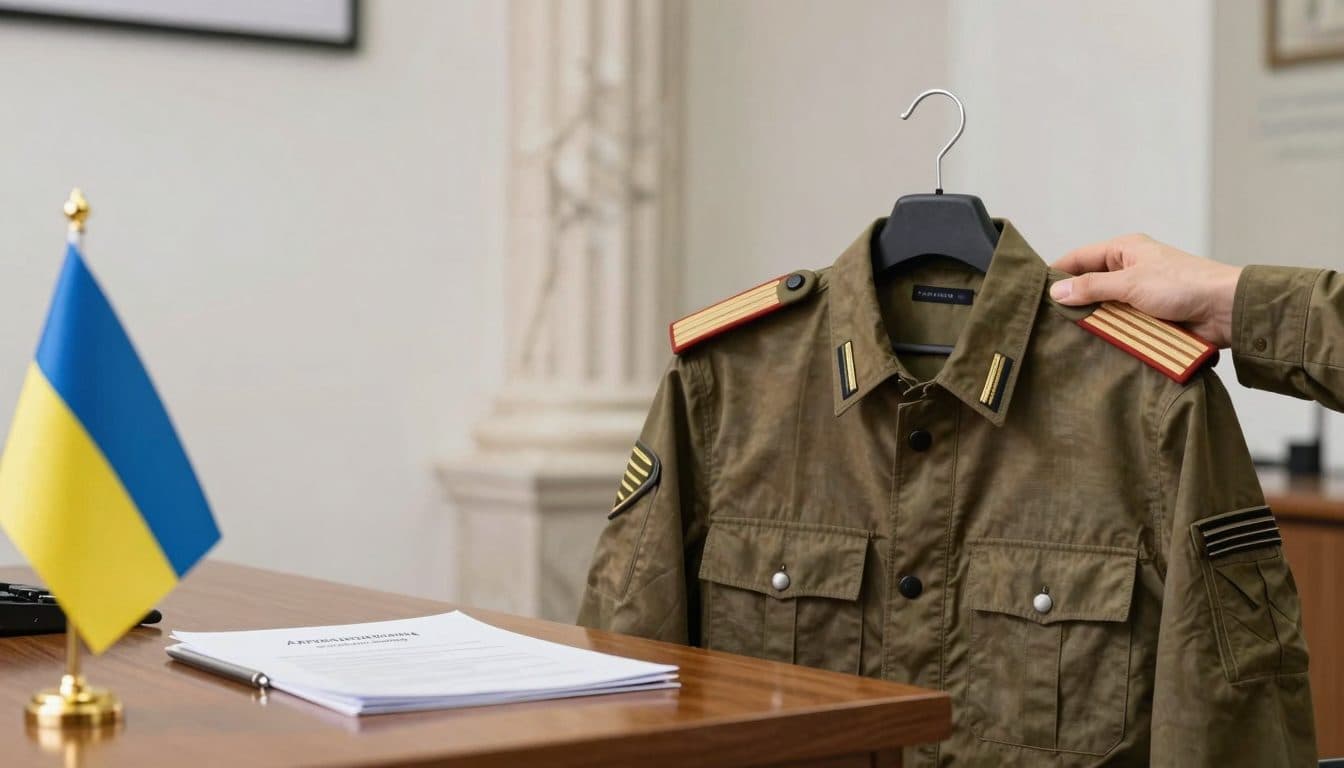
Zelensky reshuffles Ukraine's military leadership: Drapatyj succeeds Syrskyj
Kyiv, July 22, 2026
AI-generated image (z-image via Kie.ai)
Summary
Ukrainian President Volodymyr Zelensky on Tuesday evening appointed Major General Mykhailo Drapatyj as the new Commander-in-Chief of the Armed Forces, replacing his predecessor Oleksandr Syrskyj following days of protests. The change is tied to expectations of a modernized defense strategy and an intensification of offensive operations against Russia.
Kyiv, July 22, 2026
Ukrainian President Volodymyr Zelensky on Tuesday evening, July 22, 2026, appointed Major General Mykhailo Drapatyj as the new Commander-in-Chief of the Ukrainian Armed Forces, dismissing his predecessor Oleksandr Syrskyj after days of street protests.
President Volodymyr Zelensky on Tuesday evening appointed Mykhailo Drapatyj as the new Commander-in-Chief of the Ukrainian Army. Drapatyj takes over the office from Oleksandr Syrskyj, who had led the armed forces during a phase marked by long positional warfare, massive losses, and growing criticism of the military leadership. Syrskyj confirmed his dismissal on Telegram, stating that he was handing over to his successor an army that not only holds the defense but is also on the offensive: „Ich übergebe meinem Nachfolger eine Armee, die nicht nur die Verteidigung hält, sondern sich auch im Offensivmodus befindet - mit Initiative, mit Struktur und mit Menschen, die wissen, wie man den Feind besiegt".
Background: Cabinet reshuffle and mass protests
The change of commander-in-chief was preceded by an unexpected cabinet reshuffle last week. Many ministers kept their posts under the new Prime Minister Serhiy Koretsky, but not the previous Defense Minister Mykhailo Fedorov. Fedorov's dismissal sparked outrage among parts of the Ukrainian population. Mass protests broke out. The demonstrators demanded not only the return of the popular defense minister but also the removal of army chief Syrskyj. These protests then shifted from the demand that Fedorov stay to the demand that Commander-in-Chief Syrskyj go.
Observers point in particular to the fact that President Zelensky apparently made the personnel decisions under pressure from the street. Stefan Laack, correspondent in Kyiv, said in an interview with MDR AKTUELL that Zelensky apparently believed he could resolve the dispute between the previous army chief Oleksandr Syrskyj and the dismissed defense minister Mykhailo Fedorov as quietly as previous government reshuffles. According to Kyiv correspondent Stefan Laack's assessment, Ukrainian President Volodymyr Zelensky lost his political instinct when appointing new military leadership. Laack added that Zelensky must be careful not to let such political miscalculations accumulate.
A massive dispute over the strategic direction of warfare had previously erupted between Fedorov and the previous Commander-in-Chief Oleksandr Syrskyj. Fedorov, considered the mastermind of the Ukrainian drone war, advocated greater technologization and the expansion of domestically developed weapons systems. Syrskyj, on the other hand, placed greater emphasis on classic infantry operations and holding fortified cities, which resulted in high losses. After his dismissal, Fedorov declared that the war could not be won with Syrskyj at the helm. Syrskyj, in turn, pointed to his successes in the war against Russia, such as the Kursk offensive, which had caused Russia considerable problems, as well as attempts to isolate Crimea and strikes deep into Russia.
Profile of the new Commander-in-Chief
Mykhailo Drapatyj (born 1982) is a highly decorated Ukrainian major general who has distinguished himself since 2014 as a battle-tested front commander. A trained armor officer, he gained fame at the beginning of the Donbas war for his determined actions during the then "Anti-Terrorist Operation." In 2014, as a major, he broke through a pro-Russian street barricade in Mariupol with an armored personnel carrier, contributing to the defense of the port city. After the start of the Russian large-scale offensive in 2022, he coordinated, as deputy commander of the Joint Forces, the successful defense of the city of Kryvyi Rih as well as the liberation of strategic areas in the south of the country. Later, he rose through positions in the General Staff to Chief of the Ukrainian Ground Forces and finally to Commander of the Joint Forces.
In 2024, Drapatyj, as commander, stopped the Russian offensive near Kharkiv. However, when Drapatyj was tasked with the defense of the Kharkiv region in autumn 2025, observers saw this as a deliberate limitation of his influence. Media speculated that Commander-in-Chief Syrskyj wanted to sideline the popular general as a potential rival. On June 1, 2025, Drapatyj submitted his resignation as army commander after a Russian missile strike on a training ground under his command killed at least twelve recruits and injured more than 60 others. He justified this step on Facebook through his „persönliches Verantwortungsgefühl für diese Tragödie". However, President Zelensky did not accept the resignation and later appointed Drapatyj as Commander of the Joint Forces.
Power struggle between Fedorov and Syrskyj
Mykhailo Drapatyj was the only general who publicly defended Fedorov after his dismissal. On Facebook he wrote that Fedorov's entry into the Defense Ministry six months earlier had been „ein echter Versuch unternommen worden, die seit Jahren herrschenden Verhältnisse im Militär zu verändern". Under Fedorov, the Defense Ministry had developed into a real partner of the army: „Die Zusammenarbeit zwischen den Truppen und dem Verteidigungsministerium hat sich verändert. Es entstand die Bereitschaft, Kommandeuren zuzuhören, Entscheidungen schneller zu treffen und Veränderungen zu unterstützen, die aus den Einheiten selbst kommen". Drapatyj is thus not only a soldier but is considered a politically prominent figure within the Ukrainian Armed Forces.
After his appointment, Drapatyj announced on Facebook that he would implement the president's directives: „Der Präsident der Ukraine hat uns klare Ziele gesetzt: die offensiven Operationen in allen Dimensionen fortzusetzen und zu intensivieren, neue Operationen hinter den feindlichen Linien zu planen, unser Militär und seine Technologien weiterzuentwickeln und die Fähigkeiten der ukrainischen Streitkräfte auszubauen." Zelensky expects from him a modernized defense strategy as well as the continuation of the recently initiated military reforms. Major General Ihor Skybiuk was simultaneously appointed as the new Chief of the General Staff, succeeding Andriy Hnatov. Instead, President Zelensky appointed the former SBU intelligence chief Yevheniy Khmara as the new Defense Minister.
Culture war in the army: "Butcher" versus modernizers
The background to the power struggle is a cultural conflict that has shaped the Ukrainian army since 2014. According to observers, Syrskyj stands for the old Soviet school of leadership. He was accused of holding certain cities for too long, resulting in high losses. From his very first day in office, Syrskyj had the reputation of sometimes placing too little value on soldiers, and soldiers gave him the nickname "Butcher." Dmytro Koziatynsky, a 31-year-old war veteran who served as a medic in the Ukrainian army and is now one of the best-known organizers of the protests, said: „Genau das war einer der größten Fehler von Oleksandr Syrskyj: Er hat versucht, die Stimmen der Soldaten zum Schweigen zu bringen. Dabei haben gerade sie das größte moralische Recht, gehört zu werden." Many civilians were afraid of being drafted into the assault brigades favored by Syrskyj. These brigades were used to intimidate or punish soldiers who openly criticized Syrskyj.
Dmytro Koziatynsky added: „Weil ich Kriegsveteran bin und in der Gesellschaft ein gewisses Vertrauen genieße, sind viele meinem Aufruf gefolgt und sind auf die Straße gegangen." Protest participants set the government an ultimatum: they demanded the return of the former Defense Minister Mykhailo Fedorov by Friday, July 24. „Das vergangene Jahr hat gezeigt, dass unsere Gesellschaft reif genug und unsere Demokratie stark genug ist." Koziatynsky, however, also warned: „Proteste während einer großangelegten Invasion bergen immer das Risiko, den Staat zu destabilisieren. Sie dürfen nicht zur Routine werden." This is only the second time since the start of the Russian large-scale invasion that protests of this magnitude have taken place in Ukraine. A year earlier, thousands had demonstrated against a law that was intended to restrict the independence of anti-corruption agencies; the government withdrew the draft following international criticism.
International reactions and assessments
Security expert Nico Lange described the leadership change in conversation with tagesschau.de as „Eine schlechte Nachricht für Russland". Lange pointed out that Russia respects this commander-in-chief. With General Mykhailo Drapatyj, Zelensky has appointed someone „der eher auf der Seite der Modernisierer steht". Drapatyj is 17 years younger than the Soviet-era-trained Syrskyj and has been deployed in combat units repeatedly since 2014. It is remarkable that someone who has repeatedly commanded combat units since 2014 and has fought himself rises in wartime from battalion commander to Commander-in-Chief of the Armed Forces. Lange spoke of an „unforced error" by Zelensky, an avoidable miscalculation that plunged the country into a severe domestic political crisis.
Oleksiy Melnyk of the Kyiv-based Razumkov Center told Deutsche Welle that Zelensky had unnecessarily provoked a
Ukraine: Drapatyj new Commander-in-Chief – Syrskyj dismissed | allfacts360