AI warning system Collision Eye: Asfinag and ÖAMTC expand | allfacts360
AI warning system "Collision Eye" protects road workers: Asfinag and ÖAMTC significantly expand test operations
Teesdorf, July 24, 2026
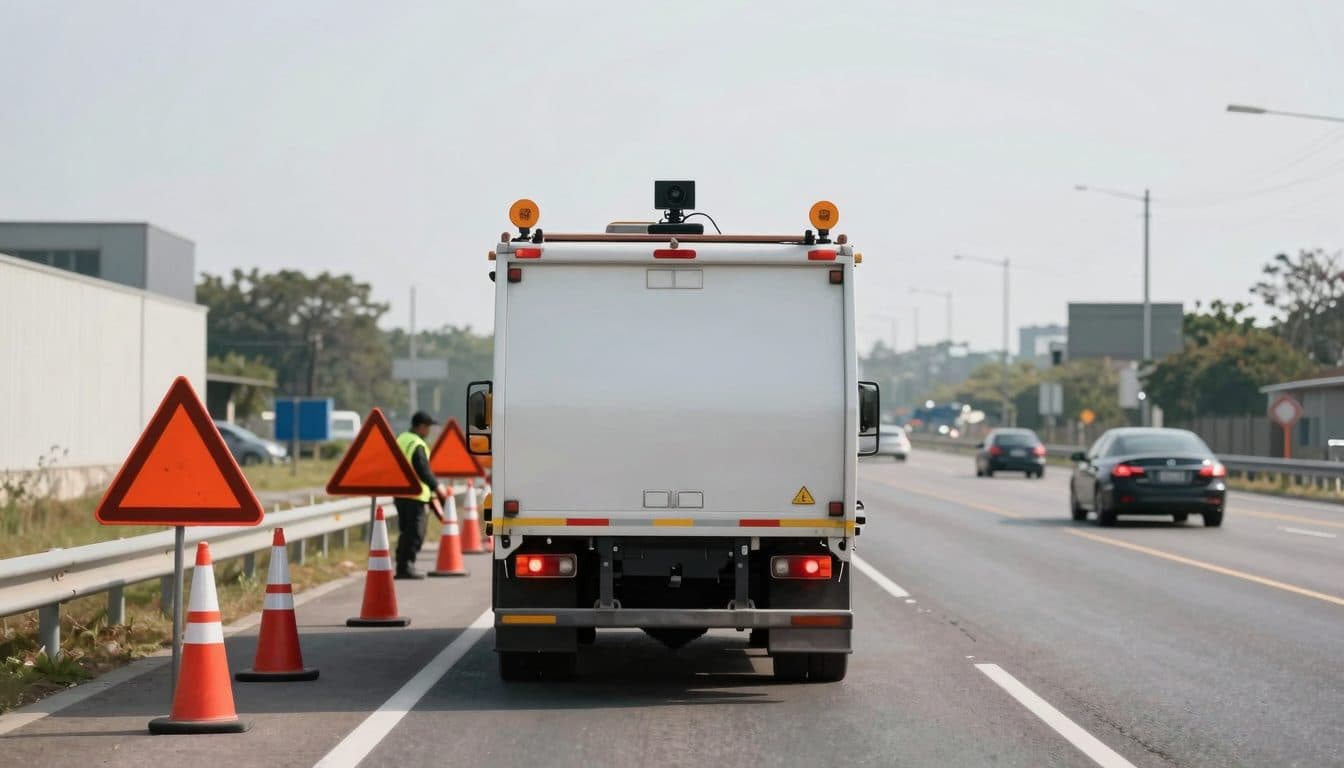
AI-generated image (z-image via Kie.ai)
Summary
The AI-supported collision warning system "Collision Eye" has proven itself in test operations at Asfinag and ÖAMTC and is now being expanded by 40 additional devices. In June alone, the system prevented ten potential collisions with approaching vehicles on highways and expressways in Asfinag vehicles.
Teesdorf, July 24, 2026
Asfinag and ÖAMTC are expanding the test of their AI-based collision warning system "Collision Eye" and equipping an additional 20 service vehicles each with the camera technology, which is designed to warn road workers and breakdown assistants of approaching vehicles.
Presentation in Teesdorf: How it works
On Thursday, the system was presented to media representatives for the first time at the ÖAMTC driving technology center in Teesdorf in the district of Baden. "Collision Eye" is a development by the Lower Austrian company Eyyes and has been undergoing a test phase since autumn 2025. During this time, nine Asfinag service vehicles and eleven ÖAMTC vehicles were equipped with the warning system. The results collected so far are so positive that both organizations are now significantly expanding the test operations, as stated at the presentation.
The heart of "Collision Eye" is a camera mounted on the road maintenance truck. With the help of artificial intelligence, the software detects approaching vehicles from a distance of around 300 meters. An integrated lane recognition system enables the system to precisely distinguish whether a car or truck is passing the service vehicle or heading directly toward the broken-down vehicle. Based on this data, the system calculates the so-called "Time to Collision" in real time – that is, the remaining time until a possible collision.
Time to Collision: How the AI calculates
If the software detects an imminent collision, it triggers an ear-piercing warning signal that gives the workers on the road seconds to get to safety. "So that the person can still get themselves to safety by jumping over the guardrail," explained Hans Pflügl from ÖAMTC, describing how it works to APA. His colleague Harald Feichtinger, deputy head of ÖAMTC's mobile services, said: "Das Feedback von unseren Testern ist äußerst positiv." Both emphasized: "Dadurch gewinnen die Mitarbeiter auf der Straße wertvolle Sekunden, um sich in Sicherheit zu bringen."
Ten warnings in June: Test phase results
How convincingly the system already works is shown by an evaluation of the test runs in June. In Asfinag vehicles alone, the "Collision Eye" was activated ten times in dangerous situations during this month, thereby preventing possible collisions. "Es gab schon einige Situationen, in denen es seine Sinnhaftigkeit eindrucksvoll unter Beweis stellen konnte," said Bernhard Lautner, Road Safety Expert at Asfinag, to APA. He expressed pride: "Wir sind stolz, dass sich das System so weit entwickelt hat, dass es praxistauglich ist und funktioniert."
Background: High accident numbers on Austria's roads
The background to the development is the still-high number of accidents in construction site and breakdown areas on Austria's roads. According to Pflügl, there are on average about 150 accidents in construction site areas per year. Only a few weeks ago, an Asfinag employee was killed in a tragic accident on the Südautobahn (A2) near Völkermarkt in Carinthia during mowing work. "Wir haben gar nicht damit gerechnet, dass ein derart großer Bedarf besteht," said Pflügl with regard to the demand for the warning system.
The response from the breakdown assistants themselves is consistently positive. "Bei unseren Pannenfahrern kommt das System bisher gut an," it was said. The technical reliability is also convincing: "Das System funktioniert einwandfrei und warnt rechtzeitig," said Pflügl. In the first version, however, the system honked relatively often – an indication that the fine-tuning of the software has been significantly improved in recent months. The warning system is used primarily in the high-speed sector, i.e., on expressways and highways. Test results continue to be collected to further increase the accuracy of the AI.
Costs and expansion: 40 additional devices planned
The cost of a device including installation is several thousand euros according to the information provided. Those responsible describe this amount as "überschaubar im Vergleich zum Nutzen," given the potentially life-saving effect. For the upcoming expansion stage, Asfinag and ÖAMTC plan to equip 20 additional vehicles each with the system – a total of 40 additional devices that will be deployed on Austria's highways and expressways in the future.
International spread and a look at drivers
The system is meanwhile no longer a purely Austrian product. According to the manufacturer Eyyes, a total of 250 systems are already in use – not only in Austria, but also in several European countries, the USA, and also Canada. Worldwide, the company has already sold 280 such collision warning devices, and the ADAC in Germany also uses the technology. The campaign "Danke, dass du auf meine Mama/meinen Papa aufpasst," which ÖAMTC and Asfinag recently launched together, is intended to further increase awareness of the dangers faced by road workers.
In parallel with the expansion of the warning system, the behavior of drivers is also coming into focus. Pflügl and Feichtinger pointed to a worrying statistic: 60 percent of under-30s admitted to having even made a video while driving at some point. Such distractions at the wheel are considered one of the main causes of rear-end collisions on routes with construction sites or broken-down vehicles – precisely those situations in which "Collision Eye" is to save lives even more frequently in the future.
With the expansion of the test operations, the amount of data with which the AI software is further trained increases. Every deployment, every triggered warning, every avoided collision provides new information to improve the system's accuracy. Pflügl announced that the results of the expanded test phase would be evaluated carefully before a decision is made on a possible nationwide rollout. But one thing is already clear: "Collision Eye" has repeatedly proven in its testing so far that it can protect road workers and breakdown assistants in critical seconds – thereby closing a gap that could not be closed by awareness campaigns alone.
Questions & Answers
What is the AI warning system "Collision Eye" and who developed it?
"Collision Eye" is a camera-based collision warning system from the Lower Austrian company Eyyes, which uses AI-supported software to detect approaching vehicles from a distance of around 300 meters and warn road workers.
How many accidents could be prevented with "Collision Eye" in June?
According to an evaluation, the system was activated ten times in dangerous situations in Asfinag vehicles alone in June, thereby preventing possible collisions.
How many additional systems do Asfinag and ÖAMTC want to purchase?
After the current test phase, Asfinag and ÖAMTC plan to equip 20 additional vehicles each with the system, increasing the total by 40 additional devices.