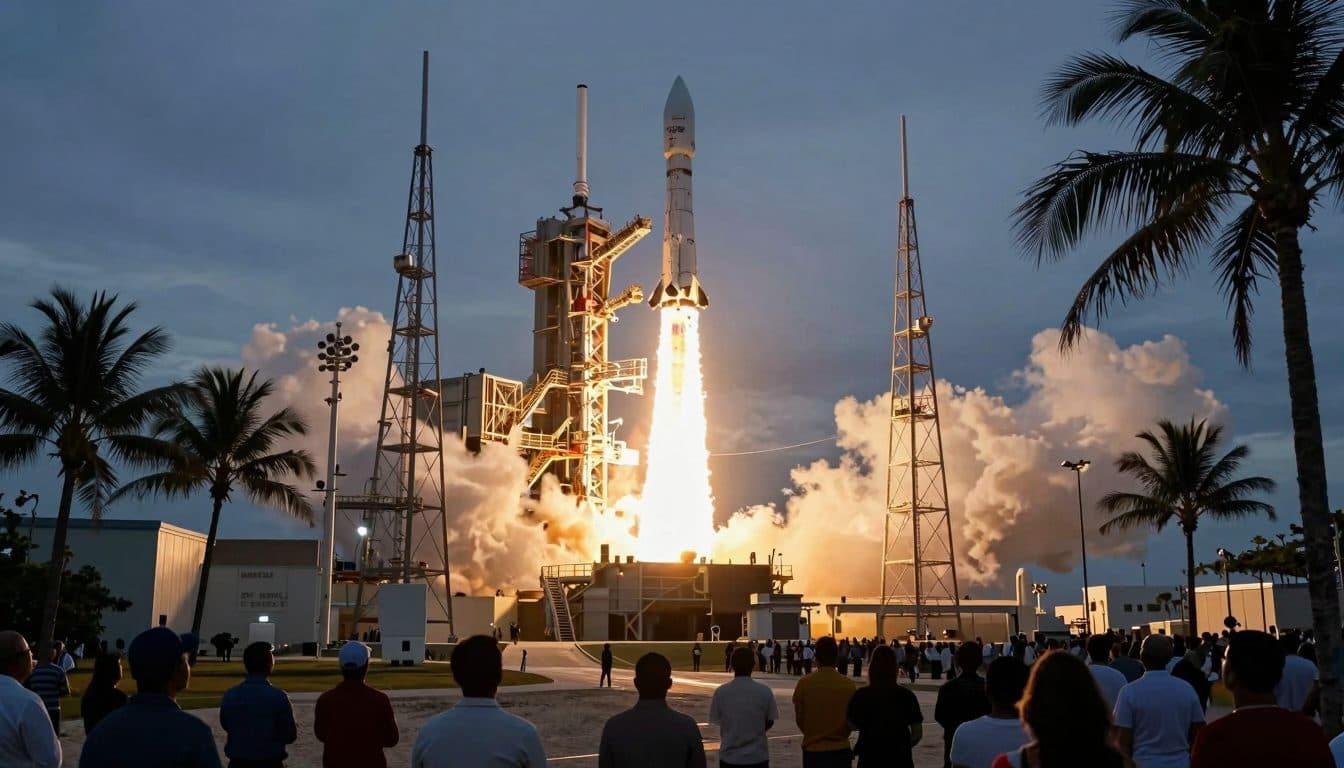
Amazon Leo reaches threshold for continuous internet service with 396 satellites
Cape Canaveral, July 03, 2026
AI-generated image (z-image via Kie.ai)
Summary
Amazon has placed 29 additional Leo satellites into Earth orbit with its eighth and final Atlas V mission. The constellation now comprises 396 satellites, which according to the company is sufficient for an initial continuous internet service. Commercial availability of the satellite internet is set to begin later this year.
Cape Canaveral, July 03, 2026
Amazon launched 29 additional satellites for its Leo internet network into low Earth orbit aboard an Atlas V rocket on Thursday, thereby reaching the minimum number required for a continuous service, according to the company.
The launch took place from the Cape Canaveral spaceport, the company announced. The satellites were deployed at an altitude of approximately 465 kilometers. They are then to be raised to 630 kilometers in order to support the internet service from there. With the United Launch Alliance (ULA) flight, the number of Leo satellites in space has risen to 396, according to Amazon's continuously updated mission overview.
"With more than 100 secured launches, the group already reserved a large share of the necessary transport capacity," it said. In March, Amazon announced a significant increase in launch frequency. The now-completed Atlas V series comprised a total of 14 missions and placed 224 Leo satellites into orbit. "In total, this launch series placed 224 Leo satellites into orbit," the company stated.
Launch capacity and preparation
Chris Weber, who is responsible for business and product development at Amazon Leo, posted on the short-message platform X: „Last few launches were big for @AmazonLeo - bringing us to 390+ satellites deployed, enough to support continuous service across initial latitudes. Still lots of work ahead - including raising all these new satellites to their assigned altitude - but we've completed enough…“ The service is thereby ready to offer continuous coverage in the initially targeted latitudes.
"The latest additions come from Amazon's eighth and final Atlas V mission for Leo," it was further stated. The flight with United Launch Alliance (ULA) added 29 more satellites. They will initially be tested at around 465 kilometers "and then raised to 630 kilometers. From there, they are later to support Amazon's internet service," Amazon explained.
The U.S. regulator FCC had initially authorized Amazon in 2020 to operate a constellation of 3,236 satellites. "After later adjustments, the current Gen1 authorization comprises 3,232 satellites." Leo is thus the third-largest satellite network in space, after Starlink and another constellation. "Measured against the 396 deployed satellites, Amazon still lacks 2,836 units to reach the regulatory target," it was stated.
FCC deadlines and exemptions
Originally, half of the authorized satellites were to have been in operation by the end of July 2026. "Originally, half of them were to have been in operation by the end of July 2026," Amazon explained. The deadline for completing the full deployment by the end of July 2029, however, remains in place. In early June, however, the authority granted the company a limited exemption, "in the public interest," as the FCC explained. "Another major satellite internet constellation alongside Starlink is, in the FCC's view, in the public interest," was given as the reason.
Amazon now has until July 2028 to launch the first half of the satellites. Should the company miss this deadline, it will lose preferred access to frequencies for satellites launched after July 31, 2026, until either half of the constellation is reached or March 30, 2028. The complete first generation must be finished by July 30, 2029, according to the license.
Melissa Wuerl, Director of Launch Systems at Amazon Leo, emphasized the preparations for the next generation of rockets: "With hundreds of flight-ready satellites at the launch site (Cape Canaveral) and a new vertical integration facility specifically set up for Leo, ready for the 'Leo Vulcan 1' mission and subsequent flights, we have a clear plan to increase launch and deployment frequency." "In parallel, Amazon is preparing additional satellites in Florida for the first Vulcan launch and later missions," it was stated.
Next steps with the Vulcan rocket
Following the end of Atlas V flights, ULA's heavy-lift rocket Vulcan is moving into focus. "Our next Leo mission with United Launch Alliance (ULA) will be carried out with the new heavy-lift rocket Vulcan; it can transport even larger Leo payloads and will help us increase the deployment rate," a spokesperson said. "It is initially to carry 40 Leo satellites per mission, eleven more than the previous Atlas V launches," the company added.
In addition to ULA, Amazon has booked launch capacity with Blue Origin, ArianeGroup, and competitor SpaceX. SpaceX already operates more than 10,000 Starlink satellites and, according to its own statements, serves more than five million customers worldwide with high-speed broadband internet. Amazon plans to make the service – "the service long developed under the name Project Kuiper" – commercially available later this year.
Competition with Starlink and investments
The group's 2026 investment program amounts to approximately 200 billion U.S. dollars, according to the company, primarily for data centers and AI infrastructure at AWS. The well-known investment framework for the entire Leo project stands at around ten billion U.S. dollars. On Thursday, the Amazon stock closed on the NASDAQ with a gain of 0.4 percent at 242.67 U.S. dollars; the market capitalization was 2.61 trillion U.S. dollars, putting Amazon ahead of SpaceX at 2.14 trillion U.S. dollars.
Amazon had originally planned to launch the first internet satellites as early as the end of 2022. In the second half of 2023, the company began launching two prototypes to test the functionality of the system. At the end of April 2025, the first 27 Kuiper internet satellites followed. In April 2026, Amazon also announced the acquisition of the satellite operator Globalstar, through which the company will also acquire Apple's 20 percent stake in Globalstar and intends to offer connectivity for iPhone and Apple Watch.
Questions & Answers
Who is Chris Weber at Amazon Leo?
Chris Weber is responsible for business and product development at Amazon Leo and leads the Leo project from this position. He explained that the current group of satellites is sufficient to offer a continuous service in the initially targeted latitudes.
Why did the FCC grant Amazon a deadline extension?
The U.S. regulator FCC granted Amazon a limited exemption in early June 2025 from the original deadline to bring half of the authorized satellites into operation by the end of July 2026. It justified this by saying that an additional major satellite internet constellation alongside Starlink is in the public interest.
What does Amazon plan next with the Vulcan rocket?
After the end of Atlas V flights, United Launch Alliance will deploy the heavy-lift rocket Vulcan, which is initially to transport 40 Leo satellites per mission, eleven more than the previous Atlas V launches. The "Leo Vulcan 1" mission is intended, together with the new vertical integration facility in Cape Canaveral, to increase the deployment rate.
Amazon Leo: 396 satellites in orbit – service launch in 2026 | allfacts360