At Least 13 Dead After Magnitude 7.1 Earthquake in Southwestern Japan
Kumamoto, July 29, 2026
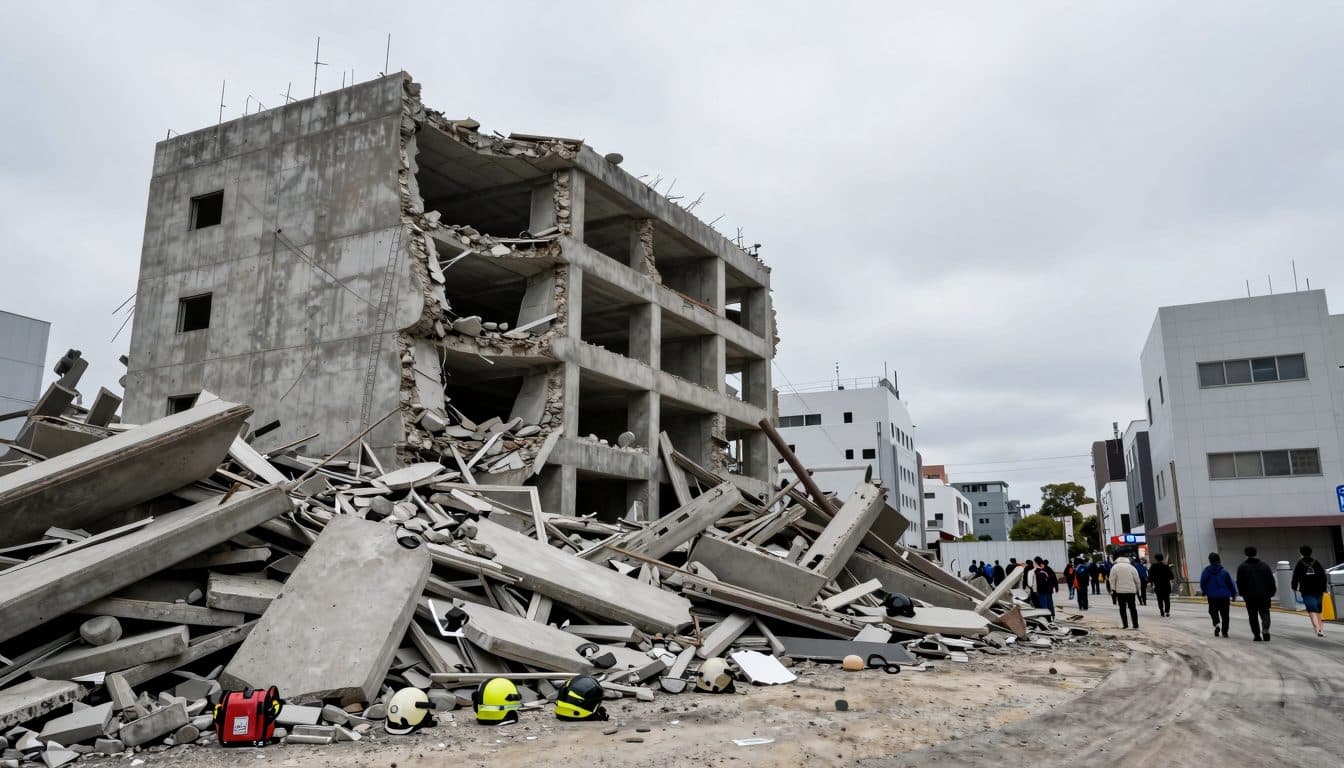
AI-generated image (z-image via Kie.ai)
Summary
Following the severe magnitude 7.1 earthquake in Kumamoto Prefecture on the Japanese main island of Kyushu, the death toll has risen to at least 13. Rescue workers continue to search for those buried under rubble, and approximately 300,000 people have been ordered to go to evacuation centers.
Kumamoto, July 29, 2026
A magnitude 7.1 earthquake struck the Kumamoto region on the southwestern main island of Kyushu in Japan on Tuesday afternoon (local time), killing at least 13 people.
Extent of the Destruction
Japanese Prime Minister Sanae Takaichi confirmed the figure of at least 13 dead in Kumamoto Prefecture the day after the quake. As reported by the Japanese television broadcaster NHK, at least 50 people were also injured. The earthquake occurred late on Tuesday afternoon and was located approximately 900 kilometers southwest of the capital, Tokyo.
According to Japan's Fire and Disaster Management Agency, approximately 260,000 to 300,000 people were ordered to leave their homes and go to evacuation centers. The authorities were responding to the immediate danger from the severe earthquake as well as to possible aftershocks.
In the particularly hard-hit Kumamoto Prefecture, power outages affected around 46,000 to 48,000 households. Several buildings and roads were damaged by the quake. Nuclear facilities in the region also showed no damage according to initial reports.
Collapsed Shopping Center in Kashima
A shopping center collapsed in the city of Kashima following the quake. The news agency Kyodo reported that staff and customers had previously been evacuated from the building. The cause of the explosion at the shopping center was initially unknown.
The Japanese television broadcaster TBS reported, citing police, that a "considerable number" of people had died in the incident at the shopping center. Rescue work in the rubble was ongoing, while police initially assumed a "high number" of possible additional victims.
Military and Rescue Forces Deployed
Head of government Sanae Takaichi announced that 3,600 soldiers would be sent to the disaster area to assist with the recovery operations. The Japanese Prime Minister made an urgent appeal to the public: "I ask everyone to get to safety."
An eyewitness described the situation after the quake in drastic terms: "It looked around us as if volcanic ash was falling." He was describing the clouds of dust stirred up by the collapsed buildings and damaged roads.
Japan is one of the most earthquake-prone countries in the world and lies on the so-called Pacific Ring of Fire, a volcanic belt surrounding the Pacific Ocean. The island nation of around 125 million inhabitants is shaken by about 1,500 earthquakes every year. Most of them, however, are so weak that they are barely felt.
Kumamoto and the Background
Kumamoto Prefecture was already struck by a severe magnitude 7.3 earthquake ten years ago. At that time, according to official figures, 275 people lost their lives. The memories of the 2016 disaster are still present in the region today and shape the handling of the current situation.
The Japanese disaster relief agency recommended that just over 260,000 people leave their homes. Other sources spoke of around 300,000 people who should go to evacuation centers. The figures illustrate the scale of the immediate threat to the population in the region.
On Wednesday, one day after the quake, rescue operations continued. Rescue teams searched for possible survivors under the rubble of the collapsed shopping center in Kashima and in other damaged buildings. The authorities warned of further aftershocks, which could place additional strain on already weakened structures.
Power Outages and Warnings
The supply of electricity to the population proved difficult in the affected areas. Power outages affected around 46,000 households in Kumamoto Prefecture, with other estimates putting the figure at up to 48,000 households. Energy providers and disaster relief agencies were working to restore the grids.
The exact number of injured was initially unclear. While NHK spoke of at least 50 injured, local media reports referred to "dozens" of injuries. Hospitals in the region prepared to admit further patients, while rescue teams continued their search for those buried under rubble.
The Japanese government set up a crisis management team to coordinate relief efforts. In addition to the 3,600 soldiers, units of the fire service and disaster relief agencies were also dispatched to the crisis area. International assistance has not been officially requested so far, although several neighboring countries have offered support.
Japan's Handling of Earthquakes
The news of the severe earthquake was broadcast on July 29, 2026, among other outlets, on the program Deutschlandfunk. The disaster thus also attracted international attention. Reporting initially focused on the search for survivors and the care of those who had been made homeless.
Due to its location on the Pacific Ring of Fire, Japan has a particularly well-developed early warning system for earthquakes. Nevertheless, damage and casualties from quakes of this magnitude can hardly be completely prevented. The experience gained from earlier disasters, such as the 2016 Kumamoto earthquake, was incorporated into the current emergency plans.
The economic consequences of the quake cannot yet be estimated. Damaged infrastructure, power supply failures, and destroyed commercial buildings such as the shopping center in Kashima are likely to pose significant challenges to the region in the coming weeks and months. The authorities announced that reconstruction would be pursued swiftly.
Solidarity with those affected was widespread in Japan. Numerous aid organizations and volunteers offered support; evacuation centers were set up and supplied with donations. National and international sympathy was also evident on social media, where those affected and helpers shared their experiences and offers of assistance.
Questions & Answers
How strong was the earthquake in Kumamoto?
According to the Japanese authorities, the earthquake reached a magnitude of 7.1 and struck the Kumamoto region on the southwestern main island of Kyushu in Japan on Tuesday afternoon (local time).
How many dead and injured are there after the quake?
Japanese Prime Minister Sanae Takaichi confirmed at least 13 fatalities, while the Japanese television broadcaster NHK reported at least 50 injured.
What relief measures were initiated?
Head of government Sanae Takaichi announced the deployment of 3,600 soldiers to assist with the recovery operations, and the authorities ordered approximately 260,000 to 300,000 people to go to evacuation centers.
Earthquake Japan Kumamoto: 13 Dead, 50 Injured | allfacts360