Austria Launches High-Performance Computer MUSICA at Three Locations
Vienna, July 3, 2026
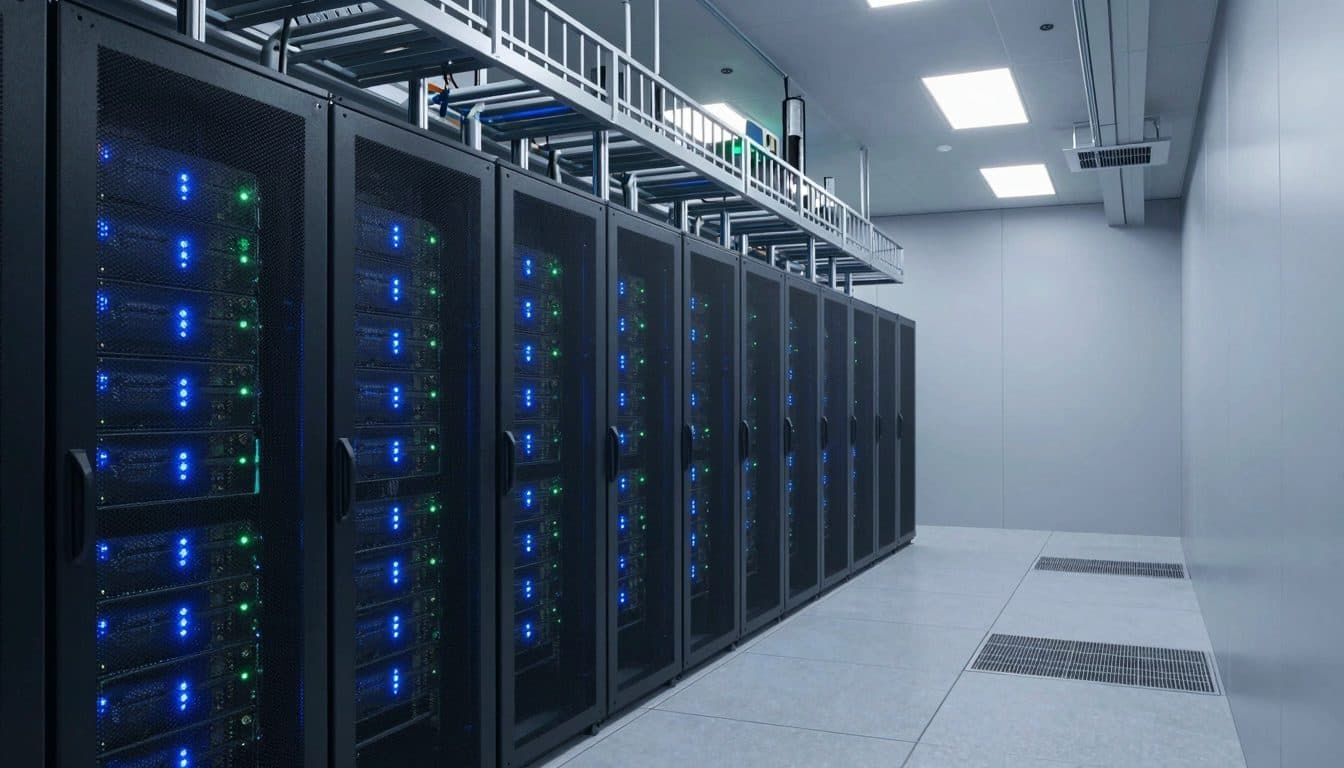
AI-generated image (z-image via Kie.ai)
Summary
At Vienna, Linz, and Innsbruck, the new high-performance computer MUSICA was officially put into operation on Friday. The approximately 36-million-euro system brings Austria back into the Top 100 of the world's fastest supercomputers.
Vienna, July 3, 2026
At the locations Vienna, Linz, and Innsbruck, the new high-performance computer MUSICA was officially inaugurated on Friday; the system achieves a performance of 45.11 petaflops and brings Austria back into the Top 100 of the world's fastest supercomputers.
The supercomputer "MUSICA" (Multi-Site Computer Austria), the most powerful computer system in the country to date, was officially presented today, Friday, July 3, 2026. The facility is distributed across three locations and pools the computing power of multiple universities as well as non-university research institutions. According to the operators, this provides domestic science with an infrastructure that reaches an internationally top-tier level.
Technical Specifications of the New System
At the "Science Center" of the Vienna University of Technology (TU) Wien at the Arsenal in Vienna's Landstraße district, there are 184 compute nodes; at the universities in Innsbruck and Linz, there are 128 each. In total, the system achieves a performance of 45.11 petaflops - a petaflop means one quadrillion computing operations per second. At its core are 1,088 graphics processing units (GPUs) and 880 central processing units (CPUs).
The new system surpasses its immediate predecessor by more than eightfold. MUSICA ranks among the Top 100 in the sometimes rapidly changing list of the fastest supercomputers - as of June. Since regular operation began in May, intensive computing has been underway on the MUSICA systems - essentially a kind of large association of individual computers that, however, work together on tasks.
Quantum Computer as an Integral Component
At the Innsbruck location, a novel quantum computer named "OTTER," equipped with up to 20 quantum-mechanically connected quantum bits ("qubits"), is also being integrated into the new computing cluster. The integration of the quantum computer cost an additional 9 million euros. The geographic distribution increases the system's resilience and availability, because the individual parts can also be operated independently of one another.
MUSICA is part of the "Austrian Scientific Computing" cluster (ASC), which also includes the two previously fastest computers in the country - the "Vienna Scientific Cluster 5" (VSC-5) and its predecessor VSC-4. According to TU Wien and TU Graz, the partner institutions are the Universities of Vienna, Innsbruck, and Linz, as well as the University of Natural Resources and Life Sciences (Boku) and the Institute of Science and Technology Austria (ISTA).
Voices from Politics and Science
The new infrastructure is "a milestone for Austria as a research location. The supercomputer creates the foundation for cutting-edge research, artificial intelligence, quantum technologies, and innovation to continue taking place in Austria at the highest level" and secures technological sovereignty, Science Minister Eva-Maria Holzleitner (SPÖ) is quoted as saying. The infrastructure's services are "open to users from research, business, and public administration who have a need for very high computing power," it is stated.
Quantum physicist Gregor Weihs - new Rector of the University of Innsbruck from March 2027 - chimes in: Here, one unites "High Performance Computing, Artificial Intelligence, and Quantum Computing at an international level." For ASC director Andreas Rauber, MUSICA unites "two worlds that are increasingly growing together in modern science: classical large-scale simulation and AI-supported data analysis."
Fields of Application of the Computing Power
The applications range, for example, from basic research questions, such as complex simulations on the propagation of electromagnetic waves, to questions from economics, engineering, or life sciences, environmental research, to calculations related to artificial intelligence (AI). This is intended to provide a broad spectrum of scientific disciplines with access to computing power.
The project was financed through the research initiative "Quantum Austria," fed by the EU recovery fund "NextGenerationEU," with 20 million euros. An additional 16 million comes from the Science Ministry. This brings the investments to approximately 36 million euros plus the nine million for the quantum computer integration.
Financing and Budgetary Challenges
Against the backdrop of the still unclear budgetary situation at the universities in the coming years, Rauber points out that "verlässlicher, planbarer Finanzierung des MUSICA-Betriebs" is needed. If university budgets were now to de facto decrease, "that affects not only high-performance computing and AI - it would also massively impact Austria's first quantum computer in its use and further development," Weihs is quoted as saying.
The JKU is one of the three locations of the new high-performance computer MUSICA, which brings Austria back into the global Top 100 of supercomputers. The Johannes Kepler University thus sees itself as a node of a national research infrastructure that opens up new possibilities for many disciplines.
With the "Multi-Site Computer Austria" (MUSICA) - a high-performance computer for research, distributed across three locations in the country - Austria re-enters the list of the world's 100 fastest computers. They are now getting a new tool, the "Multi-Site Computer Austria" (MUSICA).
Significance for the Research Location
Friday's official inauguration marks the conclusion of a multi-month setup phase in which the systems at the three locations were installed, tested, and transitioned into trial operation. Regular operation had already begun in May; now the ceremonial kickoff followed with representatives from politics and science.
With the combination of classical high-performance computing, artificial intelligence, and quantum computing, Austria is positioning itself in a field that is internationally regarded as a key technology of the coming years. The close interconnection of university and non-university research is intended to help translate scientific findings into application more quickly.
Questions & Answers
What is MUSICA and what performance does the system deliver?
MUSICA ("Multi-Site Computer Austria") is a high-performance computer distributed across the locations Vienna, Linz, and Innsbruck, achieving a total performance of 45.11 petaflops - equivalent to 45.11 quadrillion computing operations per second.
Why is the quantum computer "OTTER" part of MUSICA?
At the Innsbruck location, the novel quantum computer "OTTER," with up to 20 quantum-mechanically connected qubits, is integrated into the computing cluster to link classical high-performance computing with quantum computing.
How was MUSICA financed and what concerns exist?
The investments of approximately 36 million euros come from the EU research initiative "Quantum Austria" (20 million), the Science Ministry (16 million), and additional funds for the quantum computer integration (9 million); ASC director Andreas Rauber warns of an uncertain budgetary situation for the universities.
MUSICA: Austria's New Supercomputer Goes Live | allfacts360