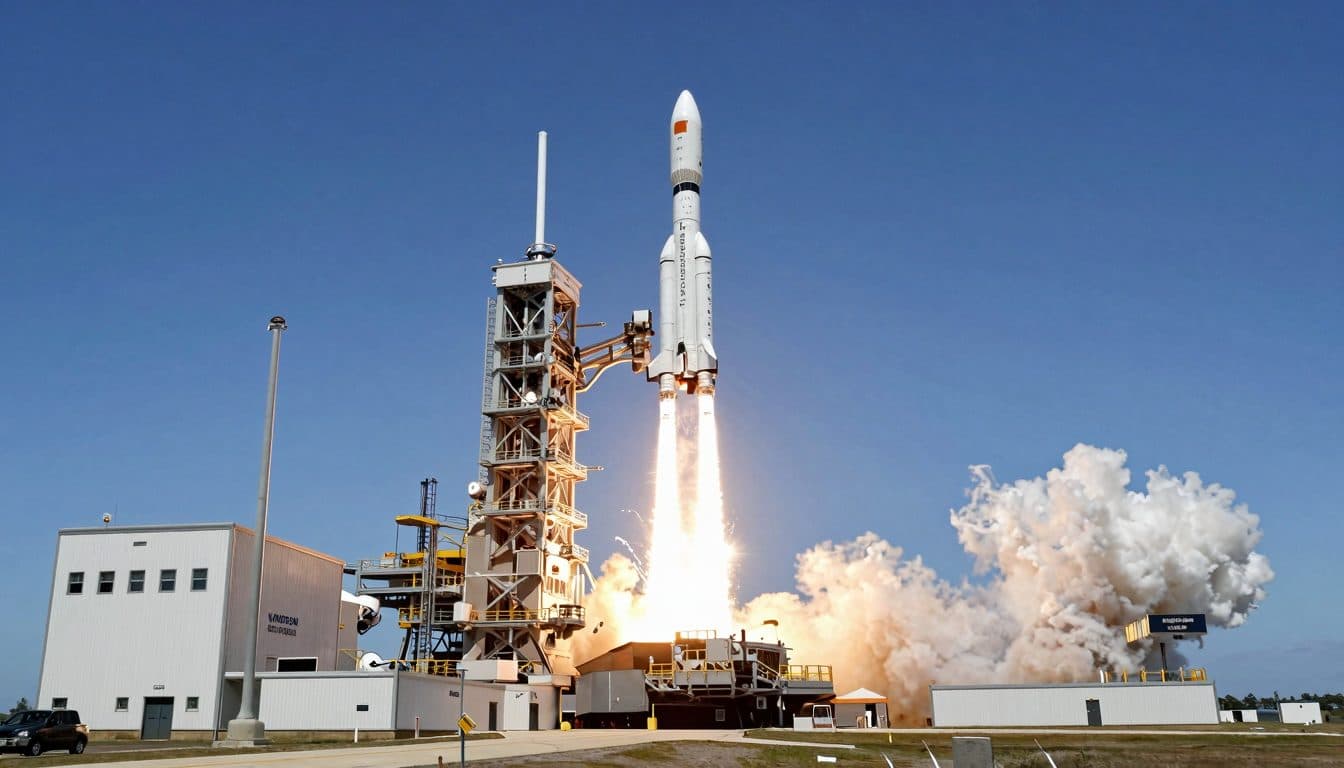
Austria's first commercial satellite "Oasis Alpha" successfully reaches orbit
Vienna, July 8, 2026
AI-generated image (z-image via Kie.ai)
Summary
The Austrian satellite "Oasis Alpha" built by the Vienna-based start-up Tumbleweed launched aboard a SpaceX rocket from Vandenberg Space Force Base into a low Earth orbit. On board are four European institutions conducting experiments in space for the first time.
Vienna, July 8, 2026
Austria's first commercial satellite, "Oasis Alpha," built by the Vienna-based start-up Tumbleweed, was launched on Tuesday aboard a SpaceX Falcon 9 rocket from Vandenberg Space Force Base into a sun-synchronous Earth orbit at an altitude of approximately 590 kilometers.
The launch took place at 09:12 local time as part of the SpaceX Transporter-17 mission. Roughly one hour after liftoff, the Tumbleweed team confirmed the successful separation of the hardware from the launch vehicle. According to the company, reaching orbit and operating in space was the decisive mission success. The satellite was deployed using the EXOpod Nova deployment system from the Berlin-based provider Exolaunch.
"Oasis Alpha" was designed as a technology demonstrator and built in nine months. The satellite was launched into space alongside dozens of other satellites as part of a so-called "rideshare mission." It carries the Austrian flag.
Technology demonstrator from Vienna
On board are standardized containers – so-called "pods" – carrying payloads from four European institutions for experiments in microgravity. Inside the containers are payloads from institutions that are each flying in space for the first time. Pre-certified "pods" are used for this purpose, which customers fill with their own experiments.
The experiments include biocatalysis trials by the pharmaceutical start-up Mass Balance involving whole cells in space, a test of autonomous intelligent systems conducted by Delft University of Technology, and investigations by the European Space Resources Innovation Centre (ESRIC) into phase transitions relevant to future technologies for extracting raw materials in space. The Spring Institute for Forests on the Moon is sending a message of hope through space and time.
Four European first flights on board
With the satellite, Tumbleweed aims to pave the way for "Oasis Beta," a next-generation platform currently under development with return capability to Earth. Oasis Beta, the next generation of pods, is already in development and is intended to be able to return experiments to Earth. The goal is to make research in microgravity not only feasible in the future, but also analyzable in the laboratory.
Tumbleweed was founded in 2024. When Tumbleweed was founded in 2024, everyone said that the path to space was unattainable because everything was too slow, too complex, and too burdensome. According to the company, the start-up now employs 20 experts in Vienna and Delft.
Mission and business model of Tumbleweed
Tumbleweed's goal is to enable institutions and companies to conduct research in microgravity quickly and with minimal red tape, without requiring expertise in aerospace engineering or regulatory compliance. The standardized, pre-certified containers are intended to significantly reduce the bureaucratic burden for research institutions and companies.
CTO and co-founder Guillaume Brault stated: "Als wir Tumbleweed gegründet haben, haben wir immer wieder dasselbe gehört: Der Weg in den Weltraum ist einfach nicht machbar. Zu langsam, zu komplex, zu viel Aufwand. Wir haben Oasis Alpha gebaut, um das zu ändern. Heute sind vier dieser Teams zum ersten Mal im All." Brault is CTO and co-founder of Tumbleweed.
CEO and co-founder Julian Rothenbuchner called the launch a milestone: "Der Start ist ein Riesenerfolg für uns und für das Space-Ökosystem in Österreich generell. Er zeigt ganz klar, dass, wenn eine Gruppe mit Passion und Drive zusammenkommt und richtig hart arbeitet, sie Satelliten in wenigen Monaten bauen kann. Gleichzeitig ist die Mission natürlich auch ein großer Meilenstein für unsere Kunden."
Reactions from politics and industry
The satellite "Oasis Alpha" was launched aboard a SpaceX Falcon 9 rocket from Vandenberg Space Force Base (USA) into a low Earth orbit. Vandenberg Space Force Base is located on the California coast and is regularly used for rideshare missions, in which numerous satellites from different operators launch together.
In recent years, several satellites from domestic universities and institutions have already been launched for research purposes. With "Oasis Alpha," however, the project stands out due to its commercial character and the systematic use of standardized experimental platforms.
The Austrian government sees the project as confirmation of the country's status as an innovation hub. Austria is investing 340 million euros in SpaceTech, and its contribution to the European Space Agency ESA is increasing by 30 percent. Innovation Minister Peter Hanke, who congratulated the team on the pioneering achievement, stated: "Erfolgreiche Raumfahrt entsteht dort, wo unternehmerischer Mut, exzellente Forschung und ein starkes Innovationsökosystem zusammenkommen. Mit Oasis Alpha beweist Tumbleweed, dass Österreich ein attraktiver Standort für zukunftsweisende Raumfahrttechnologien und eine neue Generation von Raumfahrtunternehmen ist. Solche Projekte stärken unseren Innovationsstandort, schaffen Wertschöpfung und öffnen österreichischen Technologieunternehmen den Weg auf internationale Märkte. Ich gratuliere dem gesamten Team zu dieser Pionierleistung. Sie zeigt, dass österreichischer Erfindergeist auch im Weltraum seinen Platz hat."
Outlook: Further missions in planning
Peter Hanke is Austria's Innovation Minister. His ministry has been supporting the development of Austria's space sector for years through targeted funding programs and participation in European initiatives.
The mission is part of a broader trend: an increasing number of European start-ups are using standardized platforms to facilitate entry into space research. With the successful launch of "Oasis Alpha," Austria is positioning itself in a growing commercial space market that has so far been dominated primarily by US companies.
From a European perspective, the participation of four institutions from several countries is remarkable. The mission exemplifies the internationalization of the domestic space industry and could pave the way for further commercial Austrian satellite projects.
According to Tumbleweed, the complete analysis of the scientific data will take several weeks. Initial results from the microgravity experiments are expected in the fall. If the mission is successful, Tumbleweed plans the next step with "Oasis Beta" – a platform that can return experiments to Earth, thereby completing the research cycle in space.
Questions & Answers
What is "Oasis Alpha"?
"Oasis Alpha" is Austria's first commercial satellite, operated by the Vienna-based start-up Tumbleweed. It was designed as a technology demonstrator and built in nine months, and launched aboard a SpaceX Falcon 9 rocket from Vandenberg Space Force Base into a low Earth orbit.
Which experiments are on board?
On board are four European institutions with microgravity experiments, including biocatalysis trials by the start-up Mass Balance involving whole cells, a test of autonomous intelligent systems by Delft University of Technology, and phase transition investigations by ESRIC. All four institutions are flying in space for the first time.
What comes after "Oasis Alpha"?
Tumbleweed is already developing "Oasis Beta," a next-generation platform with return capability to Earth, which is intended to bring experiments back to Earth for analysis. This is meant to make research in microgravity faster and less bureaucratically burdensome in the future.
Oasis Alpha: Austria's first commercial satellite in space | allfacts360