Austria sends draft for social media minimum age of 14 into consultation
Vienna, 28 July 2026
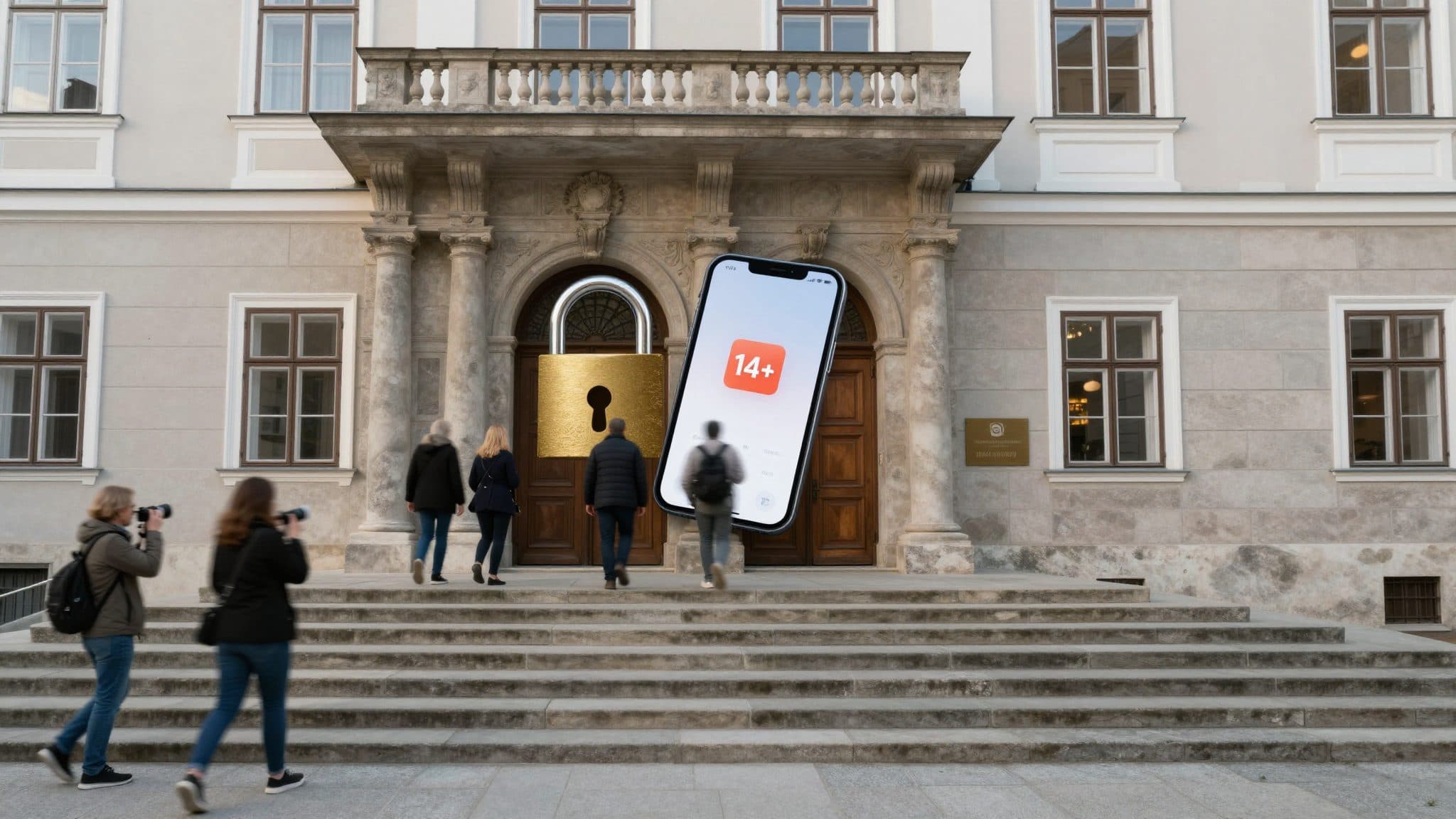
AI-generated image (z-image via Kie.ai)
Summary
The Austrian federal government sent a draft law into consultation on Monday following the summer cabinet meeting in Salzburg, aiming to restrict access to social networks and video platforms for under-14s via age verification. The platforms likely to be affected include TikTok, Instagram, YouTube, and Snapchat; upon entry into force at the earliest in January 2027, very large platforms face fines of up to six percent of their global annual revenue.
Vienna, 28 July 2026
The Austrian federal government sent a draft law into consultation and to the EU Commission for notification on Monday following the summer cabinet meeting in Salzburg. The draft would require mandatory age verification for access to social networks and video platforms for under-14s.
What the government decided in Salzburg
The project is part of an amendment to the Audiovisual Media Services Act (AMD-G). As stated from the press foyer after the cabinet meeting, the aim is to better protect children and adolescents from addiction mechanisms and problematic content on the internet. Federal Chancellor Christian Stocker (ÖVP) said there are "erstmals klare Regeln für den Zugang zu bestimmten Social-Media-Plattformen für Unter-14-Jährige"; Vice Chancellor and Media Minister Andreas Babler (SPÖ) spoke of "ein sehr guter Tag aus Sicht der Kinder". Both emphasized that responsibility for complying with the new rules should not lie with children or parents, but with the platform operators.
Specifically, persons under 14 years of age – defined in the draft as "minors" ("Unmündige") – should no longer be allowed to use the affected services. Anyone wishing to open an account on an affected platform in the future must prove that they are at least 14 years old. Age verification is to take place once upon registration; the exact procedure, however, is not prescribed by law. According to the draft, possible methods include the use of the electronic ID Austria, but certified third-party providers can also be used.
Which functions are considered to promote addiction
From the current perspective, it is clear that TikTok, Instagram, Snapchat, and YouTube are to fall under the ban. However, the law does not provide a "taxative enumeration" of all covered services. Instead, the draft defines functions considered addictive or potentially harmful that trigger the scope of application. These include recommendation algorithms where more than one third of the suggested or displayed content does not come from the user's self-selected contacts, infinite scrolling, automatic playback of videos, push notifications outside individual communication or subscribed content, reward systems such as likes, as well as unwanted direct contacts between unknown users. Incentives to increase interaction with the platform or with other users' content also fall under this.
According to the draft, pure messenger services such as WhatsApp are exempt from the scope; they should continue to be usable. Likewise exempt, according to the available facts, are pure online storage services whose content the provider does not mark or arrange. Content that originates as "programmes" from media services is also captured, insofar as it concerns episodes of moving images with or without sound.
After entry into force, the platforms receive an additional transition period of three months to technically implement the new rules. This means: even if the law enters into force on 1 January 2027, full implementation is to be expected no earlier than April 2027. In the meantime, providers are required, according to the government, to ensure that age verification via a third-party provider is carried out in such a way that neither the verifier can determine where or when the proof is used, nor does the target platform receive more than the necessary yes/no information. The draft provides for a so-called double-blind model, which, according to State Secretary for Digitalization Alexander Pröll (ÖVP), is to be implemented via zero-knowledge proof procedures.
Fines reaching into the billions
The law leaves it to the responsible regulatory authority to determine which content or behaviors are to be considered "impairing" in concrete terms. According to the draft, impairment can be physical, mental, or moral; the standard applies "sofern der Schutz Unmündiger vor beeinträchtigenden Inhalten oder Verhaltensweisen nicht gewährleistet ist". The economic character is also decisive for whether a service falls under the regulation at all: the service must be provided "in der Regel gegen Entgelt", which expressly includes advertising-financed services.
In case of violations, operators of covered platforms face administrative fines of up to 150,000 euros. Significantly harsher sanctions apply to providers classified by the EU Commission as a "very large online platform": they face fines of up to six percent of their global annual revenue. For groups such as Google or Meta, such fines could reach into the billions, according to calculations from the available sources. The platforms are also to support open standards for age verification, and the age verifier must not maintain a central usage log.
Reactions from politics and civil society
Backgrounds for the initiative, according to the federal government's presentation, include data on minors' usage. For example, studies cited in the consultation draft show that "Jedes vierte Kind zeigt demnach suchtähnliche Symptome" and "fast die Hälfte der 13- bis 17-Jährigen nutzen ihr Gerät nahezu ununterbrochen". Pröll said the platforms had had enough time to "selbst Verantwortung zu übernehmen". Since that had not happened, the government would now intervene legislatively.
The coalition parties evaluate the draft predominantly positively, although the emphasis differs. While the ÖVP places greater emphasis on the protective mandate, the SPÖ highlights the educational and family-policy dimension. The opposition Greens fundamentally support the project, but criticize "ein rechtlich schwammiges Gesetz: viel Datenschutz-Marketing, wenig konkrete Lösungen". The FPÖ rejects the amendment and sees "Zensur unter dem Deckmantel des Jugendschutzes". FPÖ General Secretary Christian Hafenecker spoke of a "hinterlistigen Frontalangriff auf die Meinungs- und Informationsfreiheit junger Menschen" and described child and youth protection as "Feigenblatt für einen massiven Zensurangriff und den weiteren Ausbau staatlicher Kontrolle".
Outside politics, the draft meets with some approval and some skepticism. The Federal Youth Representation welcomes the project, provided that the time gained is used to better prepare young people for dealing with social media. Its chair, Moritz Mittermann, said: "Diesen Funktionen einen Riegel vorzuschieben, ist deshalb ein wichtiger Schritt zum Schutz junger Menschen und ihrer psychischen Gesundheit." Rainer Will, Managing Director of the Trade Association, stated: "Wer Milliarden mit der Aufmerksamkeit junger Menschen verdient, muss auch Verantwortung für deren Schutz übernehmen." Domestic children's rooms should not be a lawless space for global platform corporations, Will said.
Looking at Australia and the EU
The topic is not new internationally either: Australia is considered a pioneer in social media restrictions for minors and lists ten affected providers – including Facebook, Instagram, Reddit, Snapchat, Threads, TikTok, Twitch, YouTube, X, and the Australian platform Kick. However, Australian children continue to use the banned platforms, according to one of the available sources, which is cited as a reason for the particularly strict age verification planned in Austria. In contrast to Australia, in Austria it is not the platforms themselves that should carry out age verification, but certified third-party providers – this was important to the SPÖ and NEOS from the start in order to avoid the so-called Australian model.
In parallel to the national regulation, the Austrian federal government continues to support the planned EU-wide initiative to introduce a minimum age for social media use. However, since a Europe-wide solution is taking time, Austria wants to take the lead and introduce the age limit at the national level, according to the cabinet. Babler explained: "Es gehe darum, das, was wir unseren Kindern nicht in der realen Welt zumuten lassen wollen, dass wir das auch im digitalen Raum nicht zulassen." Curricula are also to respond: as part of a curriculum reform, a new compulsory subject "Media and Democracy" will be introduced in upper secondary schools; at the same time, Latin classes and instruction in a second modern foreign language will each be reduced by two weekly hours to accommodate the new content. School material is also to include the topic of artificial intelligence in the future.
Next steps until the planned entry into force
The consultation period for the draft runs until 21 September. According to the available information, comments must be sent by email both to medienrecht@bmwkms.gv.at and to Post.VII-2@bka.gv.at; submitting to only one address is not sufficient. In parallel, the notification procedure begins at EU level, in which the European Commission examines whether the draft is compatible with EU law.
Babler is optimistic that the law can enter into force on 1 January 2027 if the notification procedure proceeds smoothly. Pröll sees Austria with the draft as "eines der ersten Länder in Europa, das Kindern unter 14 Jahren klaren gesetzlichen Schutz vor den Gefahren sozialer Medien geben wird". What is clear, however, is that until then the draft remains a draft – the final political and parliamentary decision has yet to be made.
It also remains open which concrete content the regulatory authority will ultimately classify as impairing, and how the obligation for age verification will play out in practice, especially when young people try to circumvent the restrictions. The question of the extent to which third-party providers for age verification will actually be available across the board, and whether the zero-knowledge proof procedures can deliver on the promised data protection assurances, also cannot be conclusively answered
Social media ban from age 14: Austria's 2027 draft law | allfacts360