Austrian cabinet adopts military service reform in Salzburg, leaving civilian service deal open
7/26/2026
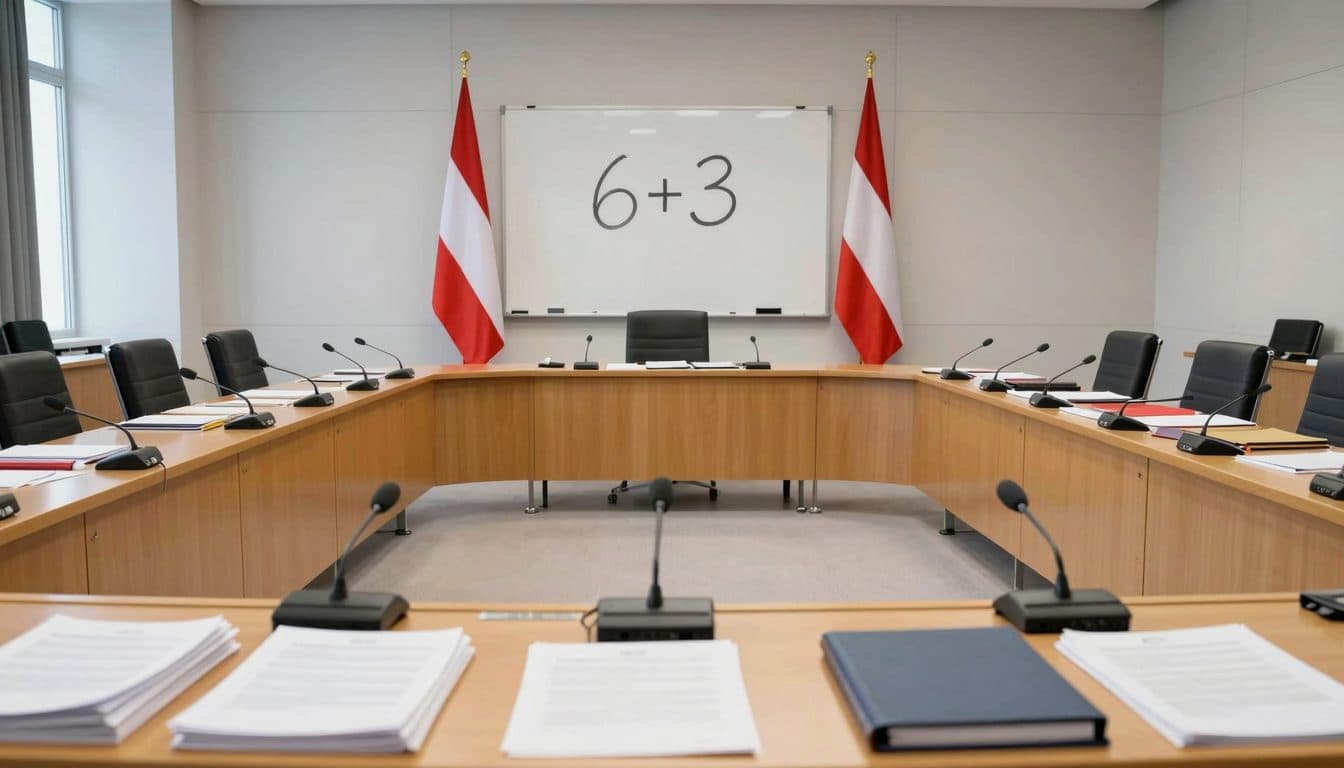
AI-generated image (z-image via Kie.ai)
Summary
Austria's three-party coalition adopted a military service reform at a summer cabinet meeting in Salzburg on Monday, extending the current six-month service by roughly three months of compulsory exercises. No agreement was reached on civilian service, leaving the compromise package only half-finished as the government prepared to present its results publicly.
Austria's federal government adopted a package reforming compulsory military service at a summer cabinet meeting held at the Schwarzenberg Kaserne in Wals near Salzburg on Monday afternoon, while negotiations on a parallel reform of civilian service remained unresolved as ministers prepared to face the press.
A reform shaped by a changed security landscape
The cabinet meeting, chaired in Salzburg by Christian Stocker, focused on three priorities: strengthening national defence, restructuring the Wehrdienst, and reshaping the civilian Zivildienst. While ministers were able to agree on extending compulsory military service, an agreement on the parallel reform of the alternative civilian service had not been finalised by the morning of the cabinet day, according to multiple reports. The decision to push ahead with only half a package reflected weeks of difficult negotiations between the governing ÖVP, SPÖ and NEOS, with one participant describing the talks to the KURIER as "eine Mischung aus Poker und Mikado".
The 'Stufenmodell' at the core
Under the reform adopted on Monday, the existing six months of basic military service will be retained, but new compulsory exercises will be added. The core package foresees a blocked troop exercise directly after the basic service and follow-up militia exercises to be completed within ten years, extending total military service by roughly three months. The government framed the changes as a response to a fundamentally altered security environment, citing Russia's war of aggression against Ukraine and pointing to a rise in hybrid attacks, cyber threats, attacks on critical infrastructure and challenges in crisis and disaster preparedness. In its statement, the government said "diese Entwicklungen zeigen deutlich, dass Österreich seine Fähigkeiten zur Eigenvorsorge und zum Schutz der Bevölkerung wieder stärker selbst in die Hand nehmen muss".
The adopted model closely tracks the so-called "Stufenmodell" proposed by experts of the Wehrdienstkommission, the independent commission that delivered its final report earlier in the year. In its original form, that staged model envisioned a blocked two-month troop exercise within 18 months of finishing basic service, followed by militia exercises totalling 40 days. The commission had recommended an "Austria plus" scheme of eight months of basic service plus two months of exercises, but described the staged variant as quicker to implement, though more expensive than that recommendation.
What the package contains
Financial terms for those called up were also upgraded. Monthly remuneration during basic military service will rise to 1,000 euros, and basic servicemembers will for the first time receive vacation days. The reform will also create a new automatic trigger: if the annual intake of basic servicemembers falls below the target of 15,000 by more than 7.5 percent, civilian service will be permanently extended by two months under a so-called "9+2" arrangement from the following year. Compulsory troop exercises will be completed shortly after the basic service, with the residual militia exercises to be performed within ten years, and in the first six months after entry into force a scientifically accompanied evaluation will examine why young Austrians choose military or civilian service.
On civilian service, the coalition remained split. The SPÖ had pushed for a "6 plus 2" compromise for military service and a "9 plus 2" extension for civilian service, combining the existing nine-month civilian term with two months of compulsory exercises. The ÖVP, by contrast, was concerned that any civilian service shorter than the new military obligation risked becoming more attractive than military service itself, and reportedly insisted on extending the civilian alternative to twelve months so the two tracks did not diverge in attractiveness. NEOS, the smallest governing partner and the party furthest from a conscription model in its starting position, had advocated a volunteer-only system and, according to multiple reports, opposed any extension of civilian service. Vice Chancellor Andreas Babler of the SPÖ told Ö1's Morgenjournal that he was confident a solution was possible, but said he did not want to anticipate the cabinet decision.
The civilian service sticking point
Stocker had set the broad shape of the eventual compromise two weeks earlier, putting a "6 plus 3" model on the table for military service. By Monday morning, indications had hardened that the three parties would settle on "6 plus 3" for the Wehrdienst — six months of basic service plus roughly three additional months of compulsory troop and militia exercises, equivalent to about 100 days — paired with a separate arrangement for Zivildienst. Sources told Austrian media that the agreed shape of the military deal broadly tracked the commission's staged model, while the civilian service file was left open, partly because NEOS had not yet given its green light to the package. Stocker had warned in an interview with DER STANDARD that "wenn wir uns nicht einigen, braucht es eine Volksbefragung", underscoring the pressure to deliver before that option had to be triggered.
A senior ÖVP figure, government coordinator Alexander Pröll, told DER STANDARD the week before: "Wir werden nächste Woche ein Ergebnis liefern müssen", making clear that a public outcome was unavoidable. Oberösterreich's Landeshauptmann Thomas Stelzer was even blunter, calling the debate "kein Ruhmesblatt" and urging the government to "schleunigst" reach a position, warning it could not push the topic off to "Sankt-Nimmerleinstag". In NEOS circles, fears that NEOS might eventually cave in were dismissed as a "Bauchgefühl", not a grounded assessment.
Pressure from inside and outside the coalition
Should the NEOS refuse to back a civilian service extension, alternative variants could return to the table, including the eight-month "Austria plus" model preferred by the commission and the ÖVP, a four-month Swiss-style alternative of basic service followed by 140 days of militia exercises, or an extension of the standoff until negotiations resume. NEOS, having campaigned for a volunteer army, was the party structurally least able to sign off on a longer conscription. This made the question of whether to extend Zivildienst the remaining knot to be untied, and one insider described the dynamic to the KURIER with the words: "Wer sich zuerst bewegt, hat Sorge zu verlieren".
If no agreement on civilian service is reached by the time the law is finalised, the government could present only the military service reform, leaving Zivildienst to a later legislative round. That scenario, which had circulated in the chancellery as a thought experiment in the days before the meeting, would put at risk the original timetable of an entry into force on January 1, 2027 for the combined model. From January 1, 2027, the package as adopted does permit a voluntary extension of civilian service by two months; the additional two months would in principle be performed at the institution where the civilian service is carried out and could be completed flexibly in time, according to the draft.
A two-thirds vote and a parallel social media draft
The reform will require a two-thirds majority in parliament because it touches constitutional provisions on military service. The coalition therefore intends to approach the opposition to assemble the necessary votes. The cabinet also separately sent into review a long-debated draft law that would, for the first time, set clear rules for access to certain social media platforms for under-14-year-olds, banning platforms with addictive features — including TikTok, Instagram, Facebook and YouTube — for that age group. That draft had been politically ready for roughly a week, but NEOS had reportedly withheld its final green light, contributing to the impression on Monday that the coalition risked facing the press conference with only partly filled hands.
The press conference following the summer cabinet meeting was scheduled to begin at 4:00 PM and was broadcast by livestream from the Schwarzenberg Kaserne in Wals-Siezenheim, Austria's largest barracks. Vice Chancellor Babler and Peter Hanke, alongside Stocker, were expected to present the adopted reform. The financial, evaluative and operational details of the reform — monthly remuneration of 1,000 euros, vacation days for basic servicemembers, and the automatic military service guarantee tied to a 7.5 percent shortfall against 15,000 basic servicemembers — were designed to make military service more attractive at a time when Austria is seeking to reverse a multi-year decline in the number of young men called up. The longer term goal, officials said, is to ensure that Austria can once again take greater responsibility for its own preparedness and the protection of its population.
Whether the start date of January 2027 can hold now depends on the political energy left to close the civilian service file. If the coalition succeeds in folding NEOS into a "9 plus 2" civilian compromise, or if it settles for a voluntary extension only, the timetable can be preserved. If NEOS digs in, the cabinet risks shipping a half-reformed Wehrdienst with the Zivildienst question postponed, and the original 2027 entry into force becomes more than doubtful, as one senior official put it ahead of the meeting. In either scenario, the structural choice made on Monday — extending military service by roughly three months, increasing pay, and embedding a guaranteed trigger tied to the number of basic servicemembers — will define Austrian defence policy for the rest of the decade.
Questions & Answers
What is the '6 plus 3' model for Austrian military service?
Under the reform adopted on Monday, the existing six months of basic military service would be retained and supplemented by roughly three months of compulsory troop and militia exercises — equivalent to about 100 days — to be completed within ten years.
Why did the coalition struggle to agree on civilian service?
The SPÖ pushed a '9 plus 2' extension of civilian service, the ÖVP wanted a twelve-month civilian term to keep it from becoming more attractive than military service, and NEOS reportedly opposed any extension at all, leaving the civilian file open as of Monday morning.
Why does Austria's military service reform cite Russia's war on Ukraine?
The government statement cited a fundamentally changed security environment, including the Russian war, hybrid attacks, cyber threats, attacks on critical infrastructure and challenges in crisis and disaster preparedness, as reasons why Austria must once again take greater responsibility for its own preparedness.
Austria military service reform 2026: 6+3 model adopted | allfacts360