Bangladesh measles outbreak 2026: 500+ children dead | allfacts360
Bangladesh Measles Outbreak Kills Over 500 Children as Hospitals Buckle
Dhaka, May 26 2026
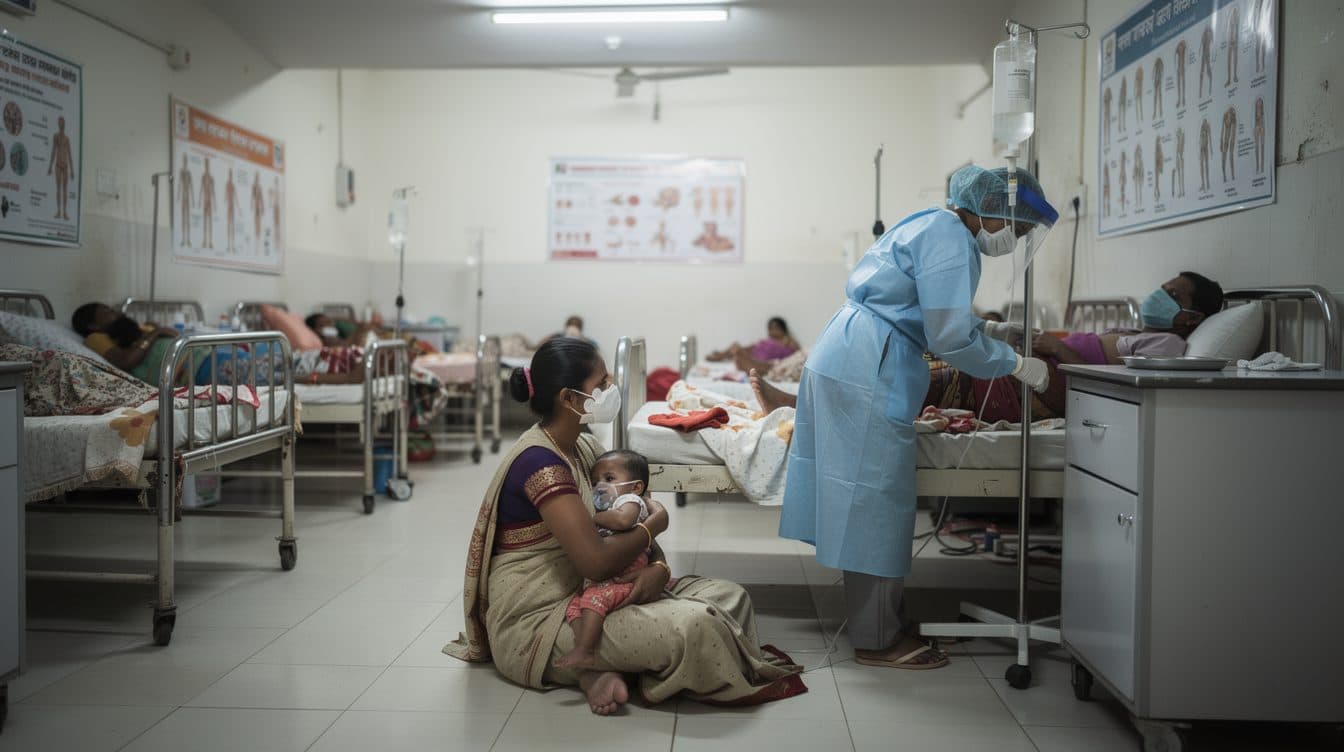
AI-generated image (flux-2/pro-text-to-image via Kie.ai)
Summary
A massive measles outbreak in Bangladesh has claimed the lives of more than 500 children since mid-March, with over 60,000 suspected cases recorded. Health facilities are overwhelmed as malnutrition makes young patients especially vulnerable.
Dhaka, May 26 2026
A devastating measles outbreak in Bangladesh has killed more than 500 children since mid-March, with health authorities confirming over 60,000 suspected cases as hospitals struggle to cope with a surge of critically ill young patients.
Miftahul Zannat, a 2-year-old from a village in Bangladesh, developed a fever, rash, vomiting and diarrhea—the classic signs of measles. “Once she fell ill, she became completely bedridden. She couldn’t even open her eyes,” her father Mohammad Kamal told reporters. The toddler’s condition spiraled until her family eventually found a hospital bed on the third attempt in the capital, Dhaka.
Miftahul’s story is one of tens of thousands. Since the virus took off in mid-March, the country has tallied more than 60,000 suspected cases and 528 suspected measles-related deaths, according to health data. The vast majority of the sick and dead are children under the age of five.
Health experts describe an outbreak that has been largely invisible to the outside world. “We’ve been crying out loud about this from the beginning, but it has been a silent situation,” said Hasina Rahman, deputy regional director for Asia at the International Rescue Committee. “There hasn’t been much attention around it.”
A Silent Emergency
The scale of the crisis has placed enormous strain on Bangladesh’s healthcare system. At the Infectious Diseases Hospital in Dhaka, Superintendent Dr. Asma Khan said, “My hospital has only 100 beds, and almost every day we are getting more than 100 patients.” Families are often turned away or forced to wait on hospital floors. “Parents are sitting outside the [child hospital] wards just helpless, not knowing what to do,” Rahman added, calling the situation “heartbreaking.”
Mim Akhter’s 9-month-old son Rizvi Ahmed Raihan developed a measles infection that left her frightened. “To get the treatment, we have to lie down here on the floor,” she said in Bengali. The baby received supplemental oxygen, fluids, and rehydration but no specific antiviral treatment, as none exists for measles. After five days his condition improved and he was released, but the experience underscored the dire conditions caregivers face.
The outbreak’s lethality is being fueled by widespread malnutrition. In Bangladesh, one in four children under five are stunted due to undernutrition, and one in ten suffer from acute malnutrition, making them far more susceptible to severe measles. The death rate in Bangladesh is around 1 percent, compared with between 0.1 and 0.3 percent in the United States.
Malnutrition Magnifies the Danger
Without sufficient reserves, children’s immune systems are quickly overrun. The virus itself weakens immunity further, opening the door to secondary infections that demand complex medical care. “It’s not surprising at all that their hospitals are overwhelmed,” said a physician who has been monitoring the crisis.
Health officials point to a disruption in the country’s vaccine supply as a key trigger. After a temporary government that ruled for 18 months decided to revamp the vaccination system, deliveries faltered. Rana Flowers, the UNICEF representative to Bangladesh, said at a press conference on May 20 that she had repeatedly warned the administration. “I sat with the interim adviser and the staff on at least 10 occasions saying, ‘We are worried. You’re going to face a mountain,’” Flowers recounted.
Reaz Mobarok, head of the High Dependency and Isolation Unit at Bangladesh Shishu Hospital and Institute, the country’s largest children’s hospital, was blunt: “The interim government did not bother about vaccination at all, so many children were not vaccinated for measles.” Those warnings proved prescient as cases exploded across 58 of 64 districts.
Vaccination Gap Blamed for Crisis
On May 4 alone, 17 children died. Most days since have brought more than 1,000 new suspected cases, with some days topping 1,500. As of May 24, the death toll stood at 528.
The new Bangladeshi government, elected in February, launched an enormous measles vaccination campaign on April 5. Officials say they have already reached approximately 18 million children. “All hospitals have been instructed to open isolation units for the measles patients, and Vitamin A capsules are being administered to affected children,” a health ministry spokesman said. Vitamin A therapy can significantly reduce the risk of death from measles, a critical intervention in a country where deficiency is common.
Now the government is racing to track down any children missed in the mass campaign, aiming “to ensure no child is left behind,” the spokesman added. The effort has drawn praise from UNICEF’s Flowers, who told reporters, “For that, I am very grateful.”
Government Responds with Mass Campaign
Yet the impact of the vaccination drive will take time to materialize. “It may take a month or more before you start really seeing an impact,” Mobarok said. In the meantime, families continue to bear the emotional and financial toll. Mohammad Kamal Hossain, a rickshaw driver from Bhola, earns about $4 a day. He has spent the past 20 days caring for his 9-month-old daughter Saifa and has already shelled out $160 getting to Dhaka and paying hospital costs, including food. “My elder kid is studying in ninth grade and now I don’t know how I will pay her tuition fees this month because I am already in debt,” he said.
Stories like Hossain’s are common. Parents have been forced to leave jobs, drain savings, and even sit outside hospital wards hoping for care. The IRC’s Rahman said the strain has been worsened by cuts in foreign aid that hit global health programs over the past year.
Despite the size of the outbreak, international attention has been scarce. “We are not getting much help,” said Mobarok. In 2019, Bangladesh was celebrated for its vaccination achievements when then-Prime Minister Sheikh Hasina received a Vaccine Hero Award from Gavi. Now, the country faces a crisis that illustrates how quickly gains can be reversed.
Families Struggle on Every Front
Medical teams are doing what they can with limited resources. At the Bangladesh Shishu Hospital, staff have converted offices into makeshift treatment areas. “We said to the doctors: ‘You will sit in other places if you need to sit and discuss something,’ ” Mobarok explained. The scramble to accommodate patients has become a daily reality.
As the mass vaccination campaign takes hold and Vitamin A capsules reach affected children, there are glimmers of hope that the outbreak might soon slow. But for families like Miftahul’s, the damage is already done. “My child was cheerful, loved to play, run, and smile,” said Kamal. “After getting infected with measles, she became silent, not eating food, and had no smile on her face.”
The world’s near-silence on Bangladesh’s measles catastrophe is a stark reminder, health advocates say, of how easily preventable diseases can explode when basic vaccination coverage falters—and how the youngest and poorest bear the heaviest price.