
Bunia, 25 May 2026
The Democratic Republic of Congo's Ebola outbreak has surged to over 900 suspected cases and 204 deaths as of Sunday, the government announced, amid growing international concern and a warning from the WHO that the epidemic is still one step ahead of responders.
On Sunday evening, the Congolese government announced that the total number of suspected cases had climbed to more than 900. Of those, 91 infections have been laboratory-confirmed, and 204 patients have died since the outbreak began. The death toll rose by roughly 30 in a single day, alongside more than 100 additional suspected infections.
The outbreak, which was first detected in mid-May in the eastern province of Ituri near the Ugandan border, has now crossed into neighboring Uganda. Uganda’s health ministry confirmed two additional Ebola cases on Monday, bringing the country’s total to seven confirmed cases linked to the Congolese outbreak. The two new cases are employees of a private clinic in Kampala, where a woman from the DRC had sought treatment for abdominal complaints before traveling back.
Spillover into Uganda
Uganda does not publish figures on suspected Ebola cases, making it difficult to assess the full scope of transmission there. Health ministers from the affected region convened in Kampala over the weekend to coordinate a joint response, underscoring the urgency of stopping cross-border spread.
WHO Chief Warns Outbreak Will Worsen
WHO Director-General Tedros Adhanom Ghebreyesus described the situation as 'an extremely serious and difficult outbreak.' 'Wir stehen vor einem äußerst ernsten und schwierigen Ausbruch. Es wird erst noch schlimmer werden, bevor es besser wird,' he said. He added: 'Doch derzeit ist die Epidemie uns noch einen Schritt voraus.' Tedros announced he will travel to the Democratic Republic of Congo on Tuesday.
Humanitarian and Security Hurdles
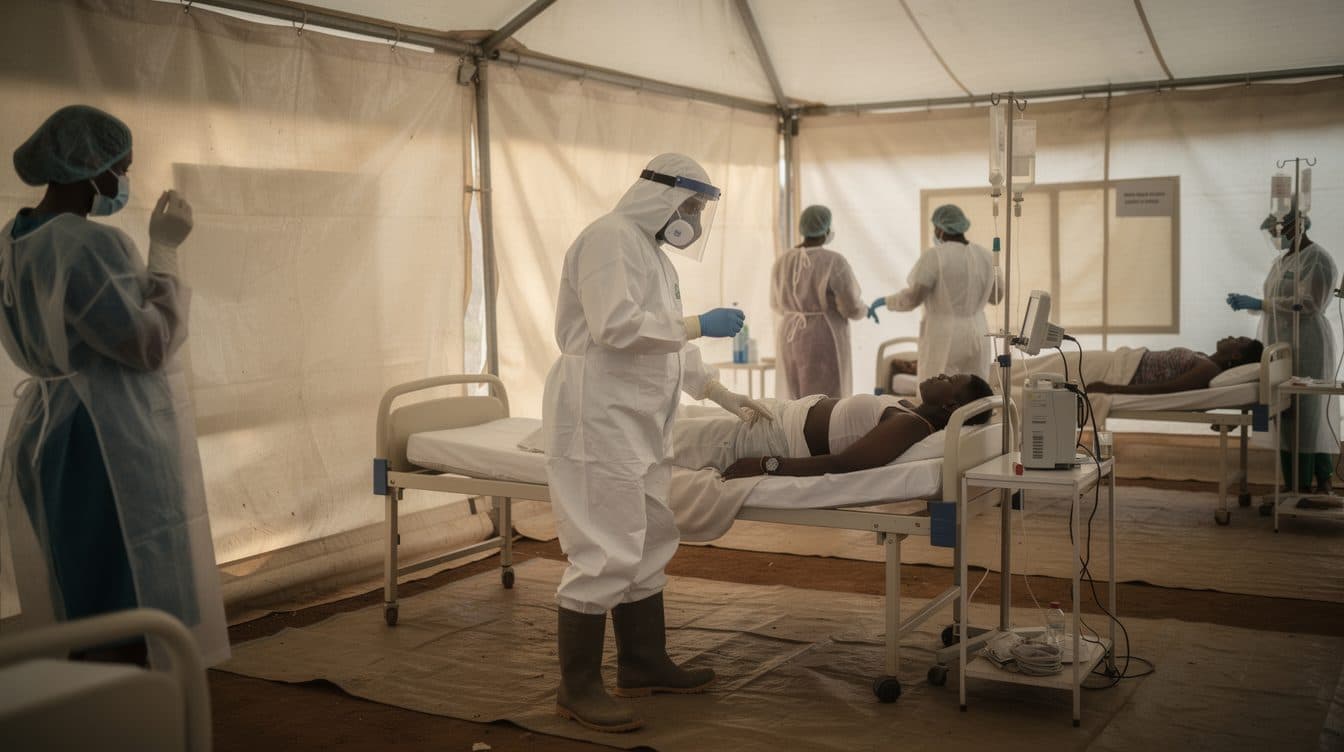
The eastern DRC is ravaged by armed conflicts and hosts several million internally displaced persons, whose constant movement complicates containment efforts. In this environment, medical teams face extreme conditions: healthcare workers wearing full protective suits in the tropical heat can typically work only for one hour at a time to avoid circulation problems.
The outbreak was able to spread undetected for weeks because the laboratory in Bunia, close to Uganda, initially failed to identify the rare Bundibugyo virus strain. It was only after samples were sent to Kinshasa that the strain was correctly diagnosed, and the first Ebola cases were laboratory-confirmed in mid-May. Shortly afterward, the WHO declared a public health emergency of international concern.
No Vaccine for Bundibugyo Strain
Unlike the more common Zaire ebola strain, for which a vaccine exists, the Bundibugyo virus currently has no approved vaccine or specific therapy. This lack of pharmaceutical tools adds to the challenge, especially as the WHO assesses the risk of infection in Congo as very high.
The WHO’s global risk assessment remains low, however, because Ebola spreads through close contact with bodily fluids of an infected person — not through airborne routes like the coronavirus. Deceased Ebola patients are highly infectious and must be buried under strict safety conditions, which has led to tensions: in recent days, treatment tents in Ebola centers have been set on fire multiple times by relatives demanding the release of bodies.
An American Ebola patient who contracted the virus in Congo is now being treated at the Charité hospital in Berlin, Germany. The hospital described the patient’s condition as very weakened but currently not critical. This case highlights the possibility of international exportation, although containment measures in well-resourced health systems are robust.
The WHO continues to coordinate with local authorities, but the outbreak’s trajectory remains uncertain. Tedros’s message was stark: 'It will get worse before it gets better.' As the region’s health ministers and international partners ramp up their efforts, the immediate priority is to improve detection, isolation, and safe burial practices to break the chain of transmission.