Bayeux Tapestry arrives in London: Millennia-old masterpiece back in England for the first time
London, July 10, 2026
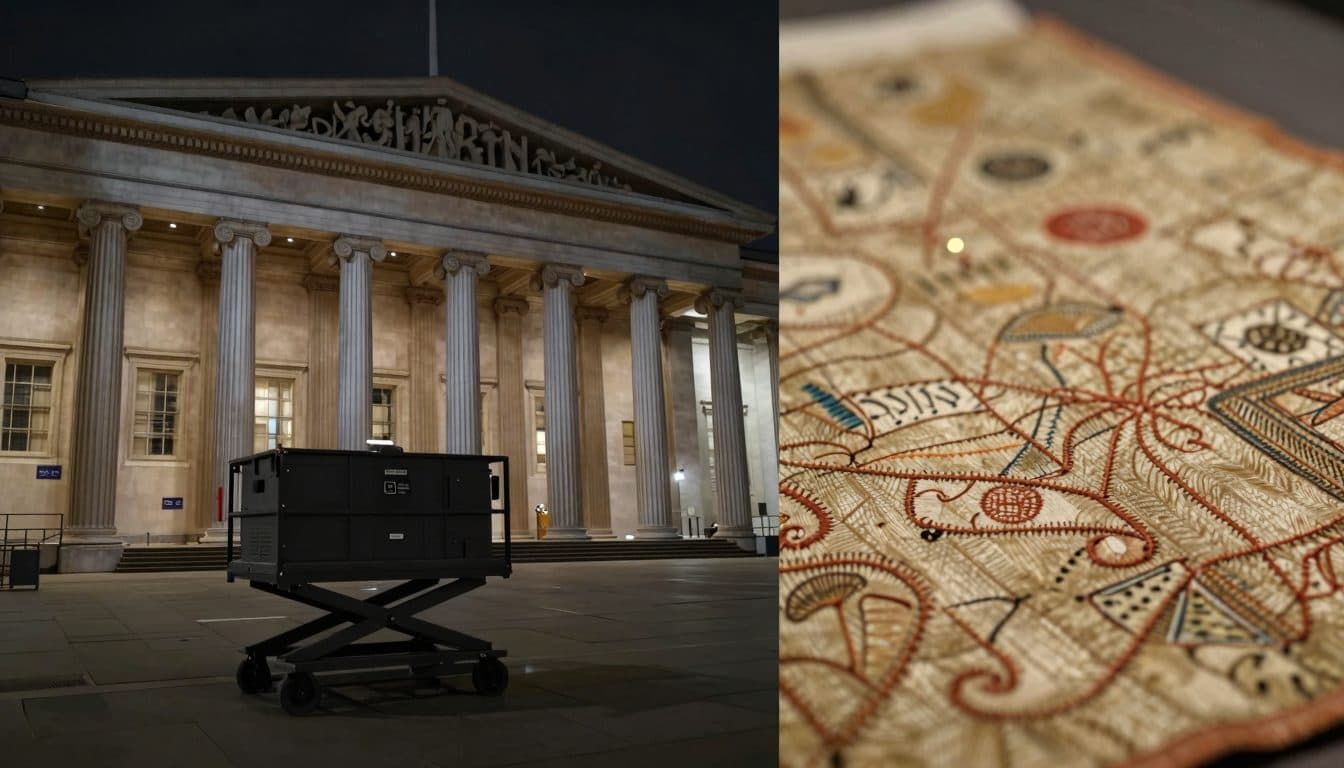
AI-generated image (z-image via Kie.ai)
Summary
The more than 950-year-old Bayeux Tapestry is back in England for the first time since its creation and will be on display as a loan at the British Museum in London from autumn 2026. France and the United Kingdom had announced the loan last year; tickets sold out within a day.
London, July 10, 2026
The legendary Bayeux Tapestry arrived at the British Museum in London in the night to Friday under the strictest security precautions and will be on view in England for the first time since its presumed creation around 1082, from autumn 2026.
Arrival under strict security precautions
In a custom-made crate with a protective frame, the 70-metre-long, extremely fragile artwork was brought into the museum in the heart of London. As the British Ministry of Culture announced, the transport had proceeded "very smoothly". The Director for Cultural Heritage and Architecture at the French Ministry of Culture, Delphine Christophe, who was travelling in the convoy behind the lorry carrying the tapestry, said upon arrival at the British Museum: "Wir sind vollkommen zuversichtlich, dass der Teppich unter den bestmöglichen konservatorischen Bedingungen gereist ist".
Museum director Nicholas Cullinan spoke of a "unique moment" and praised the logistics as a "tremendous achievement by staff of the British Museum and our partners in the United Kingdom and France". The British Culture Secretary Lisa Nandy described the arrival, according to the PA news agency, as a "historic moment".
Content and historical significance
According to the museum, the Bayeux Tapestry is more than 950 years old and is one of the most important pictorial documents of the High Middle Ages. In 58 scenes it tells the story of the Norman Conquest of England: William the Conqueror crossed the English Channel and defeated the English King Harold II at the Battle of Hastings in 1066. In total, the embroidered wall hanging depicts more than 600 people, around 200 horses, some 550 other animals, and 40 ships.
Demand for tickets was already enormous in advance. At the start of advance sales in early July, all available tickets were sold out within 24 hours, the museum announced. In total, the British Museum had sold 100,000 tickets in a very short time. From September 2026 to July 2027, the tapestry is to be on view in a custom-made flat display case in London, the museum further announced.
Risks and insurance
Because of the age and fragility of the work, the transport was a delicate undertaking. According to experts, the tapestry has 30 tears and almost 10,000 holes. A study from 2021 had already pointed to corresponding "risks", which is why some specialists had warned against transporting it to London again.
To cover the risk, the British Treasury had pledged to provide insurance cover estimated at £800 million (over 900 million euros) in the event of serious damage. The enormous sum "underlines just how serious we are about ensuring that the work returns in good condition", said the British diplomat Peter Ricketts, who is responsible for the transport on the British side, to the AFP news agency.
Political dimension of the loan
France's President Emmanuel Macron described the loan in a contribution to the newspaper "The Times" as a "tangible expression of a long-standing friendship". It showed what France and the United Kingdom can "achieve when they join forces". The loan, announced by both countries last year, fulfils a long-held British wish: the British had already requested a loan in 1953 and 1966.
The UNESCO-protected work actually belongs to the French state. Since 1983 it has been kept in the Norman city of Bayeux at the local Tapestry Museum. Since 2007 it has been part of UNESCO's Memory of the World documentary heritage. It is regarded as a kind of medieval comic, but at the same time it is a piece of 11th-century political propaganda that glorifies the Norman victory.
History of the tapestry
The history of the tapestry is marked by numerous wrong turns. During the French Revolution, in 1792, only the intervention of a knowledgeable citizen prevented the irreplaceable artwork from being cut up as an ordinary wagon cover for a military transport. In 1794, art connoisseurs forestalled it being cut into small pieces for decorative purposes. In 1803, Napoléon had the tapestry brought to Paris as propaganda material for his planned campaign against England, before it took a roundabout way to the Paris Louvre and returned to Bayeux in 1945.
The work was presumably created around the year 1082 in England. It is thus now returning for the first time to the place of its creation. The British Museum announced that the tapestry would be presented in a specially constructed, flat display case designed to show the delicate fabric as gently as possible.
The organisation of the transport was described on both sides of the English Channel as a joint diplomatic and logistical achievement. Ricketts emphasised that the insurance sum was an expression of the political will to return the work unharmed. On the French side too, the safety of the tapestry was the top priority: Christophe personally travelled in the convoy in order to be able to monitor the condition of the artwork throughout the entire transport.
Outlook on the exhibition
With the exhibition in London, the Bayeux Tapestry will be made accessible to a broad British and international audience. The British Museum hopes the special exhibition will foster increased engagement with medieval European history and the complex relationship between England and France. The exhibition runs until July 2027 and is likely to sell out quickly given the huge demand.
Cultural representatives of both countries assessed the arrival as a symbolic event. The centuries-long history of the tapestry, which has survived wars, revolutions, and political instrumentalisation, at the same time reflects the eventful history of British-French relations. The fact that the work is now being shown in its country of origin for the first time since its creation is regarded as a historic moment of international understanding.
Until the end of the exhibition period in July 2027, conservation and scientific studies of the tapestry are to be continued in close coordination between the British Museum and the Tapestry Museum in Bayeux. The findings are to feed into a joint publication that will summarise the current state of research on the unique pictorial document.
The news of the tapestry's arrival in London was broadcast on July 10, 2026 on the Deutschlandfunk programme. AFP and PA reported simultaneously on the transport. The response on social media and in cultural circles in both countries was predominantly positive; numerous users celebrated the event as a rare example of successful cross-border cultural cooperation.
Questions & Answers
What is the Bayeux Tapestry?
The Bayeux Tapestry is a more than 950-year-old, 70-metre-long embroidered wall hanging that belongs to UNESCO's Memory of the World documentary heritage and depicts the Norman Conquest of England in 1066 in 58 scenes.
Why was the tapestry brought to London?
France and the United Kingdom had announced the loan last year; the United Kingdom had wished for this loan as early as 1953 and 1966. The tapestry will be shown at the British Museum from September 2026 to July 2027.
What risks were there during the transport?
The tapestry has 30 tears and almost 10,000 holes; a study from 2021 had pointed to corresponding risks. The British Treasury pledged insurance cover of around £800 million in the event of damage.
Bayeux Tapestry in London: 950-year-old UNESCO documentary | allfacts360