Black-Red Coalition Agrees on Reform Package with Tax Cuts and Labor Market Easing
Berlin, July 3, 2026
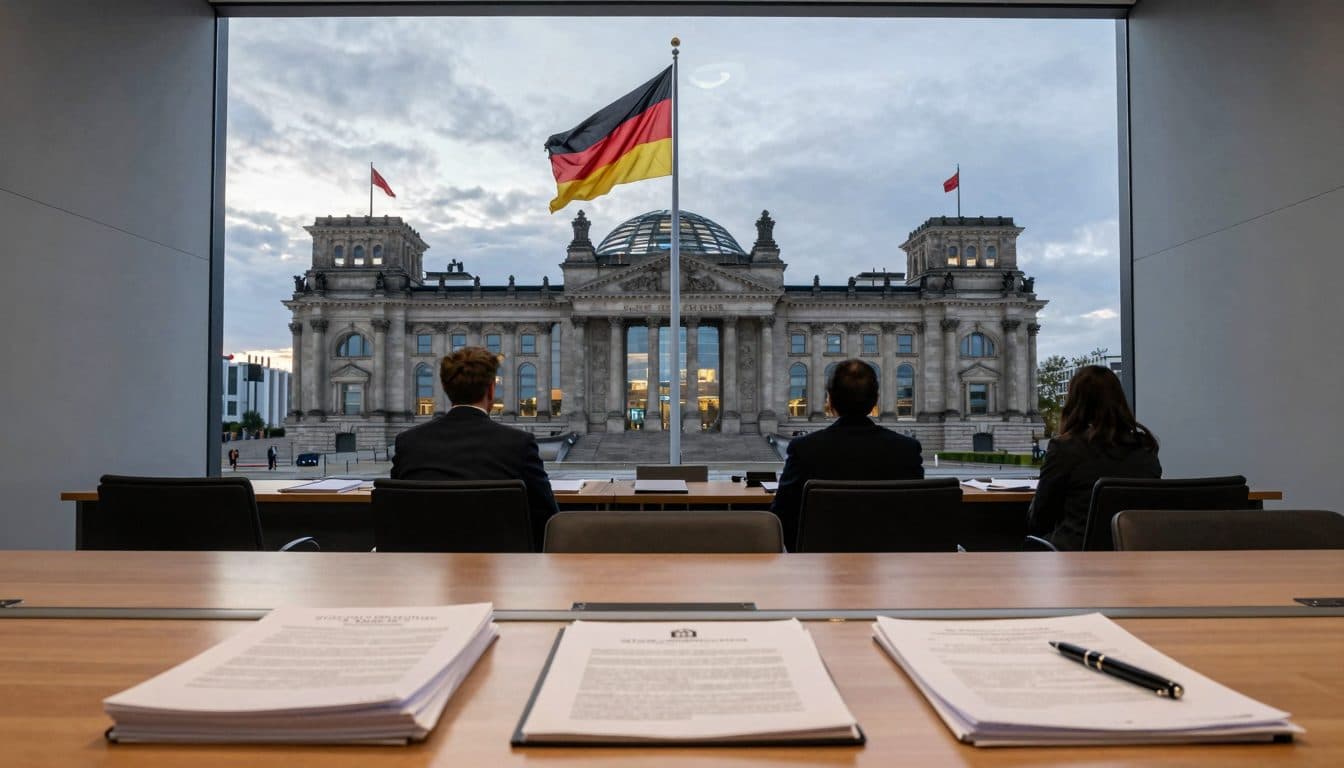
AI-generated image (z-image via Kie.ai)
Summary
The black-red coalition of CDU, CSU, and SPD has agreed after roughly seven and a half hours on an extensive reform package with 34 points. The core is an income tax reform with a relief volume of around ten billion euros per year, set to take effect from 2028.
Berlin, July 3, 2026
The black-red federal government of CDU, CSU, and SPD reached agreement late on Wednesday evening after approximately seven-and-a-half hours of negotiations in the coalition committee on a reform package with 34 points, encompassing tax relief, labor market easing, and bureaucracy reduction.
Agreement After Seven and a Half Hours
The decision was reached late Wednesday evening at the Federal Chancellery, after the leaders of the three coalition parties had negotiated for several hours. Chancellor Friedrich Merz (CDU), CSU chief Markus Söder, as well as the SPD chairs Lars Klingbeil and Bärbel Bas presented the result to the public on Thursday morning in the garden of the Chancellery. Merz spoke of a "big leap" given the strained public finances and a "good day for Germany." "We want to get Germany moving again," said the Chancellor. "We are providing more competition, more flexibility for our companies, less bureaucracy and relief for the welfare state, and we are cutting taxes."
The centerpiece of the package is an income tax reform set to take effect on January 1, 2027. The federal government puts the relief volume at around ten billion euros per year. The compromise is thus significantly smaller than previously discussed: Federal Finance Minister Lars Klingbeil (SPD) had presented models with a volume of 17 to 28 billion euros. Before the 2025 federal election, CDU and CSU had propagated relief of 90 billion euros, the SPD at least 30 billion.
The reform is intended to benefit primarily families as well as low and middle incomes. The basic allowance will rise in two stages by 2028 to 12,900 euros for single individuals and 25,800 euros for married couples. The child allowance will be increased, and child benefits are to rise in two steps by 2028 to 272 euros per month. The standard employee allowance will grow by 200 euros to 1,430 euros. According to the coalition, the tax rate in the range between 17,800 and 70,600 euros will be "somewhat flattened," and the threshold at which the top tax rate applies will be slightly raised to 70,600 euros (single) or 141,200 euros (married couples).
Income Tax Reform with Ten Billion Euro Volume
The relief is to be financed, among other things, by raising the so-called wealth tax. From January 1, 2027, a tax rate of 45 percent will apply starting at a taxable annual income of 250,000 euros (individuals) or 500,000 euros (married couples). From 280,000 euros of individual income, an additional two percentage points will be levied, so that the top wealth tax rate will then stand at 47 percent. The regular top tax rate of 42 percent remains untouched. The SPD had called for an even higher top rate as well as a higher inheritance tax, which the Union rejected. The package is also financed through a higher flat-rate taxation of minijobs, rising from two to five percent.
According to the decision paper, a working family with two children and a taxable total income of 60,000 euros can be relieved by more than 600 euros per year compared to today, "if the reform fully takes effect from 2028." For a family with an educator and an electrician, both earning 3,200 euros gross and with two children, the calculations yield relief of around 642 euros annually. A single-parent educator with two children is to have around 471 euros more per year. "The relief is designed to have the strongest impact for families with children; in doing so, the coalition is specifically easing the everyday life of families," the key points paper states.
Relief for Families with Children
For wage tax, the following applies going forward: the overall relief volume of the reform is to amount to around ten billion euros per year. In return, the tax deduction for craft services will be reduced from 20 to 15 percent, so that the maximum tax deduction will drop from 1,200 to 900 euros. The counter-financing is thus also secured through the reduction of subsidies, as the SPD parliamentary group's finance policy spokesperson, Frauke Heiligenstadt, explained in an NDR-Info interview. Additionally, Sunday and holiday bonuses are to receive more favorable tax treatment.
The package envisions significant easing in the labor market. Fixed-term contracts without objective reason will in future be possible for up to 48 months, with up to six extensions — previously 24 months and three extensions were allowed. This regulation applies until the end of 2030. Employer associations such as Rainer Dulger, president of the Confederation of German Employers' Associations (BDA), welcomed the step as an "overdue course correction." Termination protection for very highly paid employees above approximately 180,000 euros in gross annual income will also be eased: their employment contracts are to be terminable in the future without cause in exchange for a legally regulated severance payment. According to figures, the new regulation affects around 300,000 employees in Germany.
Labor Market Easing
A particularly far-reaching change concerns sick notes: the telephone sick note will be abolished. In the future, a certificate of incapacity for work must be presented from the first day of illness; previously, the obligation only applied from the fourth day. Exceptions can be made through works agreements or collective bargaining agreements. Federal Health Minister Nina Warken (CDU) announced a review of the telephone sick note. Merz described the return to the doctor's note requirement from day one as a "tough decision," but pointed to the rise in sick days since the COVID-19 pandemic. Penalties for falsely issuing a sick note are to be increased.
Reactions to the reform are mixed. The German Trade Union Confederation (DGB) assessed the plans as "the right signal" for employment, growth, and relief for citizens. DGB chief Yasmin Fahimi highlighted the planned income tax reform and the higher tax-free bonuses for Sunday and holiday work. Caritas president Eva Maria Welskop-Deffaa spoke of "great progress" and praised the social balance. The skilled crafts organization ZDH also expressed satisfaction at the consideration of long-standing demands.
Abolition of the Telephone Sick Note
Criticism came, among others, from DIW president Marcel Fratzscher: the package is "more of a symbolic package" than a "major breakthrough." It has "a social imbalance, as the focus is on relieving companies, partly at the expense of employees." Moreover, the tax reform is not fully counter-financed and will further increase the state deficit. Clemens Fuest, president of the ifo Institute, called the package an important contribution to overcoming economic stagnation, but criticized the lack of measures to consolidate public spending as well as the higher burdens for medium-sized businesses from the wealth tax.
There is also dissent from within the ranks of the coalition parties themselves. IG Metall chief Christiane Benner described the package as a "colorful bag of sweets and sours": she welcomed the tax relief, but called the expansion of fixed-term contracts without objective reason an "attack on workers' rights" and the abolition of the telephone sick note an "unsocial wish list" for employers. Verdi chief Frank Werneke saw the fixed-term plans as a shift of entrepreneurial risk onto employees and criticized the abolition of the telephone sick note as an expression of a culture of distrust. Representatives of the German Medical Association spoke of an "absolutely catastrophic" burden on GP practices.
Reactions from Business and Society
On pensions, the coalition decided to implement the proposals of the pension commission one-to-one by the end of 2026. Planned are accordingly a linking of the retirement age to life expectancy, the abolition of the penalty-free retirement at 63, and the introduction of a capital-funded pension along the Swedish model, in which two percent of gross salary — split equally between employers and employees — flows into a fund. The pension commission cautiously expects up to 5 percent returns after inflation initially, but in Germany a transition period of at least 20 years is assumed. Self-employed persons and members of parliament are to pay into the statutory pension insurance in the future; civil servants will not, for now.
On bureaucracy reduction, the coalition leaders agreed to eliminate every fourth documentation requirement within a year — with the exception of obligations arising from EU law or constitutional requirements. A pre-filled digital tax return is also to be introduced, and minimum wage documentation reduced. Data protection is to be reduced to the European minimum standard — a measure critics see as a step backwards.
Decisions on Pensions and Bureaucracy
On housing, the coalition is banking on a federal law that excludes the socialization of private housing stock by the states. In addition, a state-owned housing company is to be founded to promote social and serial housing construction in regions with proven housing shortages. Klingbeil summed up the motto as "build instead of expropriate." Berlin's governing mayor Kai Wegner (CDU) welcomed the plans aimed at preventing expropriations.
Not all reform plans found a majority: a flexibilization of working hours, agreed in the coalition contract, will not be implemented for the time being. According to Merz, no decision was made on electoral reform either; this would not be necessary until the spring of next year. CSU chief Markus Söder, who appeared before Finance Minister Klingbeil and thus partly preempted the presentation, described the package with the words: "So not the one big bang, but