Bonn's Nordbrücke shutdown strains commuters, businesses and city budget
Bonn, 11 June 2026
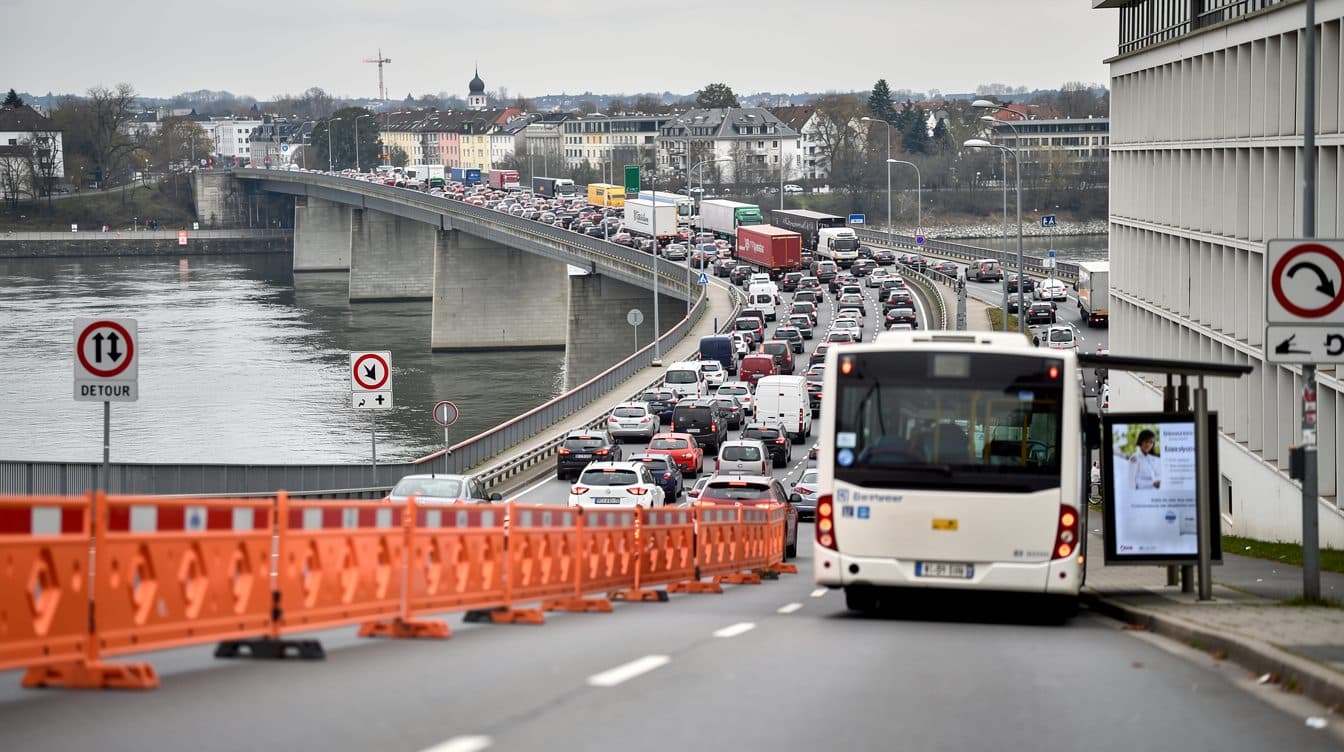
AI-generated image (flux-2/pro-text-to-image via Kie.ai)
Summary
The sudden closure of Bonn's Nordbrücke on the A565 has upended daily life in the region, with commuters facing long detours, logistics firms absorbing overtime costs, and the city scrambling to keep traffic moving. Officials warn that the economic damage from the indefinite shutdown could exceed one million euros a day while the Autobahn GmbH examines whether the bridge can be reopened at all.
Bonn, 11 June 2026
One week after the Nordbrücke, a key Rhine crossing on the A565 in Bonn, was closed indefinitely due to newly discovered damage, the Autobahn GmbH is still examining whether the bridge can be reopened, while commuters, logistics firms and local authorities grapple with detours, overtime costs and traffic chaos.
The shutdown of the Nordbrücke, described as the most important east-west connection in the Bonn region, was triggered by damage discovered on a Wednesday and announced without a timeline for reopening. According to the Autobahn GmbH, the bridge is currently being assessed, but it remains unclear how long and to what extent it will remain closed. Bonn's Lord Mayor Guido Deús of the CDU party acknowledged the uncertainty publicly, calling the situation serious and saying the city is doing everything in its power to restore the flow of traffic in Bonn and the surrounding region.
A region under pressure
The closure has already rippled through the daily routines of thousands of commuters. North Rhine-Westphalia has approximately five million commuters, making it a typical commuter state, and the loss of the Nordbrücke has lengthened journeys for many of them. Philip Spath, the authorized signatory and head of logistics at Baumann Logistik GmbH in Bonn, said his own daily drive home has stretched from 18 to 35 kilometers and that he recently needed more than two hours to complete it. To keep operations running, his workshop colleagues now begin their shifts at 6:00 a.m. instead of 7:30 a.m., a change the company made to absorb the longer travel times.
Logistics providers are not the only businesses feeling the strain. The IHK traffic expert Ocke Hamann stated that in the short term, everyone is stuck in traffic and must take significant detours. He warned that the impact could last far beyond the immediate disruption: bridge closures, he said, could damage the attractiveness of business locations over time, influence investment decisions and push companies with multiple sites to expand elsewhere. "Das hat Einfluss auf die Investitionen. Wenn Firmen mehrere Standorte haben, expandieren sie woanders," he said.
The Autobahn GmbH is currently examining whether the Nordbrücke can be reopened, and the Bonn city council has passed a package of several measures in the evening in response. Several road routes are to be widened to additional lanes for cars, planned other construction projects are to be reviewed, and alternative routes are to be created for cyclists. The city administration of Bonn has also expanded its home-office regulations for its own employees to reduce the number of journeys made during the disruption.
Free public transport and other measures
To ease pressure on inner-city traffic, the city council decided on a Thursday that public transport in Bonn will be free of charge starting from the following Monday and running until the end of June. Deús said the city wants to set an incentive system so that as many people as possible use public transport. He conceded, however, that Bonn cannot afford many of the measures in its current financial situation but is implementing them anyway.
The decision to suspend fares does not extend to existing subscribers. Deús said he cannot announce that people with an existing public transport subscription will receive money back during the free-travel period. The combination of free buses and trains, expanded home-office rules and additional road capacity is intended to keep Bonn moving while the bridge's fate is decided.
The mounting economic cost
The economic cost of the closure is already adding up. The Industrie- und Handelskammer NRW (IHK) estimates that the closure causes economic damage of more than one million euros per day. An ADAC model study published on 6 November 2025 simulated the closure and projected that car drivers would face a combined 50 million additional detour kilometers per year, with trucks accounting for 5.5 million additional kilometers annually. The same study put the macroeconomic damage from the closure at more than 170 million euros.
The ADAC Nordrhein has called the Bonn bridge closure a "Vollkatastrophe für die Region," a complete disaster for the region. The IHK Brückenmonitor, a survey of bridge conditions in the state, finds that approximately 2,500 bridges in NRW are dilapidated, of which nearly 800 are classified as deficient, and that more than 30 percent of autobahn bridges in NRW are in need of renovation. No other German federal state has as many bridges in need of replacement or renovation as North Rhine-Westphalia.
A wider bridge problem
The geography of NRW makes its bridges especially important for the wider European economy. Due to the state's central location and its proximity to international ports, many European freight transport routes pass through North Rhine-Westphalia. Combined with the dense commuter traffic, this means the failure of a single crossing can send shockwaves through both regional and continental supply chains.
The Nordbrücke is not the first major Rhine-area bridge whose sudden closure has caused widespread disruption. The Rahmedetalbrücke in the Sauerland region was closed in 2021, after which retailers reported significant revenue losses because customers avoided longer travel routes. Following that closure, skilled workers migrated partly to other regions, leading to significant staff shortages in individual companies, according to the IHK.
Calls for a master plan
Hubertus Hille, the Chief Executive of IHK Bonn/Rhein-Sieg, said on WDR 5 Morgenecho that it is unacceptable for such an important traffic artery to take twelve to fifteen years to be rebuilt. "Es ist vollkommen unakzeptabel, wenn so eine wichtige Schlagader erst nach zwölf bis 15 Jahren wieder neu gebaut wird," he said. His counterpart at the state level, Ocke Hamann, is calling for a master plan for NRW bridges, particularly Rhine bridges, to prevent further sudden closures like the one in Bonn.
In Bonn itself, the immediate priority is to keep traffic flowing on the streets that remain open. Traffic in Bonn's inner city has increased as a result of the Nordbrücke closure, and the city is attempting to mitigate the effects with immediate measures, from additional bus and train services to wider roads and expanded cycling routes. Whether those steps will be enough depends on the Autobahn GmbH's assessment of the bridge and on how quickly a long-term solution can be put in place.
The road ahead
For now, the closure has produced a familiar pattern for German commuters: accumulated overtime, lengthened journeys, and delayed deliveries. Philip Spath summarized the experience of his company, saying that employees are working additional hours, commutes have grown noticeably longer for many staff, and goods are not arriving at customers on time. Until the Nordbrücke is either reopened or replaced, businesses and travelers in the region are bracing for an extended period of disruption.
The shutdown has also revived a broader debate about infrastructure planning in Germany's most populous state. With hundreds of bridges classified as deficient and the economic cost of closures running into the hundreds of millions of euros, calls for a coordinated state-wide bridge strategy are growing louder. Whether that debate will translate into faster construction timelines remains to be seen, but for the moment, Bonn's commuters and businesses are focused on the more immediate challenge of getting through the weeks ahead.
Questions & Answers
Why was the Nordbrücke in Bonn closed?
The Nordbrücke, part of the A565 motorway and the most important east-west connection in the Bonn region, was closed indefinitely after newly discovered damage, with the Autobahn GmbH currently examining whether it can be reopened.
What measures is the city of Bonn taking in response?
The Bonn city council has approved a package including free public transport until the end of June, widened road routes for cars, alternative routes for cyclists, a review of other planned construction projects, and expanded home-office rules for city employees.
How much economic damage is the closure expected to cause?
The IHK NRW estimates economic damage of more than one million euros per day, while an ADAC model study projects more than 170 million euros in macroeconomic damage and around 55.5 million additional detour kilometers per year for cars and trucks combined.