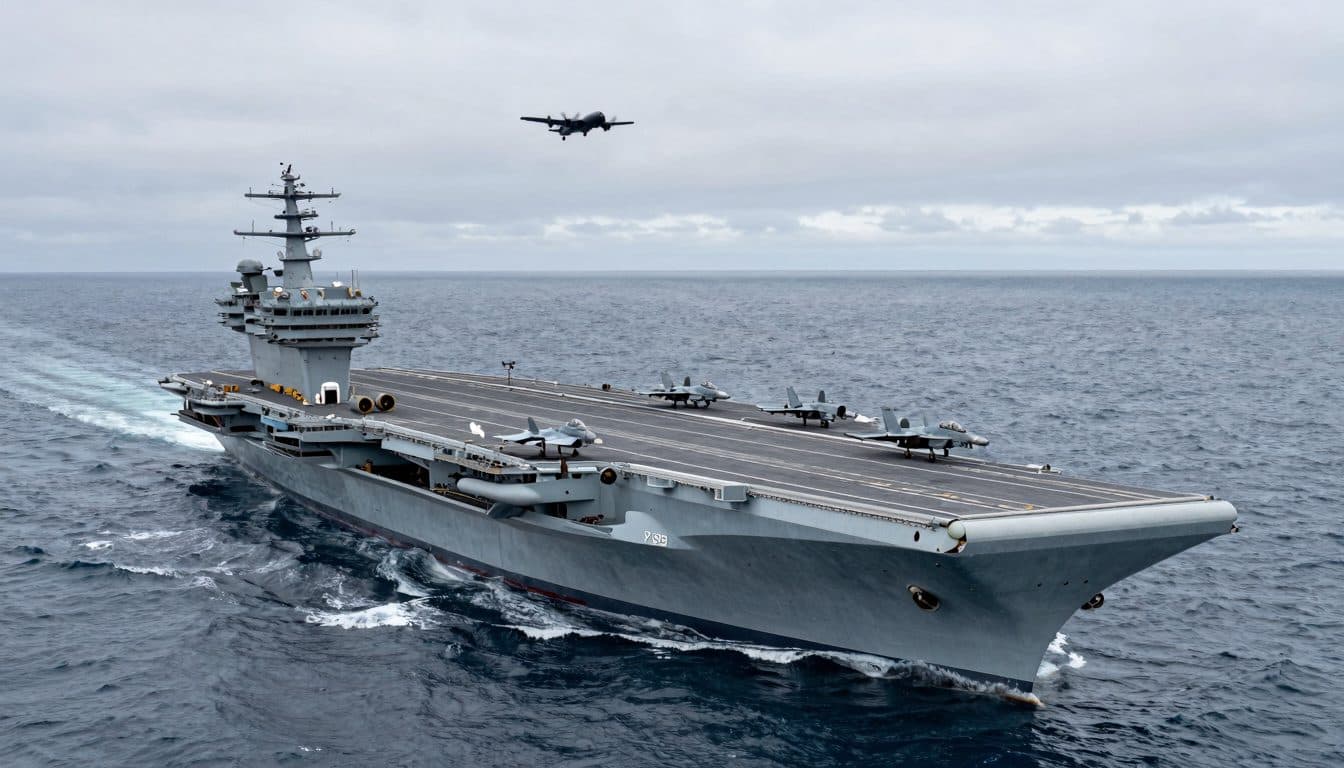
British F-35s intercept Russian reconnaissance aircraft near aircraft carrier HMS Prince of Wales
London, July 06, 2026
AI-generated image (z-image via Kie.ai)
Summary
British F-35 fighter jets took off near Iceland last Thursday to intercept a Russian Tupolev Tu-142 that had flown unnecessarily close to the aircraft carrier HMS Prince of Wales. The British Ministry of Defence described the Russian crew's behaviour as 'dangerous and unprofessional'.
London, July 06, 2026
Two British F-35 fighter jets took off last Thursday from the aircraft carrier HMS Prince of Wales in the Norwegian Sea near Iceland and intercepted a Russian Tupolev Tu-142 long-range reconnaissance aircraft that had previously flown at low altitude unnecessarily close over the British group and dropped sonar buoys.
What happened in the North Atlantic?
The incident occurred last Thursday in the European Arctic Sea off Iceland, according to the British Ministry of Defence. A Russian Tupolev Tu-142 had flown 'at low altitude and unnecessarily close' over the aircraft carrier, which belongs to a group of several ships, and had then dropped 'a large number of listening buoys in the immediate vicinity of the aircraft carrier,' the ministry in London said. The Russian aircraft had also failed to respond to attempts at contact.
Two F-35 fighter jets then took off from the aircraft carrier and intercepted and escorted the Russian aircraft until it left the area, the ministry added. A spokesperson for the British Ministry of Defence described the Russian flight crew's behaviour on Monday as 'dangerous and unprofessional'. A written statement also said: 'This activity was not safe and was unprofessional'.
The role of HMS Prince of Wales
According to sources in London, the Russian aircraft was a Tupolev long-range patrol aircraft used for reconnaissance and anti-submarine warfare. Such aircraft are regularly spotted in waters near NATO states. The dropped listening buoys are equipped with underwater microphones and are used to detect submarines. The fact that a larger number of such buoys were released in the immediate vicinity of an aircraft carrier is interpreted by Western military officials as a deliberate reconnaissance operation.
HMS Prince of Wales is currently leading the British carrier strike group, which consists of several ships, helicopters, and fighter aircraft. The group is operating in the far north as part of a NATO mission to ensure security in the Arctic and the North Atlantic. According to the Ministry of Defence, the group operates as part of the British Arctic mission codenamed 'Firecrest'.
Embedded in 'Arctic Sentry'
The British 'Firecrest' mission is embedded in the NATO mission 'Arctic Sentry', which began in February. With 'Arctic Sentry', the alliance aims to pool the activities of NATO members in the region and strengthen the alliance's deterrence presence. In addition to the United Kingdom, other allies are taking part in the operation; Germany is contributing to 'Arctic Sentry' with, among other assets, several Eurofighter jets.
The incident highlights the growing military importance of the North Atlantic and the Arctic. New shipping routes opened up as a result of climate change have significantly increased the geostrategic interest of the United States, China, and Russia in the Arctic. In addition, valuable raw materials are deposited in the region, further intensifying the race for influence.
Geopolitical background
The mission follows demands by US President Donald Trump to protect the Arctic from Russian and Chinese influence. Trump had repeatedly pointed to the strategic importance of the region and called on NATO partners to step up their presence in the Arctic and the North Atlantic. The alliance states are responding by expanding their exercises and patrols.
The United Kingdom had announced in advance that it would increasingly deploy the carrier strike group to the far north in order to ensure the security of the sea lines of communication between Europe and North America. HMS Prince of Wales is one of the largest warships in the British Navy and features modern air defence systems as well as a squadron of F-35 fighter jets capable of short take-off and vertical landing.
Observers interpret the Russian crew's behaviour as part of a pattern in which Russian military aircraft regularly fly close to Western naval groups to test their response and collect electronic and acoustic data. The dropping of a large number of sonar buoys in the immediate vicinity of an aircraft carrier is considered unusual, as such operations are typically carried out at a greater distance from hostile groups.
London announced that it would raise the incident through the usual diplomatic channels. At the same time, the British government reaffirmed that it would not be deterred from continuing the mission by the behaviour of Russian aircraft. The carrier strike group would continue its patrol voyages as planned, according to the Ministry of Defence.
Diplomatic reactions and consequences
NATO had launched 'Arctic Sentry' in response to increasing Russian and Chinese activities in the region. In addition to patrol voyages and air surveillance, the mission also includes joint exercises and drills by the participating armed forces. The aim is to send a clear signal of unity and determination to defend alliance territory.
Russia has not commented on London's allegations in detail so far. Moscow has regularly portrayed similar incidents in the past as flights in international airspace conducted in accordance with regulations. Critics, however, point out that dropping sonar buoys in the immediate vicinity of a foreign aircraft carrier violates unwritten rules of military restraint.
The incident off Iceland is part of a whole series of encounters between Russian and NATO forces in the North Atlantic and the Arctic. As recently as last year, there had been similar incidents in which Russian fighter jets and reconnaissance aircraft came close to Western naval groups. According to experts, the frequency of these incidents has increased significantly over the past two years.
Sensitivity in the context of the Ukraine war
Military experts emphasise that HMS Prince of Wales and her escort vessels feature state-of-the-art anti-submarine defence systems and that the dropped sonar buoys would not have posed an immediate threat to the group. Nevertheless, the incident is a clear signal that Russia has intensified its reconnaissance activities in the region.
Against the backdrop of Russia's war of aggression against Ukraine and the tense relations between Moscow and the West, such incidents are particularly sensitive. They always carry the risk of miscalculation — for instance, when both sides interpret defensive manoeuvres as provocation. NATO has therefore repeatedly called for secure communication channels and de-escalation mechanisms.
The British government sees the incident as evidence of the need for an enhanced NATO presence in the far north. It would therefore consistently continue its own mission in the Arctic and coordinate closely with alliance partners, according to sources in London. Upcoming exercises as part of 'Arctic Sentry' are also already being planned.
Questions & Answers
What exactly happened on Thursday off Iceland?
According to the British Ministry of Defence, a Russian Tupolev Tu-142 flew at low altitude unnecessarily close over the aircraft carrier HMS Prince of Wales and dropped a large number of sonar buoys. Two British F-35s launched from the carrier intercepted the aircraft and escorted it until it left the area.
What is the NATO mission 'Arctic Sentry'?
'Arctic Sentry' is a NATO mission launched in February that aims to pool the activities of alliance members in the Arctic and strengthen the deterrence presence. The United Kingdom is taking part with, among other assets, the carrier strike group around HMS Prince of Wales, while Germany is contributing Eurofighter jets.
Why is the Arctic currently the scene of military rivalry?
New shipping routes opened up by climate change, the race for valuable raw materials, and demands by US President Donald Trump to protect the region from Russian and Chinese influence have significantly increased the geostrategic interest in the Arctic.
British F-35s intercept Russian Tupolev off Iceland | allfacts360