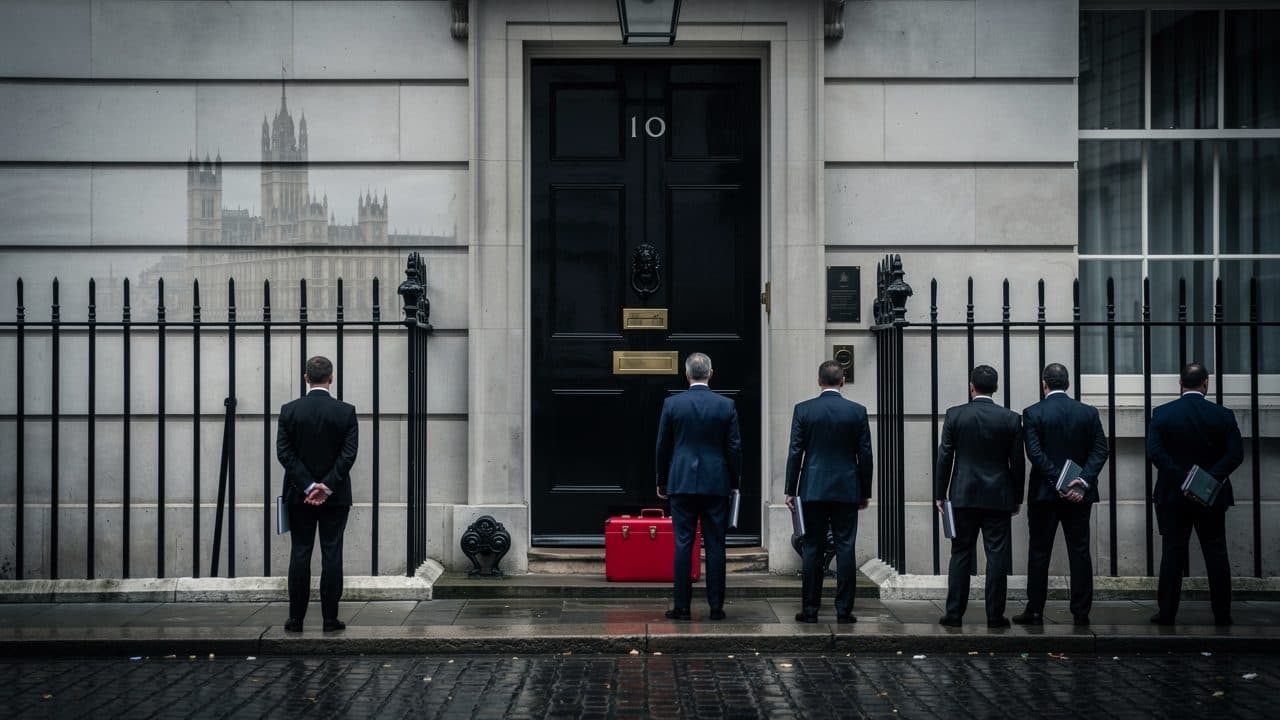
British PM Starmer Reportedly Considering Resignation – Labour MPs Push for Orderly Transition
London, 22 June 2026
AI-generated image (flux-2/pro-text-to-image via Kie.ai)
Summary
British Prime Minister Keir Starmer is reportedly considering his resignation and could announce a decision as early as Monday. Dozens of Labour MPs and senior ministers are demanding his departure after his internal party rival Andy Burnham won a seat in the House of Commons.
London, 22 June 2026
British Prime Minister Keir Starmer is reportedly considering his resignation, according to the BBC and other British media outlets, and could make a decision as early as Monday, while dozens of Labour MPs and several cabinet members are demanding his departure.
Reports of Imminent Resignation
Starmer, who has led the Labour Party since April 2020 and has served as Prime Minister since July 2024, is said by media reports to be on the verge of stepping down. Starmer spent the weekend at the Chequers country residence to reflect on his political future. As The Observer reported on Saturday, citing Labour Party sources, Starmer may declare his resignation on Monday and present a timetable for the transition at the top of government. The Times wrote that Starmer wanted to announce a corresponding timetable on Monday. "Starmer erwägt seine politische Zukunft," the BBC reported on Sunday evening. A cabinet meeting is scheduled in London on Tuesday.
Pressure from the Ranks
Pressure on the Prime Minister had grown massively in recent weeks. Following the local and regional elections in May, in which Labour recorded the worst result for a governing party in three decades, his standing within the party and among voters had dropped dramatically. Starmer is battling the lowest approval ratings of any British head of government in recent memory. According to the PA news agency, more than 100 Labour MPs are now demanding his resignation.
Andy Burnham as Challenger
The situation was further exacerbated by the return of his internal party rival Andy Burnham to the House of Commons. Burnham, who previously served as Mayor of Manchester for nine years, won Thursday's by-election in the Makerfield constituency in northwest England with around 55 percent of the vote. With the mandate, he can now trigger an internal party leadership debate, as membership in the House of Commons is a prerequisite for the post of Prime Minister. Surveys among party members suggest that Burnham would win a contested vote. According to The Observer, the majority of MPs are behind him. Burnham meets the formal threshold of 20 percent support from Labour MPs.
Cabinet Keeping Its Distance
Starmer is receiving little backing from the cabinet either. According to a report by Sky News, Foreign Secretary Yvette Cooper urged Starmer to step down in a private conversation over the weekend. Business Secretary Peter Kyle told LBC that the Prime Minister was reflecting on the political challenges he faces. Starmer finds himself in a very difficult situation. A spokesperson for Cooper initially left a request for comment unanswered. Defence Secretary John Healey had already resigned earlier following a dispute over the defence budget.
Kyle attempted on Sunday to play down reports of Starmer's imminent departure. Speaking to Sky News, he said there was no reason to believe that Starmer's determined stance had changed. Kyle told Sky the Prime Minister was taking "Zeit, um über die politischen Realitäten, Herausforderungen und Chancen nachzudenken, die sich ihm stellen." Kyle added that any decision the Prime Minister makes would be "im besten Interesse des Landes." He also told the BBC: "Ich möchte hier nicht so tun, als gäbe es keinen Prozess, keine Kräfte, die den Premierminister als Parteivorsitzenden herausfordern – das ist ganz klar der Fall."
Trump's Interference via Truth Social
On Friday, Downing Street had still stated that Starmer had no intention of resigning. Following the entry of his internal party rival Andy Burnham into Parliament, the Prime Minister had defiantly declared that he was ready to face any challenge. He would not budge. However, The Sunday Telegraph had reported, citing allies of the Prime Minister, that he was "ready" to go. Starmer's team had pointed a few days earlier to his victory in the 2024 general election, which gave Starmer a mandate to govern until 2029. On Saturday evening, Downing Street told the BBC that the Prime Minister's position had not changed since Friday. Nevertheless, it rejected initial reports about the day of the decision and referred to Starmer's remarks from Friday.
The situation is also attracting international attention. US President Donald Trump wrote on Sunday on his platform Truth Social that Starmer would resign as Prime Minister of the United Kingdom. "Keir Starmer wird als Premierminister des Vereinigten Königreichs zurücktreten. Er hat bei zwei sehr wichtigen Themen schwer versagt – MIGRATION UND ENERGIE (ÖFFNET DAS NORDSEE-ÖL!). Ich wünsche ihm alles Gute!" The relationship between Trump and Starmer had already been strained beforehand, not least after the Prime Minister refused to support Trump in connection with the Iran war. Trump had repeatedly criticised Starmer in the past. Whether Trump was speaking on the basis of concrete information or had his own motives for intervening in the debate remained unclear.
According to dpa, Starmer's wife Victoria encouraged him over the weekend to keep fighting and not resign. On X, Starmer wrote for British Father's Day: "Being a father is my greatest joy." Former minister Jess Phillips told the BBC she felt as though they had reached the end of the road. A Starmer departure should be handled as dignified as possible.
What Happens in the Event of a Resignation?
Should Starmer actually resign, he would under the existing rules remain in office until a successor is found. In a contested vote between Starmer and Burnham, it would formally only concern the party leadership, but in this case it would also decide who becomes head of government. Such a leadership election could take weeks or even months. Former Health Secretary Wes Streeting, who had gradually distanced himself from Starmer, is being discussed as another potential candidate. Should Burnham take over the office, he would be the seventh British Prime Minister in the past ten years. Since 2016, prime ministers have been coming and going. Should Starmer's time as Prime Minister come to an end, his successor would be the seventh head of government since the EU referendum. That is as many as in the 40 years before that.
Scandals and Course Corrections under Starmer
Starmer, born in 1962 in a small terraced house on the outskirts of London and who studied law in Leeds and Oxford, had led the Labour Party back to power after 14 years in opposition with a large majority. He had promised upon taking office to end the chaos of his Conservative predecessors. The Labour Party had won the July 2024 general election under Starmer's leadership by a large margin after 14 years in opposition. But instead of stability, his tenure brought a series of scandals and political setbacks: In September 2025, Deputy Prime Minister Angela Rayner had to resign because she had not fully paid a property tax; in the same month, Peter Mandelson, whom Starmer had appointed as ambassador to Washington despite his known closeness to convicted US sex offender Jeffrey Epstein, was recalled under public pressure, triggering further staff resignations.
There were also sharp policy decisions: Shortly after taking office, the Starmer government announced cuts to heating cost subsidies for older citizens, although this was not in the election manifesto. After a storm of outrage, the government had to backtrack. In foreign policy, Starmer worked together with Germany and France to organise support for Ukraine, which had been attacked by Russia, and, as a Brexiteer opponent, negotiated trade facilitation with the EU. A cabinet meeting is scheduled in London on Tuesday, at which the situation could escalate further.
The politically embattled head of government could then decide whether to resign or to fight for the party leadership in his Labour Party, people familiar with the deliberations said on Sunday. The right-wing populist party Reform UK, which had already benefited from Labour's losses in the local elections, could benefit additionally from a prolonged leadership dispute. A Guardian analysis had previously found that Starmer's voters felt he had not delivered the changes he had announced after the victory over Rishi Sunak.
On Friday, the team of his internal party rival Andy Burnham had said they were giving Starmer the weekend to reconsider his position and hoped for an orderly transfer of power. Burnham, who grew up in Liverpool and is counted among the moderate-left wing of the party, had earned a reputation as the charismatic darling of the moderate-left faction during his time as Mayor of Greater Manchester. He had already been a member of the House of Commons from 2001 to 2017, before moving to the head of the Greater Manchester Combined Authority.
ARD correspondent Christoph Prössl also raised the possibility on Sunday that Starmer could announce on Monday that he intends to remain in office until September to enable an orderly transition. A final decision on resignation or fighting for the party leadership did not appear to have been made. The coming hours were considered in London to be decisive for the political future of the British Prime Minister.
Questions & Answers
How would a Starmer resignation work in concrete terms?
If Starmer resigns, he would remain in office until a successor is elected. An internal party leadership process would then take place, which could last weeks or months; the winner would simultaneously become the new Prime Minister.
Keir Starmer Resignation: Labour Pressure Mounts Ahead of | allfacts360