Heating Act reform: heat pump subsidies fall from July | allfacts360
Bundestag votes on reform of the Heating Act – subsidies for heat pumps drop with immediate effect
Berlin, 10 July 2026
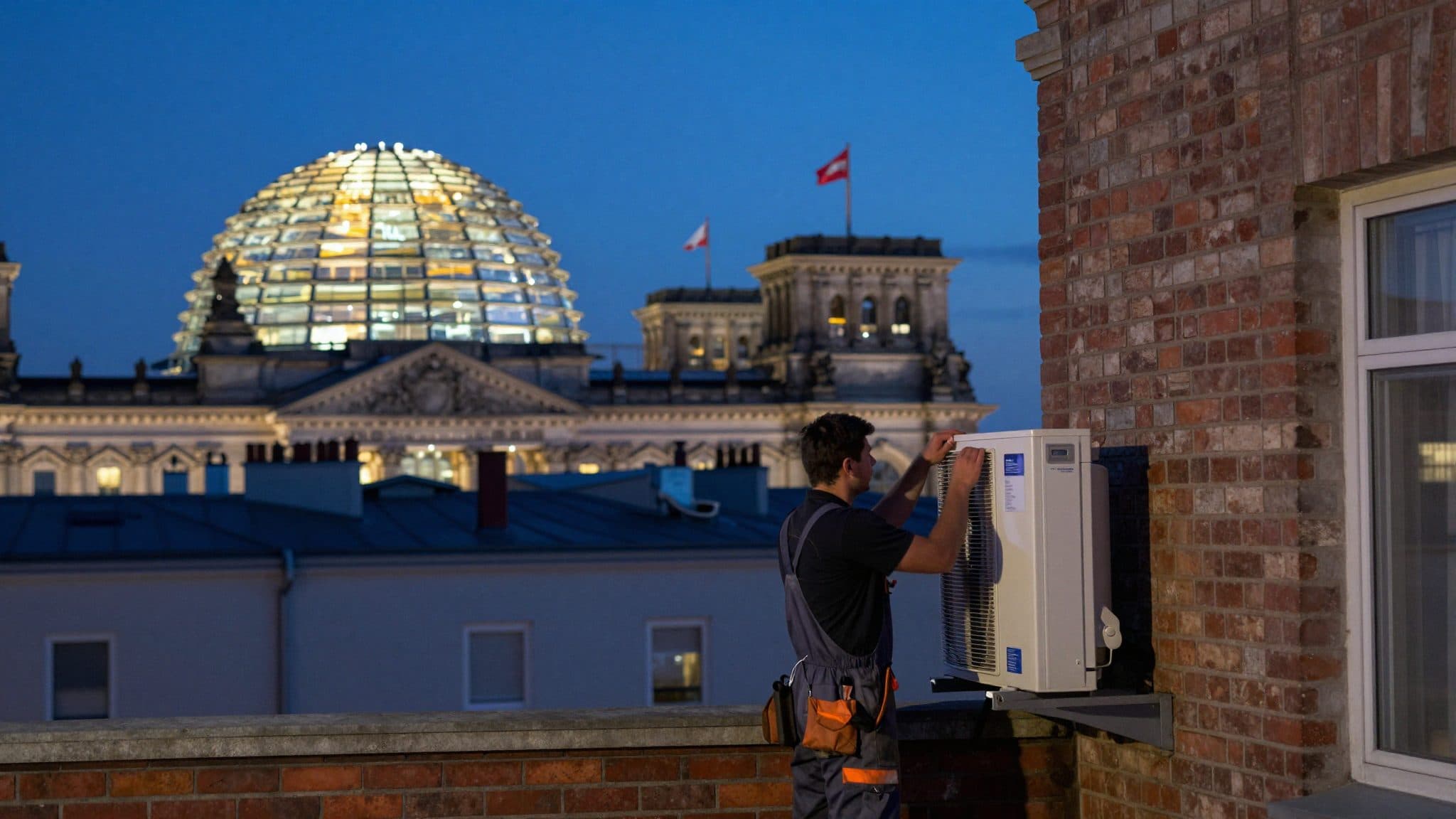
AI-generated image (z-image via Kie.ai)
Summary
State subsidies for heat pumps and other climate-friendly heating systems are being reduced with immediate effect; no further applications can be submitted until 21 July. The Bundestag is to vote on 10 July on the Building Energy Modernisation Act, which replaces the previous Heating Act and removes the 65-percent renewables rule.
Berlin, 10 July 2026
The Bundestag is voting on Friday on the Building Energy Modernisation Act (GModG), with which the black-red federal government is cutting subsidies for heat pumps and other climate-friendly heating systems with immediate effect and suspending applications until 21 July.
According to the Federal Ministry for Economic Affairs, there will be a transition phase from 9 to 20 July for technical adjustments at the state development bank KfW and the Federal Office Bafa. During this phase, according to the ministry, a trust protection rule applies: anyone who already has a valid application confirmation or a technical project description can continue to apply under the previous conditions. From 21 July onwards, new, lower subsidy conditions are to apply.
Technical transition at KfW and Bafa
The federal government's plan provides for state subsidies for heat pumps and other climate-friendly heating systems to be gradually reduced over the coming years. "Bislang konnten sich Immobilienbesitzer den Einbau mit bis zu 70 Prozent und maximal 21.000 Euro der Investitionskosten bezuschussen lassen." In the future, owners of single-family or multi-family homes, condominium owners' associations as well as companies and municipalities can apply for the subsidy under the new rules from 21 July at the Kreditanstalt für Wiederaufbau (KfW).
The basic subsidy of 30 percent remains in place. However, the previous climate speed bonus is being reduced from 20 to 16 percent with immediate effect and will then be cut further every six months. The draft for the Bundestag's budget committee also provides for further reductions every six months under the plans. By 2030, around 2.1 billion euros are to be saved through the measure.
Subsidy rates tied more closely to income
In future, subsidy rates will depend more strongly on household income. "Wer weniger als 30.000 Euro im Jahr verdient, könnte künftig bis zu 22.400 Euro Förderung erhalten." For this income group, the maximum subsidy amount rises in 2026 from 21,000 to 22,400 euros. "Zugleich soll der Einkommensbonus künftig vor allem Menschen mit einem geringen Jahreseinkommen unter 30.000 Euro zugutekommen." For owners with an annual income of up to 40,000 euros, however, it falls to 19,600 euros in 2026 and to 13,200 euros by 2030. "Bei Einkommen ab 40.000 Euro liegt die maximale Förderung schon jetzt bei 16.500 Euro und soll ebenfalls schrittweise sinken." For households with more than 50,000 euros in annual income, the grant could fall to 6,600 euros by 2030 under the plans.
A child bonus is being newly introduced: for a family with one or more children, the income to be taken into account is reduced by 10,000 euros. The child bonus also applies to families with higher incomes. "Für Familien mit Kind sollen die Einkommensgrenzen jeweils um 10.000 Euro steigen."
The black-red federal government is planning a reform of the previous Heating Act, which is to replace the current Heating Act. It permits the installation of new oil and gas heating systems because it abolishes the requirement that new heating systems must run on at least 65 percent renewable energy from 2028 onwards. The core of the existing Building Energy Act is to be removed, namely the 65-percent rule: this stipulates that every newly installed heating system should be operated with 65 percent renewable energy.
Bio-staircase replaces the 65-percent rule
In future, new gas and oil heating systems are also to remain possible if they gradually use a growing share of CO2-neutral fuels such as biomethane. The so-called bio-staircase provides that the share should be at least 10 percent by 2029 and then rise in stages to at least 60 percent by 2040. By 2045, it must rise to 100 percent. At least for new buildings, the option of choosing a new oil or gas heating system could disappear in 2030 because an EU directive sets strict climate protection requirements there.
The Federal Heat Pump Association told MDR AKTUELL that the adjustments were probably unavoidable given the financial situation. "Es gibt keinen Grund zu warten, aber es gibt jetzt auch keinen Grund, panisch zu werden." Martin Sabel, Managing Director of the association, advised: "Deshalb sei jeder, der über eine Wärmepumpe nachdenke, ‚gut beraten, nicht allzu lange zu warten'." At the same time, the association had called for the subsidy to be left unchanged in amount and structure. "Kritisch sieht Sabel vor allem, dass parallel auch Änderungen im Ordnungsrecht geplant seien. Dadurch gehe ein Stück weit Orientierung verloren." The Federal Association of the German Heating Industry stated that adjustments had to be made with "Augenmaß". "Entscheidend sei, dass notwendige Investitionen in den Gebäudebestand nicht ausgebremst würden."
Criticism from associations and the opposition
Criticism is coming both from the opposition and environmental organisations as well as from the Federal Association of the Energy and Water Industry (BDEW). They fear that the climate targets in the building sector will not be achievable under the new law. Green Party energy politician Alaa Alhamwi said: "Die Bundesregierung hat den Menschen eine verlässliche Heizungsförderung bis 2029 versprochen." The energy consultants' association GIH is also reacting "äußerst kritisch". Its head, Stefan Bolln, warned: "Kurzfristige Kürzungen, komplexe Regelungen und fehlende Übergangsfristen bremsen genau die Menschen aus, die heute in klimafreundliche Gebäude investieren wollen." In addition, green gases were not available in sufficient quantities and were needed more urgently in other sectors, such as industry.
The background to the reform is also that Germany has committed to becoming climate-neutral by 2045. At the same time, critics point out that heating costs for private households that continue to rely on oil or gas will rise significantly due to the steadily increasing CO2 prices.
Under the new law, landlords must share the running heating costs of tenants if they install a new gas or oil heating system. Specifically, landlords must bear half of the grid charges, the CO2 price and the costs of bio-fuels – for example biomethane. The Federal Heat Pump Association stressed that the application confirmation alone was not yet a valid subsidy application; applicants would have to use the transition phase to complete their documents in good time.
Questions & Answers
When do the new, lower subsidy conditions for heat pumps apply?
According to the Federal Ministry for Economic Affairs, the new subsidy period at KfW begins on 21 July. Before that, there is a technical transition phase from 9 to 20 July, during which no applications can be submitted.
How much funding can low-income earners receive in the future?
Households with an annual income of less than 30,000 euros can in future receive up to 22,400 euros in funding; the maximum subsidy amount for this group rises in 2026 from 21,000 to 22,400 euros.
What happens to the previous 65-percent renewables rule?
The Building Energy Modernisation Act abolishes the requirement that new heating systems must run on at least 65 percent renewable energy from 2028 onwards. Instead, a so-called bio-staircase applies to new gas and oil heating systems, with rising biomass shares up to 2045.