Drone Defense Germany 2026: 300 Special Forces | allfacts360
Bundeswehr and Police Strengthen Drone Defense: DNA Trace at Leipzig Airport Poses a Puzzle
8/10/2026
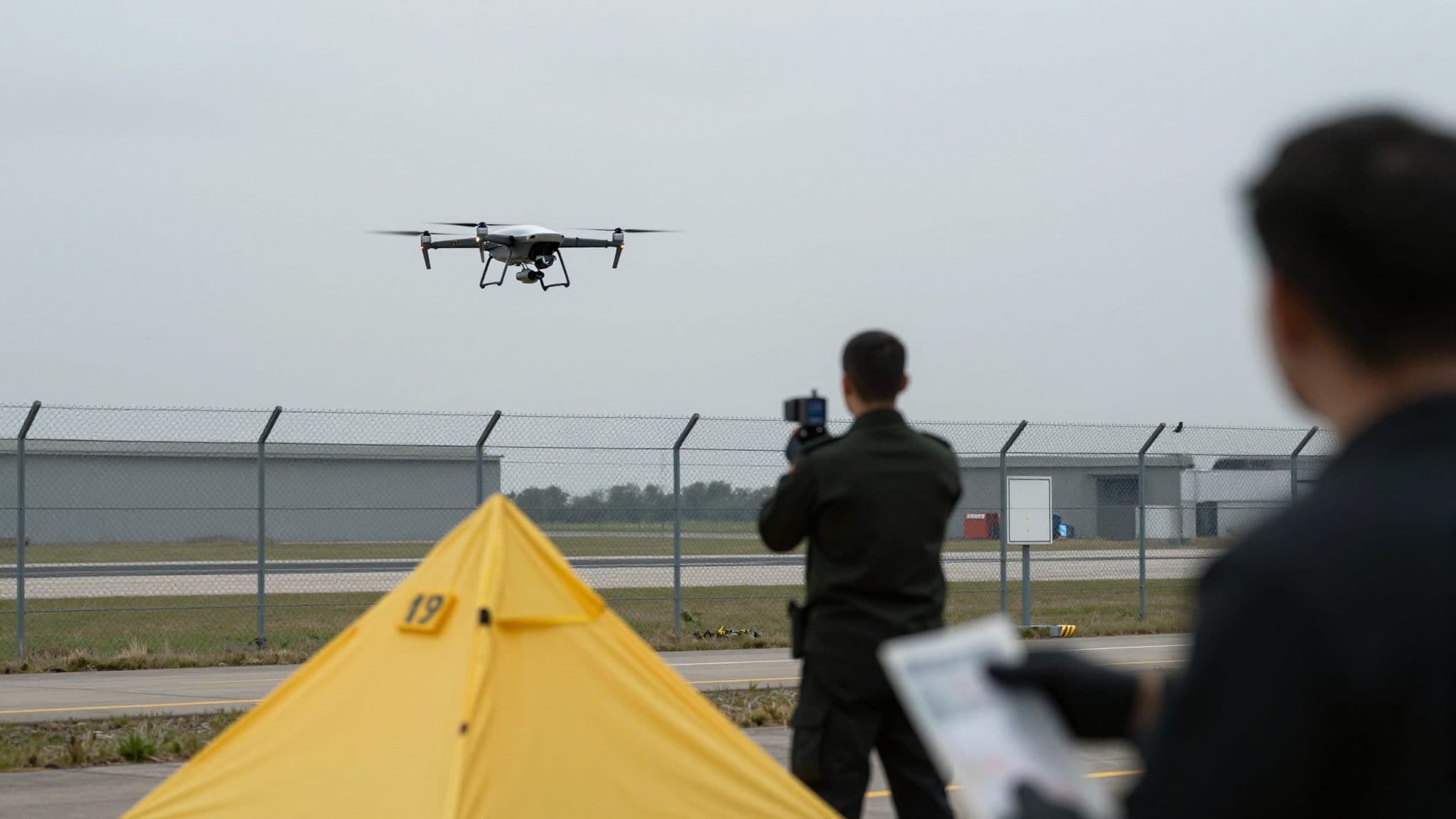
AI-generated image (z-image via Kie.ai)
Summary
Following drone sightings over sensitive locations in Germany, the Bundeswehr is expanding its drone defense. 300 special forces personnel are to be deployed at eight sites, while at the same time a DNA trace found at Leipzig Airport is being investigated.
The Bundeswehr is setting up 300 special forces personnel at eight locations in Germany for drone defense, while a DNA trace found after drone overflights is being investigated at Leipzig/Halle Airport.
The Bundeswehr is significantly expanding its defense against unmanned aerial objects. According to information from Berlin, around 300 soldiers of a newly established special unit are to be stationed at eight locations across Germany in the future, in order to be able to respond more quickly to drone overflights over critical infrastructure and military facilities. In doing so, the federal government is responding to a growing number of sightings of foreign drones, which had been registered in recent weeks over barracks and airports, among other places.
Schleswig-Holstein's Minister President Daniel Günther had already publicly called for the expansion of drone defense and pointed to the particular threat situation in the Baltic Sea region. In view of Russian air activities over the Baltic Sea and near Baltic NATO partners, Günther had repeatedly demanded a more robust German defense. Federal Interior Minister Alexander Dobrindt had also recently made clear that the security authorities would have to respond to the increasing overflights.
DNA Trace Found at Leipzig Airport
It remains unclear who is behind the drone flights. At Leipzig/Halle Airport, investigators secured a DNA trace after a renewed incident, which is now being analyzed using forensic techniques. The find could provide clues about the person who controlled or launched the unmanned aerial vehicle. Previously, drones had been sighted at the airport on multiple occasions, leading to brief operational restrictions.
According to the Basic Law, the Bundeswehr is fundamentally responsible for external defense, while the police ensure internal security. Deployments of the armed forces on German soil are only possible under narrowly defined conditions, such as in the event of a disaster or for administrative assistance. With the new drone defense unit, the Bundeswehr is operating at the interface between national and alliance defense, as drone overflights over military properties directly affect the troops themselves.
Legal Limits on Bundeswehr Operations on German Soil
The focus of reconnaissance is currently on the eastern part of the country and on sites with direct relevance for NATO's eastern flank. This also includes Lithuania, where the Bundeswehr has led a multinational battalion brigade for years. Sightings over German territory are now being closely cross-referenced with the intelligence services and the Federal Police in order to identify patterns and possible connections to foreign actors.
The federal government emphasizes that the new structure does not mean a permanent stationing within the country, but rather a rapidly deployable intervention reserve. With the distribution across eight locations, it is to be ensured that forces can be assembled at any relevant point in the country within a short time. At the same time, the federal and state governments are working on a standardized reporting chain so that municipalities, police, and the military no longer operate in parallel when drone alarms occur.
Politically, drone defense remains a sensitive issue. While government representatives emphasize the pressure to act, opposition politicians are calling for greater transparency regarding the incidents and the suspected perpetrators. It also remains unclear whether the DNA trace secured in Leipzig can be attributed to a single person or a group, and what nationality they hold.
Political Debate and Open Questions
The Ministry of Defense said the new unit was being built up gradually and was to reach initial operational readiness by the end of the year. In parallel, training in the use of interceptor drones, jammers, and mobile radar stations is being intensified. According to the Interior Ministry, the Federal Police will increase its presence at airports and railway hubs in order to detect and document suspicious flight movements at an early stage.
Regardless of this, there is growing concern that drones could in the future be used not only for reconnaissance but also for sabotage. According to official information, there is no evidence of concrete attack planning, but the incidents of recent weeks have made the vulnerability of critical infrastructure clearly apparent. The coming months will show whether the new structures and the investigations in Leipzig can deliver rapid results.
Internationally, Lithuania in particular is watching the development with attention. There too, drones had been repeatedly registered in the airspace near military facilities in recent months. Closer coordination with the Baltic NATO partners on drone defense is considered likely, especially since Germany maintains the largest troop presence in the region outside its own country.
For the general population, little changes in everyday life for the time being. Overflights in residential areas that are not connected to official measures remain prohibited and will continue to be prosecuted by the responsible aviation authorities. Citizens can continue to report suspicious observations to their local police stations.
According to security experts, the DNA analysis in Leipzig could be a first concrete investigative success. Should the trace be attributed to an identifiable person, this would be a rare, solid piece of evidence in a series of incidents that have so far remained largely inconclusive.
Until then, it remains unclear whether the drone flights are coordinated actions or isolated cases. The federal government has assured that it will regularly inform the Bundestag's Interior Committee about new findings.
Questions & Answers
Who called for the expansion of drone defense?
Schleswig-Holstein's Minister President Daniel Günther had publicly called for the expansion in view of the threat situation in the Baltic Sea region; Federal Interior Minister Alexander Dobrindt also pressed for responses from the security authorities.
Why is a DNA trace being investigated at Leipzig/Halle Airport?
After renewed drone sightings, a DNA trace was secured at Leipzig/Halle Airport, which is now being analyzed using forensic techniques and could provide clues about the person controlling the drone.
What is the task of the new Bundeswehr unit?
The around 300 soldiers are to be stationed at eight locations in order to be able to respond quickly to drone overflights over critical infrastructure and military facilities.