Ceasefire ended: Iran fires missiles at US bases, US and… | allfacts360
Ceasefire ended: Iran fires missiles at US bases, US and Saudi Arabia launch retaliatory strikes in Iraq
Washington, July 29, 2026
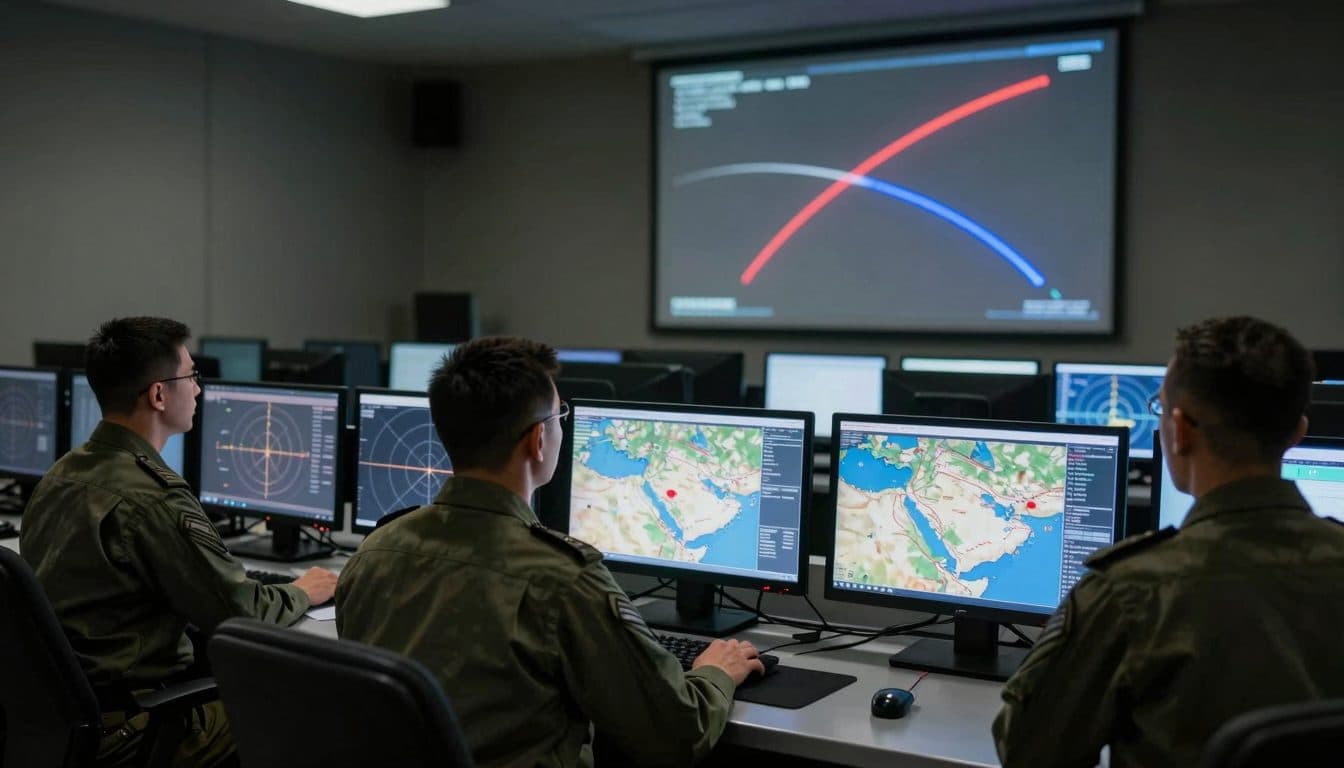
AI-generated image (z-image via Kie.ai)
Summary
The ceasefire between the United States and Iran lasted only a few days.
Washington, July 29, 2026
Attack and interception of the missiles
The ceasefire between the United States and Iran lasted only a few days. As the responsible US regional command, CENTCOM, announced on Tuesday evening, the Iranian Revolutionary Guards had fired several ballistic missiles at US positions in the Middle East. The missiles had been "fully intercepted," according to the statement released by the command via the platform X. CENTCOM also spoke of a "surprise attack on US forces stationed in the Middle East."
The missiles were reportedly flown toward a US base in Jordan, the US news portal Axios reported, citing informed circles. CENTCOM itself initially did not comment on the specific target of the attack. The exact launch point of the projectiles was also initially not publicly disclosed by officials. The government in Tehran had not commented on the allegations by the editorial deadline.
Background: Munitions concerns and warnings from Washington
According to information from the television network CNN, US Vice President JD Vance and Chairman of the Joint Chiefs of Staff Dan Caine had expressed concern about an escalation of the conflict. Citing informed individuals, the network also reported that Caine had pointed to dwindling US munitions reserves. The "New York Times" had previously reported that air defense missiles of the Patriot type played a particular role in the supply concerns.
President Donald Trump had, according to his own statements, stopped the attacks on Iran to give ongoing negotiations with Tehran another chance. "We are in very deep negotiations with Iran," Trump told the portal Axios. As early as Monday, he had described a "good chance" of a deal with Tehran. Israeli Prime Minister Benjamin Netanyahu was also a guest at the White House on Tuesday for a behind-closed-doors meeting in Washington. According to media reports, Netanyahu wanted to use the meeting to secure the US government's approval for new Israeli strikes on Iran, among other things.
Diplomacy under pressure: Trump, Netanyahu and the negotiation path
Iran expert Hamidreza Azizi of the CDU-affiliated Foundation for Science and Politics wrote on the platform X that it was the first time Iran had attacked without having previously been attacked by the US or Israel. Azizi also suspected a connection to Netanyahu's visit to the White House. The attack could "have been a signal in the context of Netanyahu's visit to the White House," he wrote.
Still on Tuesday evening, the US, together with Saudi Arabia, responded with airstrikes on targets in eastern Iraq. As CENTCOM further announced, American and Saudi Arabian fighter jets had attacked several logistics and weapons depots of an unnamed group. The attacks were "precision strikes" against "Iran-allied terrorists," the regional command stated. Saudi Arabia described the joint action as an act of "self-defense."
Retaliatory strikes in Iraq: US and Saudi Arabia strike back
According to the US account, the strikes were a response to "allegedly more than 30 drone attacks ordered by the Iranian Revolutionary Guards in the past 72 hours." As early as Monday, the Houthi militia in Yemen had reported drone attacks on "sensitive hubs" for oil transport to Yanbu. The Saudi Arabian Ministry of Defense also stated that "militants linked to Iran" had again launched drone attacks from Iraq against Saudi Arabia. The drones had been intercepted, it said.
According to US information, strikes hit positions of the Hashd al-Shaabi, a network of former paramilitaries that has been largely integrated into the regular Iraqi armed forces, although some of its pro-Iranian subgroups continue to operate independently. The militia said several people were killed and others wounded in the attack. In addition, "official headquarters" of the group in several parts of the country had been hit. The Hashd al-Shaabi spoke of "treacherous terrorist attacks carried out by US and Saudi forces."
The Shia militia alliance "Islamic Resistance in Iraq" rejected the accusations, calling the allegations "fabrications." Riyadh merely wanted to justify its inability to respond to the "painful Yemeni attacks" by the Houthis, it said. In the event of further Saudi action in Iraq, the group threatened a "harsh" response.
Houthis, tankers and naval blockade in the Red Sea
The situation on several fronts in the Middle East had already escalated in the days before the collapse of the ceasefire. According to CENTCOM, the militias had carried out "more than two dozen drone attacks" in recent days. In Yemen too, the Houthis expanded their attacks: the pro-Iranian militia announced a naval blockade against Saudi Arabia the previous week and on Tuesday claimed to have fired on the tanker "NCC Ghazal." The ship had "violated" the blockade, ignored warnings and was "forced to turn around after several missiles were fired," the militia said via its television channel Almasirah. According to data from the platform MarineTraffic, the "Ghazal" sails under the Saudi Arabian flag. Its last known location was the port of Yanbu on the Red Sea.
Yanbu is the terminus of the important East-West oil pipeline, through which crude oil flows from the production sites on the Persian Gulf. With its help, the Strait of Hormuz, de facto blocked by Iran since the war began, can be bypassed. In reaction to the new fighting, the oil price rose by more than three percent per barrel on Asian exchanges. A Saudi-led military coalition has supported the Yemeni government in the fight against the Houthis since 2015. Following a ceasefire mediated by the United Nations in 2022, fighting between Saudi Arabia and the militia had largely come to a halt – but the recent mutual attacks threaten to overturn this de facto ceasefire.
The escalation follows a phase of unprecedentedly intensive aerial warfare. US strikes on Iranian targets had reportedly been flown almost every night for nearly two weeks. After 13 consecutive nights of new US airstrikes on Iran and Iranian retaliatory attacks, both sides had reported no mutual strikes on the Friday before the latest incidents. The US temporarily halted operations to give negotiations with Tehran room – a tactical maneuver that Iran expert Azizi considers to have failed.
Warnings, background and possible consequences
The US government had repeatedly sharply warned the Revolutionary Guards. The "Revolutionary Guard and its terrorist proxies must stop these attacks to avoid further US military responses," an earlier statement said. The Iranian Revolutionary Guards were also said to have incited "terrorists" to attack US troops stationed in Saudi Arabia and energy infrastructure in the country, according to CENTCOM. In Iraq, there are dozens of armed groups supported by Tehran, most of which emerged in the context of the US-led invasion in 2003.
US President Trump had declared on March 6 that only an "unconditional" Iranian capitulation would end the war. Subsequently, the reciprocal attacks in the Gulf region flared up again after a few days of relative quiet. The latest escalation heightens concern in Washington that the already limited munitions stocks could shrink faster than planned if fighting intensifies further. Observers also interpret Tehran's behavior as a signal to the US government that negotiations are not equated by Iran with a curtailment of military responses.
The German government and the European Union could initially not be officially reached for comment on Tuesday evening. Diplomatic circles in Brussels referred to ongoing coordination with Washington and the Gulf states on possible mediation formats. It initially remained unclear whether the talks scheduled for the coming days between US representatives and Iranian negotiators would be continued despite the new violence.
Regardless of the latest escalation, the US did not completely halt the air war, according to its own account. CENTCOM spoke of a "temporarily" suspended operation, without naming an end date. Trump had repeatedly stressed in interviews that military pressure and diplomacy were not mutually exclusive. With regard to the parallel negotiations, he said an agreement remained "possible, but not guaranteed."
The developments also show how fragile the ceasefire in force since 2022 between Saudi Arabia and the Houthis is. Should the Iranian leadership continue to escalate the conflict, regional experts assess that several fronts could be activated simultaneously – from the Iraqi-Syrian border region to the Saudi East-West pipeline to the shipping routes in the Red Sea. This would further drive up the already tense energy market to the detriment of import-dependent economies in Europe and Asia.
The coming days are considered decisive for whether the diplomatic channels remain open or whether the conflict will culminate in an open military confrontation between the US and Iran. Trump had repeatedly stressed that he wanted a "big, winning deal" with Tehran – a formulation that observers read as both a lever and an offer to negotiate.
Questions & Answers
What consequences does the escalation have for energy prices and the region?
The oil price rose immediately by more than three percent per barrel on Asian exchanges. Analysts fear that the ceasefire between Saudi Arabia and the Houthis in place since 2022, as well as the East-West pipeline in Yanbu, will be drawn into the conflict.