Iran's Attacks on Kuwait and Bahrain: One Dead and Over 60 Injured at Kuwait Airport
Berlin, June 04, 2026
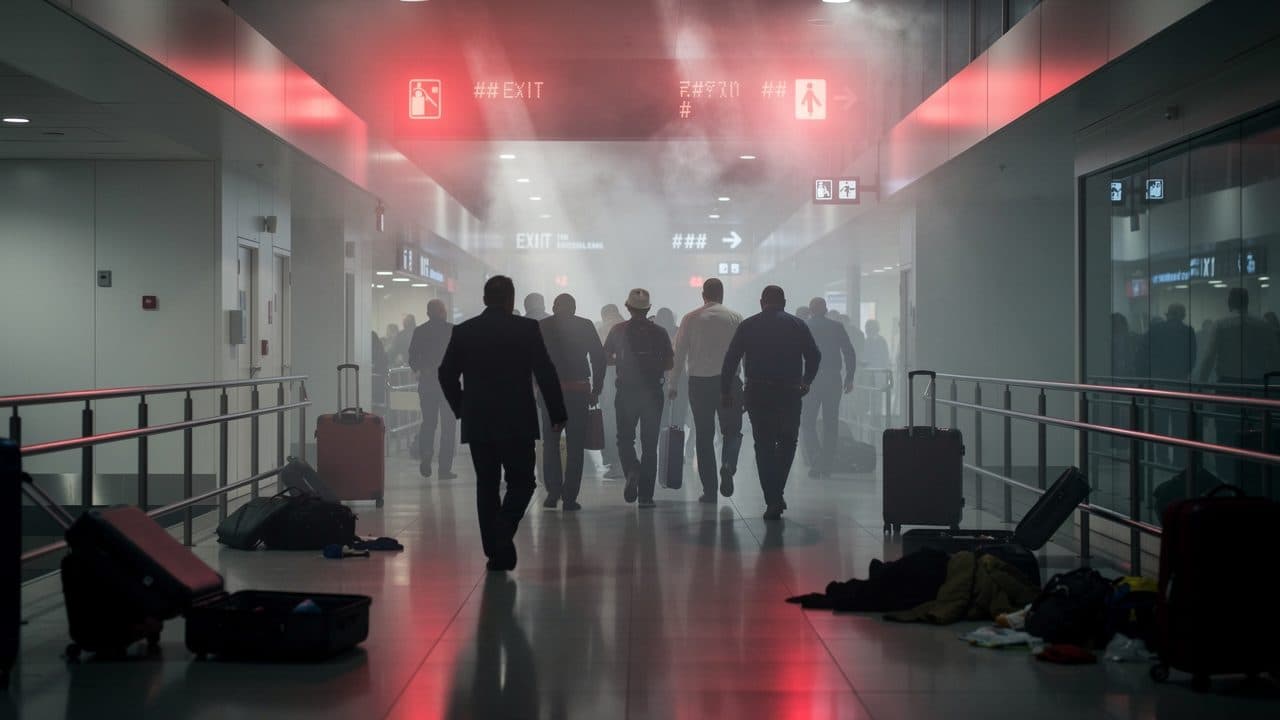
AI-generated image (flux-2/pro-text-to-image via Kie.ai)
Summary
Iran's Revolutionary Guards attacked Kuwait and Bahrain with ballistic missiles and drones on Wednesday night. One person was killed and more than 60 others were injured at Kuwait International Airport. The US military stated that it had repelled several attacks and, in turn, attacked targets on the Iranian island of Qeshm.
Berlin, June 04, 2026
Iran's Revolutionary Guards attacked targets in Kuwait and Bahrain with ballistic missiles and drones on Wednesday night, killing one person and injuring at least 63 others at Kuwait International Airport.
Attack on Kuwait and Bahrain Overnight
The Iranian Revolutionary Guards stated on Telegram that they had targeted the Ali al-Salem Air Base in Kuwait and the headquarters of the US Fifth Fleet in Bahrain. According to the Kuwaiti armed forces, 13 ballistic missiles and 17 drones were fired from Iran at the emirate since dawn. Kuwaiti air defense intercepted 13 missiles and 17 drones, the Ministry of Defense announced. The Ali al-Salem Air Base is located about 60 kilometers from the capital's airport.
At Kuwait International Airport, at least one person was killed and 63 others were injured, according to official reports. A spokesperson for the Kuwaiti Ministry of Health stated that the injured included civilians, airport staff, and travelers. The injuries reportedly included head injuries, brain hemorrhages, amputations, and injuries resulting from explosions. Seven individuals required emergency surgery, according to information from Kuwait.
Situation at Kuwait International Airport
According to the Indian Embassy, the deceased was an Indian national. Images and video footage from the aftermath of the attack showed a destroyed airport hall, dense smoke, and fire. According to Kuwaiti reports, there was severe property damage in the passenger area of Terminal 1. Iran's missiles and drones hit the airport building and damaged several facilities, as reported by the state news agency Kuna.
According to Kuwait's Civil Aviation Authority, all flights scheduled for Wednesday were suspended or rerouted to other airports. An emergency plan was activated at the airport, which had only fully resumed operations on Monday after several earlier attacks. After hours, operations gradually resumed, initially only from Terminal 4. The state airline Kuwait Airways announced that flight operations would resume fully "very soon." The chairman of Kuwait Airways, Abdelmohsen al-Fakan, told the Qatari television channel Al-Araby that the airport would reopen "very soon" and all flights would return to normal.
Trigger: US Attack on Oil Tanker
The Iranian Revolutionary Guards spoke of "retaliatory strikes" in connection with the attacks. Previously, the US military had, according to its own statements, attacked an unloaded oil tanker off the island of Kharg, which is important for Iran's oil exports, on Tuesday. According to the US military, the oil tanker had attempted to approach an Iranian port despite the US blockade. The ship ignored warnings and was ultimately disabled with a missile, the US military stated. Shortly thereafter, Iranian missiles and drones launched attacks on Kuwait and Bahrain.
The US military stated that it had repelled a "wave" of Iranian drones in Kuwait and Bahrain. According to the US regional command for the Middle East, Centcom, several ballistic missiles and drones targeting various objectives in the Gulf region were intercepted. No US soldiers were injured, Centcom further stated. Two Iranian missiles fired at Kuwait missed their target or broke up during flight, and three missiles fired at Bahrain were immediately intercepted by US and Bahraini air defenses. The US Navy also shot down three drones that Iran had fired at civilian ships in regional waters.
Centcom denied claims by the Iranian Revolutionary Guards that they had hit the US Navy's Middle East headquarters and a US air base in the region with missiles and drones in Bahrain. All Iranian attacks on US forces failed. According to information from Washington, the US military's account of the night's events could not be independently verified at first.
US Response: Strike on Qeshm Island
In response to the Iranian attacks, the US and its allies carried out a "self-defense strike" on the Iranian island of Qeshm near the Strait of Hormuz. The US military, in turn, attacked an Iranian military facility on the island of Qeshm in the Strait of Hormuz. According to Tehran, the targets of the Iranian attacks were US military bases in the Persian Gulf states. Centcom stated that the ceasefire between Iran and the US remained in effect despite the attacks. It remained ready to defend against "unprovoked Iranian aggression," the US regional command for the Middle East stated.
An Iranian military spokesperson confirmed retaliatory strikes by the Revolutionary Guards on the platform X. Any threat to the security of the Strait of Hormuz would "cost the US military dearly," he warned. Iran's armed forces had taken control of the strait shortly after the war began, which is of great importance as an export route for fertilizer, oil, and liquefied gas for the global economy. The US wants to achieve an unrestricted reopening of the Strait of Hormuz. The US has imposed a naval blockade to prevent Iranian oil exports.
The spokesperson for the Iranian Foreign Ministry held Kuwait and Bahrain responsible for the US attacks on Iran. Tehran emphasized "the direct and unambiguous responsibility of the leaderships of Kuwait and Bahrain." The ministry condemned "the colonialist use of the territory and infrastructure of countries in the region by the USA" for attacks. Mohsen Rezai, military advisor to the Iranian Supreme Leader, threatened on X with further Iranian missile and drone attacks if the US continued to attack Iran: "Every shot fired and every attack will be answered with a flood of missiles and drones. The aggressor will be punished immediately."
Diplomatic Reactions and Threats
Kuwait rejected the accusations and stated that it would not allow US attacks from its territory. The Kuwaiti Ministry of Foreign Affairs announced that it would declare two members of the Iranian embassy persona non grata and give them 24 hours to leave the country. The number of Iranian embassy staff in the emirate would be reduced, the ministry announced on X. The acting chargé d'affaires of the Iranian embassy in Kuwait was summoned to the Ministry of Foreign Affairs and handed a formal protest note. The decision was made due to the continued and severe Iranian attacks with ballistic missiles and drones.
The Kuwaiti Ministry of Defense described the attack as a "criminal Iranian aggression." Kuwait's armed forces declared their readiness to take "any steps" to protect the security and stability of the Gulf state. Anwar Gargash, a senior diplomat from the United Arab Emirates, called on the Arab Gulf states for "a firm, unified, and closed Gulf position." "This aggression is not directed against a specific state, but against all of us," Gargash wrote.
The German government condemned the renewed Iranian attacks on the Gulf states of Kuwait and Bahrain. A spokesperson for the Federal Foreign Office stated: "Attacks on uninvolved parties and especially on civilian infrastructure are in no way acceptable and must cease immediately." Federal Foreign Minister Johann Wadephul (CDU) sharply condemned the latest Iranian attacks on targets in the Gulf region. The attacks were directed "against the peace process" and "against uninvolved third parties," Wadephul said.
Stalled Negotiations Between the US and Iran
The latest exchange of blows occurred against the backdrop of stalled negotiations for a framework agreement to end the war and reopen the Strait of Hormuz for shipping. US President Donald Trump, despite contrary statements from Iran, reiterated on Tuesday that negotiations between Washington and Tehran on the Iran war were ongoing. "Fake news reports that the Islamic Republic of Iran and the USA stopped talks a few days ago are false and misleading," he wrote on his platform Truth Social. He had told Iran that it was time to "close a deal one way or another." Trump held out the prospect of a meeting with the spiritual leader of Iran, Mojtaba Khamenei, on Wednesday, should the negotiations be successful.
The Iranian news agency Fars, which is close to the Revolutionary Guards, reported, however, that no talks had taken place between Tehran and Washington for several days. The Iranian agency Tasnim reported similarly on Monday, referring to the ongoing war by Israel against the pro-Iranian Hezbollah militia in Lebanon. Iranian chief negotiator and Parliament Speaker Mohammed Bagher Ghalibaf stated that in a conversation with Lebanese Parliament Speaker Nabih Berri, he had signaled Iran's readiness for renewed attacks: "I emphasized that if the crimes of the Zionist regime in Lebanon continue, we will not only break off negotiations but also oppose them." Iran has insisted since the beginning of the negotiations that a ceasefire with the US must also include an end to the fighting in Lebanon.
Despite ongoing negotiations between the United States and Iran, the exchange of blows was one of the most severe since the ceasefire began on April 8. According to the Kuwaiti military, 13 Iranian ballistic missiles and 17 Iranian drones were fired at Kuwait since dawn. In addition, explosions were heard and sirens sounded in Bahrain during the night, an AFP correspondent reported. According to Kuwait, two dozen ambulances were in use to treat the victims and transport them to hospitals. The airport had only fully resumed operations on Monday after several Iranian attacks during the Iran war. This news was broadcast on Deutschlandfunk on 06/03/2026.
Questions & Answers
Who is responsible for the attack on Kuwait Airport?
The Iranian Revolutionary Guards claimed responsibility for the attacks on Kuwait and Bahrain as retaliation for US attacks on an oil tanker and the island of Qeshm. They stated that they had attacked the Ali al-Salem Air Base in Kuwait, among other targets.