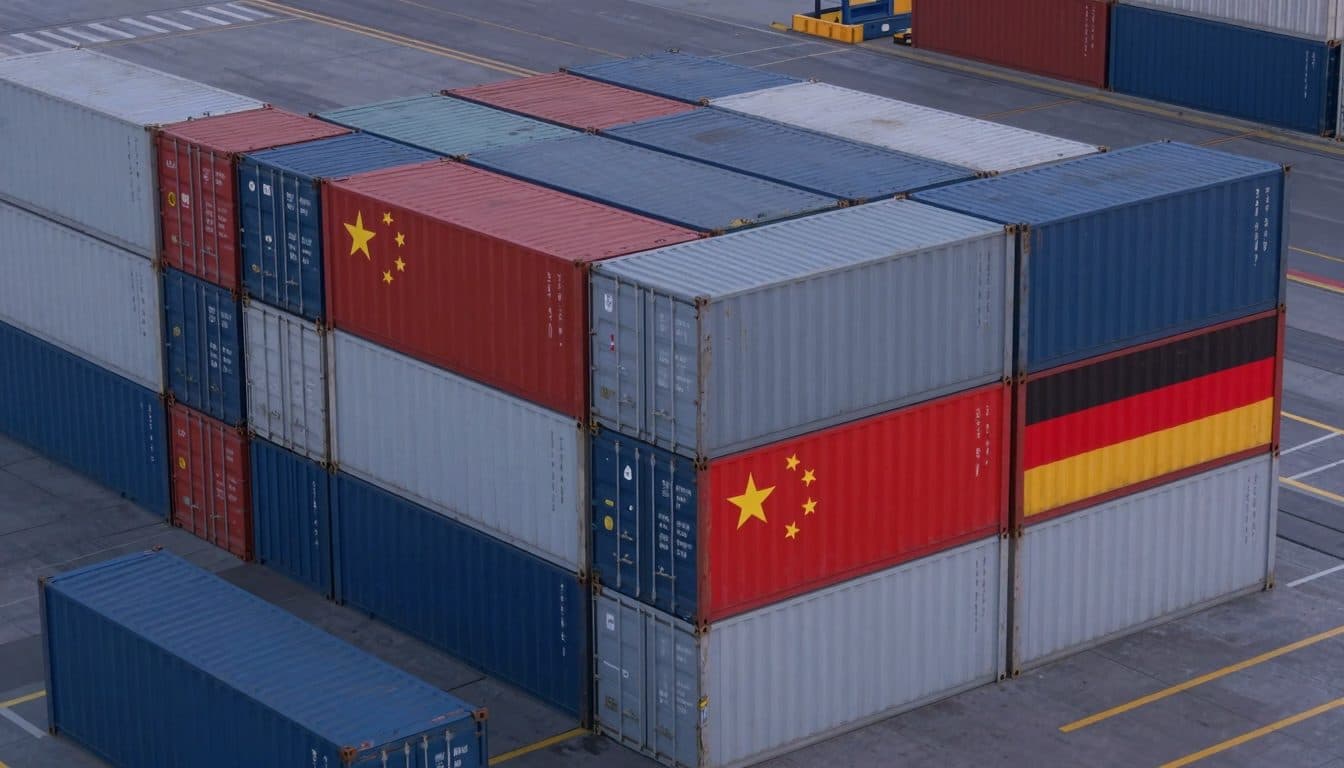
China's state-driven industrial policy is intensifying competitive pressure on key German sectors from chemicals and pharmaceuticals to the automotive industry. The EU is preparing new trade instruments, but the balancing act between market presence and protecting domestic production remains contentious.
Berlin, July 11, 2026
China's state-expanded industrial capacities and its aggressive export strategy are putting the German industry under pressure in more and more sectors, while the EU prepares new trade instruments.
According to the current Chinese five-year plan, industrial capacities are to rise from 30 to 45 percent. China produces significantly more than it needs itself, thereby pushing cheap goods onto European markets. Since the People's Republic joined the WTO in 2001, Chinese products have flowed onto world markets on a large scale – but the current wave, often described as "China-Schock 2.0," hits the German economy in a phase of structural weakness.
Trade Balance Tilts
In 2025, Germany's trade deficit with China jumped sharply to 89.3 billion euros. In the same year, China overtook the United States as Germany's most important trading partner. Imports from the People's Republic rose by 8.8 percent to 170.6 billion euros, while German exports to China shrank by almost a tenth. "Während die EU-Exporte nach China in den letzten zehn Jahren nur leicht gestiegen sind, haben sich die Importe aus China fast verdoppelt," the analysis states.
Sectors long considered strengths are also coming under pressure. In recent years, China has overtaken Germany as the world's leading exporter of machinery and is by far Germany's most important battery supplier – ahead of European countries such as Hungary. In the first half of 2026, the share of newly registered passenger cars from Chinese brands in Germany reached 3.7 percent. The automotive industry, "bei Autos" a traditional German flagship, faces growing competition, as the industry is heavily dependent on business with China.
Chemicals Between Market and Competition
The situation is also coming to a head in the chemicals sector. China accounts for 45 percent of global chemical revenue and is by far the largest chemical market. BASF CEO Markus Kamieth warned: "China werde in den kommenden fünf bis sechs Jahren drei Viertel des weltweiten Wachstums im Chemiemarkt ausmachen." At the same time, the company is sticking with its new integrated site in Zhanjiang, which at around 8.7 billion euros is the largest single investment in the company's history and, according to BASF, has already recorded almost two profitable months. Kamieth makes clear: "Auf den Markt wollen wir einfach nicht verzichten." VCI Managing Director Wolfgang Große Entrup also sees the situation as split: "Für die deutsche Chemie bleibt China strategischer Schlüsselmarkt und härtester Konkurrent zugleich."
Competition is also growing in pharmaceuticals. Estimates suggest that around three quarters of the European pharmaceutical value chain depend on imports. "China baut seine Rolle als Pharma-Innovations- und Produktionsstandort seit Jahren systematisch aus und wird damit auch für Deutschland zu einem immer wichtigeren Wettbewerber," said Claus Michelsen, chief economist of the VFA (Verband der forschenden Pharmaunternehmen). In Germany, there have been repeated shortages of painkillers, diabetes medications and antibiotics, as pharmaceutical manufacturers have scaled back production domestically.
Jobs and Dependencies
The consequences are already being felt today. "Der Druck ist bereits im gesamten industriellen Kern Deutschlands spürbar," said Esther Goreichy, economic expert at the Berlin-based China research institute Merics. "Der China-Schock 2.0 habe weitreichende Folgen für die deutsche Wirtschaft, da er beide Seiten ihres traditionellen Wachstumsmodells betrifft: den Export und die Industrieproduktion." Since 2021, "laut Schätzungen allein in Deutschland über 400'000" jobs have been lost because Chinese demand for German products declined.
Europe – like the rest of the world – also remains heavily dependent on China for rare earths. Battery expert Gunther Kellermann of the ZVEI warned: "Wenn diese unterbrochen werden oder einzelne Regionen ihre Exporte kurzfristig komplett einstellen, wird klar, wie verletzlich wir sind, insbesondere in kritischen Sektoren wie der Verteidigung oder bei Rechenzentren." His concern: "könnten wir die industrielle Batterieproduktion auf dem europäischen Kontinent unwiederbringlich verlieren," if better framework conditions are not created quickly. German battery production did rise to a record value of 8.1 billion euros in 2025, but structural change is underway.
EU Arms Up on Trade Policy
Politically, the debate is intensifying. France had long called for a tougher course. "Nicht nur Frankreich, das schon länger mehr Schutz für die europäische Industrie fordert, sondern auch der deutsche Bundeskanzler Friedrich Merz, dessen Land lange für einen gemässigten Kurs plädierte, fordert inzwischen offen mehr Schutz." At the last EU summit in June, member states tasked the EU Commission with drawing up new trade instruments. The Commission is likely to present its proposals by autumn.
Previously, the EU had already introduced tariffs on electric cars from China. Since July 2026, the EU has been levying a tariff of almost 50 percent on steel from third countries. Brussels also has the so-called Anti-Coercion Instrument in its drawer – often referred to as the "trade bazooka." With it, the EU could, for example, exclude Chinese companies from public contracts. However, the EU has never used the instrument before. Its use does not require unanimity, but does require a qualified majority among member states (at least 55 percent of member states representing no less than 65 percent of the EU's population).
The industry association VDMA is meanwhile calling for better production conditions in Germany – deregulation and tax relief – as well as stricter EU market surveillance on imports. The association also proposes countervailing duties on goods exported to Europe from third countries in violation of anti-dumping and anti-subsidy rules. The federal government's High-Tech Agenda, meanwhile, names many of the same future fields as the Chinese five-year plan: semiconductors, robotics, quantum technologies, nuclear fusion, hydrogen and biotech. "Der nächste Konkurrenzkampf steht schon bevor."
In the meantime, the following holds true: "Deutschland verdiente jahrzehntelang am Aufstieg Chinas." Now the People's Republic is becoming a rival in more and more sectors – and the pressure to adapt on the German economy is growing.
Questions & Answers
What is the "China Shock 2.0"?
The China Shock 2.0 refers to the current wave of Chinese industrial policy, which, with a massive capacity expansion from 30 to 45 percent and cheap exports, is intensifying competitive pressure on German industry in more and more sectors.
Which sectors in Germany are particularly affected?
According to the available data, chemicals, pharmaceuticals, mechanical engineering, battery production and the automotive industry are among the sectors in which China is increasingly becoming a rival.
What new trade instruments is the EU considering?
The EU Commission is to present proposals by autumn; countervailing duties, the Anti-Coercion Instrument for application, and since July 2026 a steel tariff of almost 50 percent on third countries are also available.
China Shock 2.0: Pressure on German Industry Rises | allfacts360