"Commercial to Residential" Funding Program Launches: Up to €30,000 Per New Apartment
Berlin, 30 June 2026
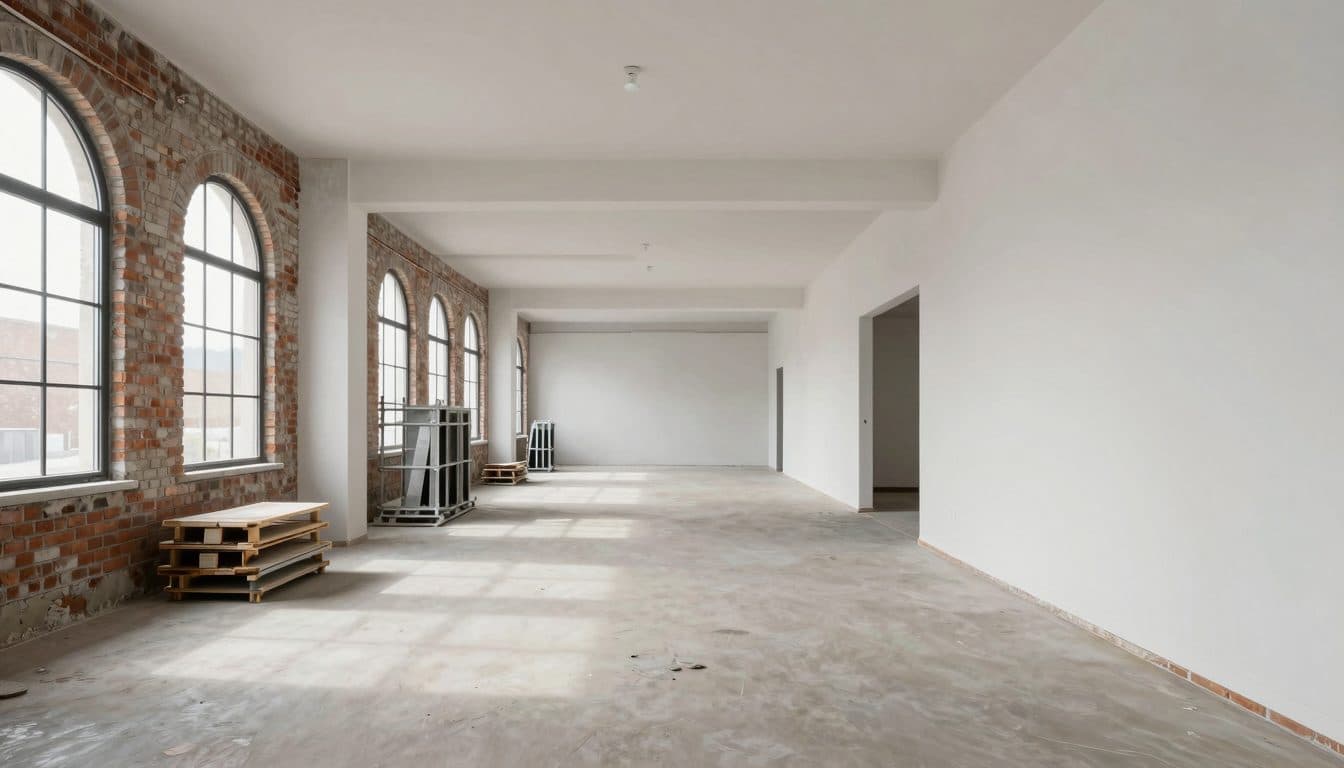
AI-generated image (z-image via Kie.ai)
Summary
Starting 1 July 2026, builders and investors in Germany can apply for funding of up to €30,000 per newly created apartment if they convert vacant office or commercial space into housing. The Federal Ministry of Building is providing €300 million for this purpose this year and expects thousands of additional apartments in city centers.
Berlin, 30 June 2026
Starting Wednesday, 1 July 2026, builders and investors in Germany can apply for funding of up to €30,000 per newly created apartment if they convert vacant offices or commercial space into housing, the Federal Ministry of Building announced.
Launch of "Commercial to Residential"
The program titled "Commercial to Residential" ("Gewerbe zu Wohnen") had already been announced in April by Federal Minister of Building Verena Hubertz (SPD) and is now ready to launch. Applications can be submitted via the Kreditanstalt für Wiederaufbau (KfW) starting the day after publication. "We are providing €300 million to give unused office and commercial properties a second chance," Hubertz explained when presenting the program.
According to the Federal Ministry of Building, more than twelve million square meters of office space stand vacant in Germany. At the same time, affordable housing is lacking in many cities. "In many cities, buildings stand empty while apartments are lacking," Hubertz said. "This is precisely the contradiction we want to tackle with the help of our new funding program 'Commercial to Residential.'"
Funding Conditions at a Glance
The funding is granted as a non-repayable subsidy. Per newly created apartment, investors or owner-occupiers can receive up to €30,000, but the subsidy is capped at a maximum of €300,000 per investor. The federal government plans to equip the program with a total of €300 million this year.
"The funding is extremely attractive for investors and at the same time a powerful impulse to launch projects that will sustainably transform our cities," Hubertz continued. The minister pointed out that such conversions could conserve resources and breathe new life into city centers. "If they were used as apartments, this would save resources and bring new life to the centers."
Which Buildings Are Meant?
Specifically, the program targets vacant shops, offices, and old village primary schools, as Hubertz explained. "It's about empty shops and offices or even the old village primary school," Hubertz said. "Buildings that were once full of life and now stand still while so many people are looking for housing." Slightly relaxed requirements also apply to listed buildings because they may not be altered to the same extent.
The energy retrofit must, however, meet the "Efficiency House 85 EE" standard. This requires modern insulation, new windows, efficient heating technology, and a high share of renewable energy. These requirements are part of the program's three objectives: combat vacancy, create housing, and retrofit in a climate-friendly manner.
Hubertz visited a building in Berlin for the presentation that formerly housed Berliner Rundfunk and has stood vacant for a long time. It is currently being converted into apartments. This was meant to demonstrate that the conversion works and that new housing can be created in city centers, the SPD politician said.
How Big Is the Potential?
Experts differ in their assessments of how great the potential actually is. The Ifo Institute calculated in 2024 that converting commercial space in Germany's seven largest cities could create up to 60,000 apartments for roughly 100,000 people. Real estate specialist Jones Lang LaSalle (JLL) saw a potential of approximately 11,000 apartments in these metropolises alone from unused office space.
The Ifo Institute also pointed out that conversion is not economically viable in many cases. "Ifo explained that in many cases the conversion does not pay off, because in some cases spaces designed for entirely different purposes must be converted at great expense and effort." Construction costs have also risen significantly in recent years, further driving up the cost of conversion.
Office buildings are also not automatically attractive places to live, the ministry emphasized. "Moreover, office buildings are not always attractive places to live, for example when there is no connection to schools, local transport, kindergartens, shops, or parks." Fire protection and structural requirements also pose particular challenges in conversions, explained Dirk Ruß of the Dortmund planning office "Planungsgruppe Stadtbüro." "The need for natural light is naturally greater in apartments than in offices."
Criticism and Limits of the Program
Criticism of the program came, among others, from the Pestel Institute. Its managing director Matthias Günther said the cap of €300,000 per investor is insufficient for large-scale projects. "Large projects can thus hardly be tackled," Günther criticized. The nationwide decline in construction activity of roughly 90,000 apartments within two years cannot be offset by the program.
According to calculations by the Pestel Institute, North Rhine-Westphalia alone is short roughly 376,000 apartments. To close the gap by 2030, approximately 94,000 new apartments would need to be built annually. According to the state's statistical office IT-NRW, only around 41,000 apartments were completed in NRW in 2024. "We will see how the program is received by potential investors at the earliest in six months," Günther said.
That the conversion of large existing stocks is fundamentally possible is already demonstrated by completed projects. In Düsseldorf, the former Thyssenkrupp administrative building, where around 1,000 employees worked until 2006, was converted into the "Living Circle" project with more than 300 apartments. In Dortmund-Hörde, an old police station became a building with 23 apartments, including cluster apartments with shared spaces. In Wuppertal, the conversion of a former textile factory into the "Bob Campus" began as early as 2017.
Examples from Practice
With the funding program, the aim is to give unused office and commercial space a second chance, Hubertz had already said when announcing the program in April. In the future, people will be able to live here at affordable prices, the SPD politician said. The ministry sees the program as a first, important building block in resolving the contradiction between vacant offices and missing apartments.
The news about the program's launch was broadcast on 30.06.2026 on Deutschlandfunk and distributed via the dpa news channel under the identifier 260630-930-308793/1. The funding conditions and application channels are to be made accessible in the coming weeks via the KfW and the Federal Ministry of Building's websites.
Experts emphasize that the program's impact will only become visible in the medium term. Alongside the funding, planning and approval procedures are also decisive in determining how quickly vacant offices actually become apartments. The combination of subsidies, energy requirements, and location criteria is intended to ensure that the outcome is not only more apartments but also more climate-friendly and livable neighborhoods.
Questions & Answers
Who is Verena Hubertz and what role does she play in the funding program?
Verena Hubertz is Federal Minister of Building and a member of the SPD. She announced the "Commercial to Residential" program in April and presented it to the public on Tuesday before its launch on 1 July 2026.
How much money can investors apply for per apartment?
A non-repayable subsidy of up to €30,000 is possible per newly created apartment, but capped at a maximum of €300,000 per investor. In total, the federal government is providing €300 million this year.
Why do experts say the program is insufficient to solve the housing shortage?
Matthias Günther of the Pestel Institute criticizes that the cap of €300,000 per investor makes large projects barely feasible and cannot offset the decline in construction activity of around 90,000 apartments within two years. The Ifo Institute also points out that conversions often do not pay off economically due to high conversion costs.
Commercial to Residential: Funding Program Launches on 1 | allfacts360