Correctiv Analysis: Thousands of EU Bathing Spots Located on Chemically Polluted Waters
Berlin, 03 July 2026
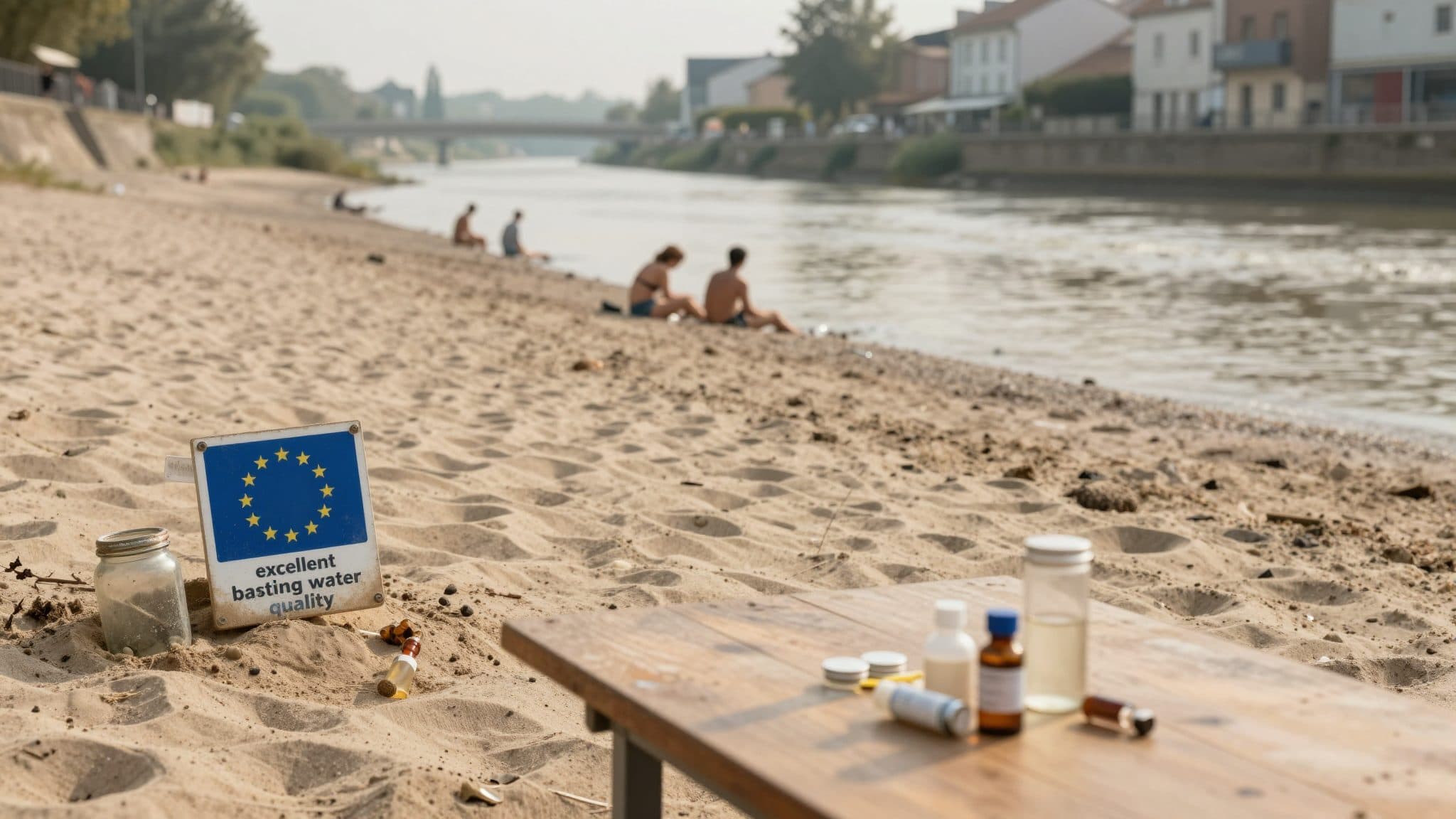
AI-generated image (z-image via Kie.ai)
Summary
An analysis by Correctiv shows that at least 7,866 officially classified as clean bathing spots across the EU are located on waters that are demonstrably contaminated with chemical pollutants. Critics are calling for the Bathing Waters Directive to also take chemical parameters into account in the future.
Berlin, 03 July 2026
An analysis by Correctiv shows that at least 7,866 officially classified as clean bathing spots across the EU are located on waters that are demonstrably contaminated with chemical pollutants.
The European Environment Agency (EEA) had still certified European bathing waters as predominantly excellent in mid-June: almost 85 percent of the more than 22,000 bathing spots examined in the 27 EU member states as well as Albania and Switzerland were considered excellent, and 96 percent at least met EU minimum standards. However, an investigation now published by Correctiv paints a more nuanced picture.
Excellent Readings – but with Limitations
The journalists evaluated official water body data from the EEA – the same agency that compiles the annual bathing waters report – while additionally taking chemical pollutants into account. According to this, at least 7,866 bathing spots across the EU are located on waters demonstrably contaminated with chemical substances, even though they are classified as clean under the existing criteria.
In Austria, Belgium, the Netherlands, Sweden, Luxembourg, Latvia, and Slovakia, "alle in unserer Analyse erfassten Badestellen an Gewässern, die den guten chemischen Zustand gemäß der Wasserrahmenrichtlinie nicht erreicht haben," according to the Correctiv report. For Germany, this applies to all recorded sites. The analysis is based on an EU-wide monitoring program in which local authorities test waters for dozens of pollutants – from heavy metals such as arsenic to pesticide residues and industrial chemicals such as PFAS.
Correctiv Evaluates Additional Data
The authors explicitly point out, however, that chemical contamination does not necessarily pose a health risk for bathers. „Die Dosis macht das Gift," the Correctiv report notes by way of caveat. How high the respective contamination actually is cannot be determined from the underlying measurement data. Detailed concentration figures for individual substances are, according to the authors, only available for a few countries: for Austria, Belgium, the Czech Republic, Denmark, Estonia, Malta, and Romania from 2023, for Germany from 2021, and for other countries in some cases from even earlier years.
Chemist Markus Große Ophoff from Osnabrück University of Applied Sciences, who serves on an expert commission of the German Federal Environment Agency, demanded warning notices at affected sites: „An Badestellen sollte vor dem Baden gewarnt werden, wenn das Wasser nachweislich mit Schadstoffen in stark erhöhten Konzentrationen belastet ist." Particular caution is warranted when foam forms: „Meeresschaum oder auch der Schaum an Seen kann besonders stark mit PFAS belastet sein," the chemist explained. Many PFAS compounds are surface-active, "und Schäume bieten eine besonders große Oberfläche und reichern daher diese Schadstoffe an."
"The Dose Makes the Poison" – Concentrations Missing
Toxicologist Hans-Jörg Martin from the University Hospital Kiel sharply criticized current assessment practices. „Die gegenwärtige Bewertung reicht nach meiner Meinung nicht aus," he said. „Würden die Behörden bei der Bewertung der Badewasserqualität auch chemische Parameter berücksichtigen, fänden sie belastete Badegewässer – mit potenziellen Folgen für die menschliche Gesundheit." Martin sees a danger for consumers in the existing methodology: „Ein Gewässer kann die Grenzwerte von chemischen Stoffen sprengen und dennoch als exzellent eingestuft werden. Das ist irreführend."
The EU Commission, meanwhile, acknowledged a fundamental problem: the World Health Organization (WHO) called in a 2025 report for greater attention to cyanobacteria in bathing waters. The EEA likewise pointed out in a statement that the EU Bathing Waters Directive currently only provides for the consideration of two fecal bacteria. „Dies bedeutet keinesfalls, dass an allen Badestellen in diesen Ländern zwangsläufig ein Gesundheitsrisiko besteht," the agency clarified at the same time. „Vielmehr spiegelt dieses Ergebnis wider, dass die meisten Oberflächengewässer in diesen Ländern – oder, wie im Fall von Deutschland, sogar alle – chronisch belastet sind."
Voices from the Scientific Community
The Correctiv investigation thus highlights a gap in European bathing water monitoring. While microbiological water quality is regularly tested and reported in the EEA's annual reports, chemical contamination from the Water Framework Directive is so far only insufficiently incorporated into the assessment of bathing spots. The data base is also patchy: for many countries, there are no concentration measurements at all, or only outdated ones.
The Correctiv map, which shows which pollutants were found at which bathing spots, leaves questions open. It does not depict the concentration at which the substances are present – and therefore whether, and from what level, a concrete health risk exists. Experts like Martin consider precisely this information to be crucial in order to be able to protect bathers in a targeted manner.
Gap in the EU Bathing Waters Directive
For Austria, the analysis yields a particularly differentiated finding: although 96.5 percent of the 260 bathing waters examined were rated as "excellent," at the same time – as also in Belgium, the Netherlands, Sweden, Luxembourg, Latvia, and Slovakia – all Austrian bathing spots captured in the Correctiv survey are located on waters that fail to achieve good chemical status under the Water Framework Directive.
The discrepancy between microbiological and chemical assessment raises political questions. Critics are calling for the EU Bathing Waters Directive to be expanded so that chemical pollutants are also incorporated into official classifications in the future. Whether and when such a reform will come remains unclear. The Correctiv authors see their analysis as a starting point for a necessary debate.
Findings for Austria and Germany
What is certain: anyone who wants to swim at a European lake, river, or coast this summer can use the official lists as a guide – but should be aware that these lists primarily focus on microbial contamination. For chemical risks, there is so far no comparably transparent system.
The report could also have implications for the tourism industry, as many travelers inform themselves in advance about the water quality of their holiday destinations. Tour operators and authorities are thus faced with the task of providing more comprehensive information in the future about the actual contamination of bathing waters.
The Correctiv investigation joins a growing number of studies pointing to the chronic contamination of European surface waters with pollutants – from PFAS to pesticides to heavy metals. As long as the Bathing Waters Directive does not systematically take these substances into account, the official "excellent" classification of many bathing spots remains, in the critics' view, an incomplete picture.
In the longer term, the authors say, the analysis could also help further develop European water protection policy. After all, the data shows where action is needed – not only with regard to bathing, but to the protection of waters overall.
Questions & Answers
How many EU bathing spots are chemically polluted according to Correctiv?
The Correctiv report names at least 7,866 bathing spots across the EU that are located on waters demonstrably contaminated with chemical pollutants. In Austria, Belgium, the Netherlands, Sweden, Luxembourg, Latvia, and Slovakia, this affects all recorded sites.
Why are these bathing spots still listed as "excellent" in EU lists?
According to the EEA, the EU Bathing Waters Directive currently only takes two fecal bacteria into account. Chemical pollutants such as PFAS, pesticides, or heavy metals are not included in the official assessment, even though they have been detected in many waters.
Which substances were found in the waters?
EU monitoring examines dozens of substances, including heavy metals such as arsenic, pesticide residues, and industrial chemicals such as PFAS. Above all in foam on lakes or in the sea, these substances can, according to chemist Markus Große Ophoff, become heavily concentrated.
EU Bathing Waters: Correctiv Finds Pollutants at Thousands | allfacts360