De la Espriella Wins Colombian Runoff Election by Narrow Margin
Bogotá, June 22, 2026
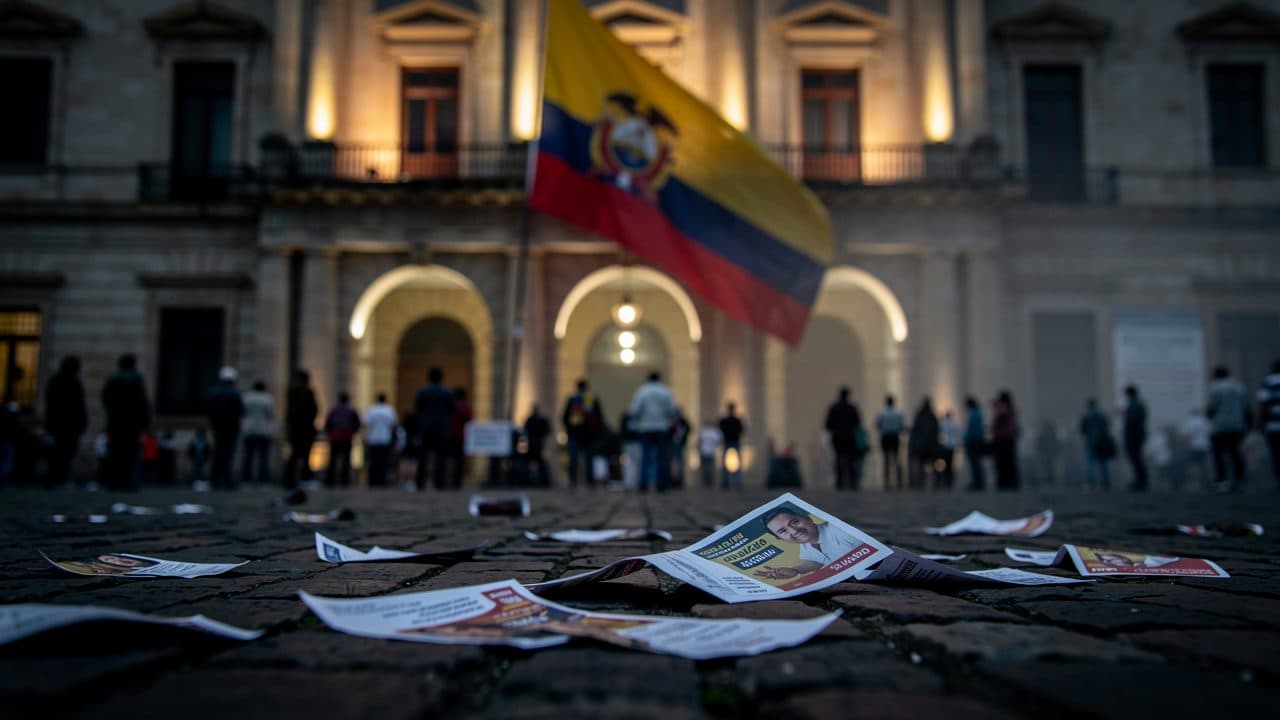
AI-generated image (flux-2/pro-text-to-image via Kie.ai)
Summary
The right-wing lawyer Abelardo de la Espriella has won the runoff election for the Colombian presidency with 49.7 to 48.7 percent against the left-wing candidate Iván Cepeda. The margin of approximately 250,000 votes is the narrowest in the history of Colombian presidential elections.
Bogotá, June 22, 2026
The right-wing lawyer and political newcomer Abelardo de la Espriella has narrowly won the runoff election for the Colombian presidency over left-wing candidate Iván Cepeda, according to preliminary results, with 49.7 to 48.7 percent.
A Victory with a Historically Narrow Margin
With de la Espriella's victory, the violence-plagued South American country is undergoing a sharp shift to the right. The 47-year-old jurist, entrepreneur, and political outsider will thus succeed Gustavo Petro, who leaves office on August 7. The gap of roughly 250,000 votes is the narrowest in the history of Colombian presidential elections.
De la Espriella first became known as a criminal defense attorney for prominent clients, including paramilitary leaders and suspected drug traffickers. His supporters call him "El Tigre" - the tiger. De la Espriella is an outspoken Trump fan. Politically, he visibly models himself on figures such as Donald Trump, Nayib Bukele, and Javier Milei.
De la Espriella Wins Colombia's Presidential Runoff by | allfacts360
Biography and Political Orientation
Politically, the right-wing populist advocates a hard line against armed groups. De la Espriella promises to clean up with an iron fist, bombs, and mega-prisons. He is planning a 90-day military offensive against criminal gangs and drug trafficking, has announced bombings against armed groups, and wants to resume the spraying of coca fields.
The president-elect also announced the construction of mega-prisons modeled on those of Salvadoran President Nayib Bukele, in which inmates are to live on "water and bread." He said he had "die Eier" to govern the country "with an iron fist." He also announced that he would receive military support from the United States and Israel for his security policy.
Security and Economic Course
In his economic policy course, de la Espriella is counting on deregulation. Among his most controversial proposals are shrinking the state apparatus by up to 40 percent, promoting fracking, and making greater use of fossil fuels. "Back to fossil fuels," summarizes Latin America expert Sabine Kurtenbach the new president's energy policy course. He wants to "abwickeln" the energy transition.
While Petro relied on his strategy of "Total Peace" (Paz Total) - negotiations with guerrillas and criminal groups - de la Espriella is announcing its end. Instead of dialogue, he wants military pressure. Ten years after the historic peace agreement between the Colombian government and the FARC guerrilla, many armed groups remain active in Colombia.
The election is overshadowed by the worst wave of violence in Colombia in a decade. The politically independent International Committee of the Red Cross spoke of the worst humanitarian crisis in ten years. The country's armed gangs exploited the state's demonstrative inaction displayed during the peace talks to expand their power in the territories.
Wave of Violence and Post-Election Protests
After the election, there were partly violent protests. In Bogotá and Cali, thousands of supporters of the defeated left-wing camp took to the streets. Some demonstrations escalated into clashes with police. The AFP news agency reported barricades, burning tires, and chants against the new president.
Cepeda has since conceded his defeat and called on his supporters to remain calm. At the same time, the defeated candidate pointed to the still-outstanding official review of all polling station records and announced that he would recognize the final result only after the procedure was completed. According to his campaign team, results from around 33,000 polling stations are being challenged.
Domestic and International Reactions
Colombia thus faces a clear shift to the right after a previously left-leaning government. Analyst Elizabeth Dickinson, deputy director for Latin America at the International Crisis Group, emphasized that it was precisely the regions particularly affected by the conflict that had voted predominantly for the opposing candidate, Iván Cepeda. This was a signal against an exclusively military strategy.
"Whoever governs must win the trust of the other half. This is not the moment for revenge or extreme politics, but for a path of reconciliation," Dickinson demanded. Kristin Wesemann, head of the Konrad-Adenauer-Stiftung office in Bogotá, also stated: "Colombia has voted, and it could hardly have been closer. The country is politically divided almost exactly down the middle."
In his victory speech, de la Espriella spoke of the beginning of a "new era" for Colombia. "I just spoke a few minutes ago with the President of the United States. He expressed his support and his recognition of our victory," he said after the phone call with Trump. Trump congratulated the right-wing lawyer by phone.
Outlook for a Divided Andean Region
The U.S. president had already openly supported "El Tigre" (the tiger) - as de la Espriella publicly calls himself - during the campaign. "The Trump administration looks forward to working closely with your incoming government," wrote U.S. Secretary of State Marco Rubio on the platform X. Argentina's President Javier Milei also celebrated the election victory with the words: "Freedom in the region can no longer be stopped."
When de la Espriella takes office, the entire Andean region - from Argentina through Bolivia, Chile, Peru, Ecuador, and Colombia - will be governed by right-wing heads of state. However, in Peru and Colombia, the defeated left does not yet recognize the election result. The Trump administration had classified Colombia last year as a country that was not fulfilling its international obligations in the fight against illegal drugs.
Some 41 million eligible voters live in Colombia. Political observer Yann of the Universidad del Rosario pointed out that neither candidate has a majority in Congress. Cepeda belongs to the ruling Pacto Histórico coalition and had announced during the campaign that he intended to continue the central projects of the Petro government. Colombia remains completely divided, concluded Sabine Kurtenbach, acting president of the GIGA Institute.
This news was broadcast on June 22, 2026, at 9:12 a.m. on Deutschlandfunk.
He was openly supported by Trump and had already received congratulations from the Republican camp in the United States. The president-elect therefore also wants to visibly tie in with U.S. and Argentine models: shrinking the state like Milei, security course like Bukele, political style like Trump. The coming weeks will show whether de la Espriella will be able to unite the divided country.
Questions & Answers
Who is Abelardo de la Espriella?
De la Espriella is a 47-year-old Colombian jurist, entrepreneur, and political newcomer who calls himself "El Tigre" and previously became known as a criminal defense attorney for paramilitary leaders and suspected drug traffickers.
Why was the victory so narrow?
According to preliminary results, de la Espriella received 49.7 percent and Cepeda 48.7 percent; the gap of approximately 250,000 votes is the narrowest in the history of Colombian presidential elections.
What political changes is de la Espriella announcing?
De la Espriella wants to end the "Total Peace" strategy and instead use military pressure against armed groups, shrink the state apparatus by up to 40 percent, and rely on fracking and fossil fuels.