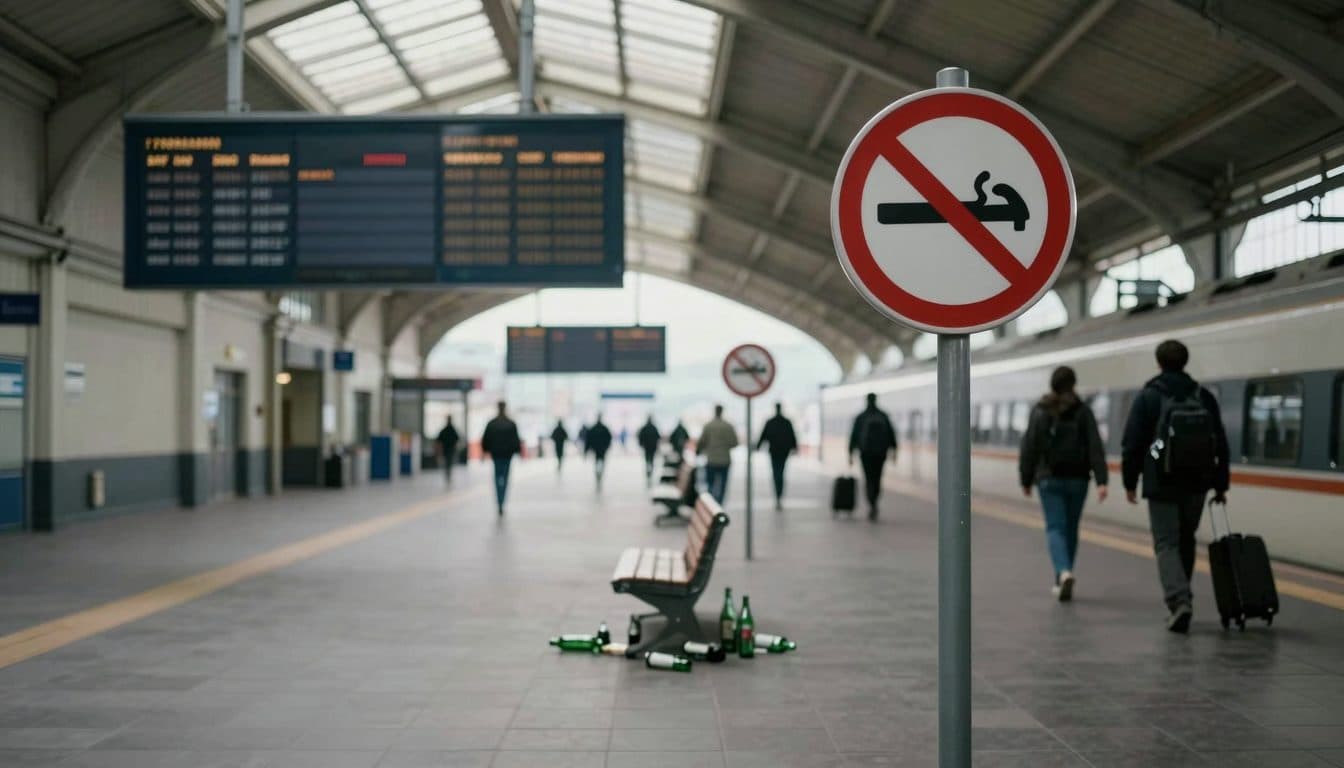
Deutsche Bahn announces nationwide alcohol ban at train stations – reactions are mixed
Berlin, July 22, 2026
AI-generated image (z-image via Kie.ai)
Summary
Deutsche Bahn intends to ban the consumption of alcohol from October 2026 at all 5,400 train stations in Germany. While police unions warn of insufficient staffing and social welfare organizations express concerns about homeless people, the federal drug commissioner Streeck and individual interior politicians fundamentally welcome the move.
Berlin, July 22, 2026
Deutsche Bahn has announced that it will ban the consumption of alcohol at all approximately 5,400 train stations in Germany from October 15, 2026, drawing approval but also significant concerns from police unions, social welfare organizations, and federal politicians.
What exactly is to be banned?
Deutsche Bahn announced on Tuesday that it would ban the consumption of alcohol at all German train stations. Bahn CEO Evelyn Palla told the Bild newspaper: „Zu oft mussten wir feststellen, dass dort, wo zu viel Alkohol fließt, auch die Gewalt zunimmt. Deshalb kommt jetzt das Alkoholverbot an Bahnhöfen. Es geht um den Schutz unserer Mitarbeitenden und Fahrgäste.“ She added: „Es reicht. Genug ist genug. Wir greifen jetzt noch härter durch. Wir wollen mehr Ordnung und Sicherheit auf unseren Bahnhöfen und in unseren Zügen. Für mich zählt nur eins: der Schutz unserer Kollegen und unserer Reisenden.“
According to the plans of the state-owned company, the ban is to be implemented in stages by October 15, 2026 at all 5,400 train stations. The purchase and transport of sealed bottles will remain permitted; the ban explicitly applies only to the drinking of beer, wine, or spirits on platforms and in station halls outside of station restaurants.
Support from federal politicians
Anyone who violates the ban must expect an immediate order to leave the premises. Repeat offenders face a permanent ban from the respective station, according to the Bild newspaper. Deutsche Bahn intends to enforce the ban with the help of the Federal Police at all 5,400 train stations, relying on its Hausrecht (property rights).
The federal government's drug commissioner, Hendrik Streeck, praised the move. Der Vorstoß der Deutschen Bahn ist richtig, Streeck told the Rheinische Post, calling it a gain for everyone. Train stations must be places where „sich Menschen sicher bewegen können und Eltern nicht überlegen müssen, welchen Bereichen sie mit ihren Kindern besser ausweichen“, he continued.
Criticism from police unions
The Gewerkschaft der Polizei (GdP) also fundamentally supports the ban. Its federal police chief Andreas Roßkopf said: „Bahnhöfe sind in Deutschland mittlerweile absolute Kriminalitäts-Hotspots. Der Alkoholkonsum vor allem in den großen Bahnhöfen, welche rund um die Uhr geöffnet sind, stellt ein großes Problem dar.“ To date, a ban on alcohol consumption has primarily applied at major German train stations such as Frankfurt, Hamburg, and Cologne.
Other police unions and social welfare organizations were notably more critical. The federal chairman of the Deutsche Polizeigewerkschaft (DPolG), Heiko Teggatz, told the Welt newspaper: „Das ist eine Sache des Hausrechts der Bahn. Sie muss dafür sorgen, mehr Sicherheitspersonal zu stellen.“ Anyone who demands „ein flächendeckendes Alkoholverbot an Bahnhöfen“ must also create „die personellen Voraussetzungen“ for it. The Federal Police would only be called in if people do not comply with an order to leave or commit further legal violations.
Manuel Ostermann, head of the Bundespolizeigewerkschaft, told MDR AKTUELL that it is impossible for federal police officers to be present at every station. Deutsche Bahn lacks both the technical equipment and the personnel to enforce the ban nationwide. The Bundespolizeigewerkschaft therefore considers the plan unenforceable.
Concerns from homeless services
Federal Interior Minister Alexander Dobrindt (CSU) described Palla's initiative in an initial response as „erstmal positiv, dass es eine Initiative der Deutschen Bahn gibt, genau in diese Richtung die Situation an Bahnhöfen zu verbessern“, but at the same time expressed concerns. He described the enforcement of such a ban as „problematisch“ and announced that he would speak with the Bahn CEO about „welche Grundlage, welche Informationen oder welche Studien sie vielleicht dazu hat“.
There was also support from the CDU/CSU parliamentary group, with a condition. The interior policy spokesperson Alexander Throm stated in Welt: „Dass die Deutsche Bahn ihre eigenen Sicherheitsbemühungen verstärkt, begrüße ich ausdrücklich. Dazu gehört aber auch, dass sie diese Regeln mit eigenem Personal durchsetzt.“ SPD interior politician Sebastian Fiedler demanded that implementation could only be considered „sofern die Bahn eine erhebliche personelle Verstärkung bei der DB Sicherheit nachweist“.
The Left and the AfD also registered criticism. The Left's legal expert Hoß said according to Welt: „Die Bahn wälze die Verantwortung ab und belaste die Angestellten noch stärker durch die Kontrolle von noch mehr Verboten.“ AfD transport politician Wiehle argued, however, that existing smoking bans can ultimately be enforced as well.
Substantial objections also came from homeless services. Joachim Krauß, deputy managing director of the Bundesarbeitsgemeinschaft Wohnungslosenhilfe (BAG W), told the Redaktionsnetzwerk Deutschland: „Durch das Verbot werden die Menschen in Bereiche gedrängt, die weniger Schutz bieten und weniger Anschluss an das Hilfesystem haben.“ In Hamburg, where a corresponding ban is already in place, the experience has been that people have been displaced into adjacent city districts. A ban does not change the living situation of people who spend time at the station, but merely displaces them from view.
Experience from Hamburg
Hamburg is considered a model, where an alcohol ban has been in effect at the main station since April 2024 and later also in Hamburg-Altona. Bahn reports that since then, there have been fewer conflicts and altercations as well as an improved perception of safety among travelers; the cleaning effort has also decreased according to an initial assessment. Numerous signs with a crossed-out bottle indicate the prohibited zone in front of the halls.
However, on-the-ground experiences are mixed. A Hamburg woman named Anne reported that it is significantly more pleasant to enter the station hall, it does not smell, and she is jostled and harassed less. Another Hamburg woman, Nicole, told MDR AKTUELL: „Ich würde sagen, die Leute sind vor allem nachts noch genauso betrunken wie früher.“ However, she herself has not yet experienced a dangerous situation.
Others see the ban as an infringement on freedom. A passerby named Andrea said: „Dann fühle ich mich wie in den USA. Das ist die Freiheit von Leuten.“ A traveler said he had not noticed any change in Hamburg and had not even noticed „dass es das [Alkoholverbot] überhaupt gibt“.
A seller at a station bakery at Hamburg main station named Mohammad assessed the ban positively: Drunk people sometimes fall onto the tracks, and with the ban it will be safer for people. Christoph, another respondent, demanded at the same time: „Die Polizei sollte schon härter durchgreifen“, but criticized that crime continues to occur around the station.
Background: Alcohol and safety at train stations
The Frankfurter Allgemeine Zeitung stated in an editorial: „Der Vorstoß der Bahn ist richtig.“ Alcohol consumption promotes aggressive behavior; large train stations are crime hotspots in many cities. At the same time, the paper conceded: „Ebenso offensichtlich ist jedoch, dass der Alkoholkonsum nicht das einzige Problem in Bahnhöfen ist. Ausufernder Drogenkonsum und wachsende Verwahrlosung kommen hinzu.“ Ultimately, the success of the ban will likely depend above all on whether it can be enforced consistently.
The background to the debate, according to the Deutsche Hauptstelle für Suchtfragen, is approximately 44,000 deaths per year attributable to alcohol consumption – one of the most common preventable causes of death in Germany. The Federal Police, alongside DB security personnel, is responsible for security at train stations and is subordinate to the Federal Interior Ministry; Bahn itself employs approximately 4,500 security personnel at the stations, according to its own figures.
Questions & Answers
What exactly has Deutsche Bahn announced?
Bahn intends to ban the consumption of beer, wine, or spirits on platforms and in station halls outside of restaurants from October 15, 2026 at all 5,400 train stations. The purchase and transport of sealed bottles is to remain permitted.
Who is supposed to enforce the ban?
Enforcement is to be carried out initially through DB security personnel via the company's property rights; according to DPolG chairman Heiko Teggatz, the Federal Police would only be called in if people do not comply with orders to leave or commit further offenses.
Why is the move being criticized?
Police unions and social welfare organizations warn of insufficient staffing for controls and of the displacement of homeless people into districts with fewer support services; Federal Interior Minister Alexander Dobrindt called enforcement „problematisch".
Alcohol ban at train stations: DB plan by October 2026 | allfacts360