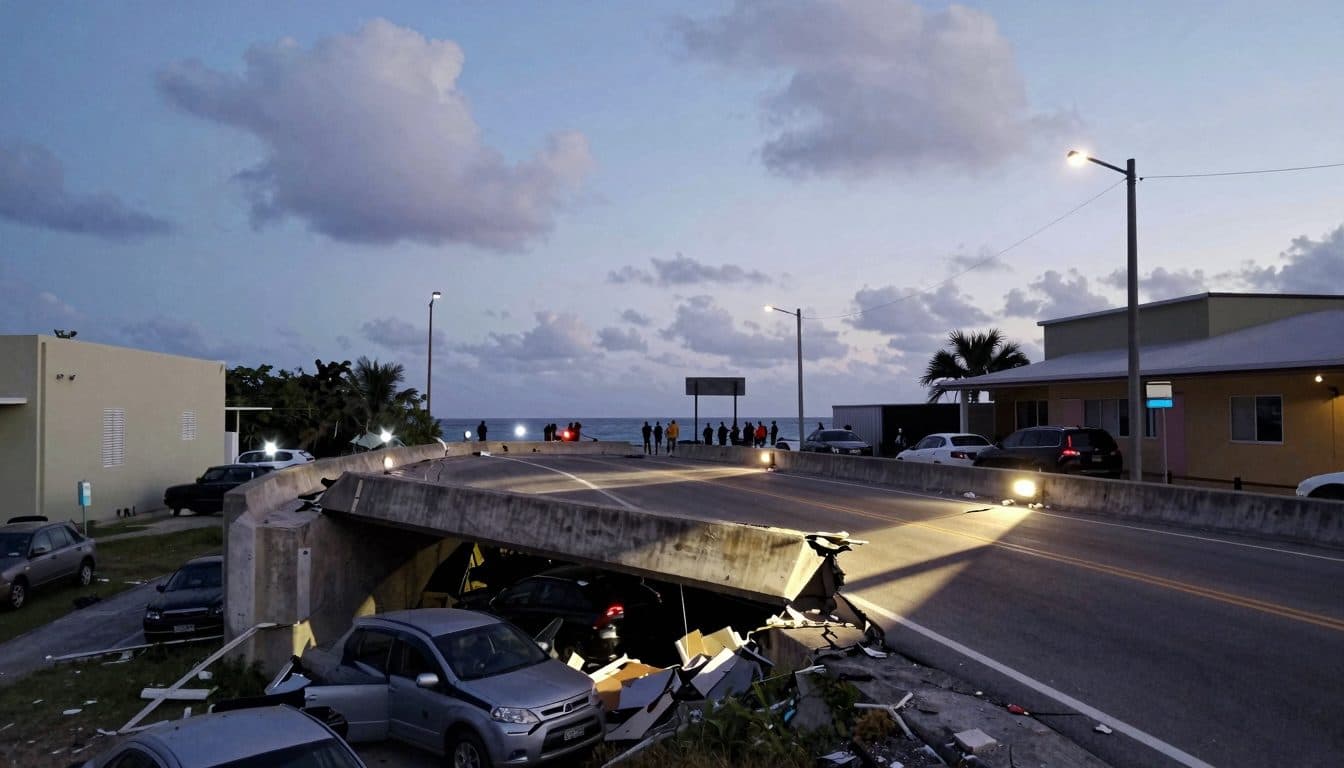
Double earthquake shakes Venezuela – authorities fear up to 10,000 dead
Caracas, June 25, 2026
AI-generated image (z-image via Kie.ai)
Summary
Two severe earthquakes of magnitude 7.2 and 7.5 struck Venezuela on Wednesday evening, triggering the strongest quake in the South American country in more than a century. Acting President Delcy Rodríguez declared a state of emergency, declared La Guaira a disaster zone, and announced a 200-million-dollar reconstruction fund.
Caracas, June 25, 2026
Two severe earthquakes of magnitude 7.2 and 7.5 struck northwestern Venezuela on Wednesday evening (local time), triggering the most powerful quake in the South American country in more than a century.
Double shock within 39 seconds
The first quake struck at 6:04 p.m. local time approximately 24 kilometers east of the city of San Felipe at a depth of 21.9 kilometers, according to the US earthquake monitoring agency USGS and the Austrian earthquake service GeoSphere Austria. Just 39 seconds later, a second tremor of magnitude 7.5 followed at a depth of around ten kilometers, with its epicenter near the small town of Yumare – according to the USGS, just five to ten kilometers from the first quake. The tremors were, according to the USGS, part of a so-called earthquake doublet, triggered by two closely neighboring faults at the plate boundary between the Caribbean and South American plates.
The metropolis of Caracas lay more than 150 kilometers east of the epicenter but was still shaken noticeably; the tremors could even be felt some 1,000 kilometers away in Bogotá, Colombia. The hardest hit was the state of La Guaira on the Caribbean coast, which is also home to the Simón Bolívar international airport and an important seaport. Acting President Delcy Rodríguez declared La Guaira a disaster zone overnight into Thursday and called on the population to remain calm: „Wir rufen unsere Bevölkerung dazu auf, Ruhe zu bewahren“.
Epicenter in the northwest – La Guaira worst affected
According to official figures, the death toll rose to at least 164 by early Thursday morning, with more than 1,500 people injured; authorities at one point spoke of up to 971 injured. A search platform set up specifically by the opposition abroad listed around 6,600 people as unaccounted for at around 2:00 a.m. local time; according to later reports, more than 10,000 people were considered missing. The USGS model suggests that the actual casualty count could run into the thousands; authorities fear up to 10,000 dead.
Rodríguez imposed a national state of emergency, had the metro and gas operations in Caracas suspended as a precaution, and ordered that all medical personnel report for duty at hospitals. Clinics such as the Hospital de Clínicas in Caracas doubled their night shifts, schools were closed for the rest of the week, with some of them to serve as emergency shelters and donation centers. The government called on the public to report damage via a specially set up app; at the same time, mobile phone connections collapsed in many neighborhoods, particularly in La Guaira.
State of emergency, appeals and aid pledges from around the world
President Donald Trump and US Secretary of State Marco Rubio immediately announced the deployment of search and rescue teams, medical assistance, and humanitarian aid. Rubio declared via the platform X: „Amerika steht in dieser schwierigen Zeit an der Seite des venezolanischen Volkes“. The US State Department set up a crisis unit to coordinate with Caracas. Trump wrote on Truth Social: „Die ersten Berichte sind nicht gut!!!“ and assured the country of swift assistance.
The European Union activated the Copernicus Earth observation program according to EU Crisis Management Commissioner Hadja Lahbib, with EU-funded partner organizations saying they were already on the ground. German Defense Minister Boris Pistorius stated that the Bundeswehr had six A400M transport aircraft on standby to bring personnel and relief supplies – also for the Federal Agency for Technical Relief and the German Red Cross – into the region. „Die Nachricht von den vielen Tausenden Toten in Venezuela hat mich tief erschüttert“, said Pistorius, „jetzt gilt es, schnell Hilfe zu leisten“.
Reactions from Germany and the EU
Salvadoran President Nayib Bukele also announced via X that 300 rescue workers and paramedics along with 50 tons of relief supplies were ready to be brought to Caracas. The presidents of Brazil, Mexico, and the Dominican Republic, as well as the prime ministers of India and Spain and Qatar also pledged support; China offered humanitarian aid, and Spain's Queen Letizia assured the neighboring country of assistance. German Chancellor Friedrich Merz declared via X: „Deutschland steht an der Seite Venezuelas und wird helfen“; the Foreign Office convened its crisis unit.
Rodríguez announced the establishment of a reconstruction fund of 200 million US dollars, financed with funds from the International Monetary Fund (IMF); it is to be used to rebuild infrastructure, hospitals, and housing. Caritas worker Rafael Filliger, who was in contact with people in Caracas via WhatsApp, warned in the meantime of the long-term consequences: „Jetzt braucht es sicher sauberes Wasser, Schutz, Zelte.“ He also described how entire rows of houses had collapsed in the slums of the capital and residents were digging through the rubble with their bare hands to recover relatives.
Venezuelan Gabriela Mesones Rojo, who spoke to the Tagesspiegel by voice message on the night after the quake, described her drive through parts of Caracas as follows: „Als ich zu ihm gefahren bin, hatte ich das Gefühl, ich fahre durch ein Kriegsgebiet: Überall lagen Trümmer, alles war voller Staub, fast alle Häuser hatten Schaden genommen. Die Straßen waren voller Menschen, die evakuiert wurden.“ She went on: „Die Einwohner kämpften sich mit Händen durch die Trümmer, um Angehörige zu retten. Etliche werden vermisst“, and added: „In Katastrophen wie diesen kann der fehlende Zugang zu Informationen Menschenleben kosten“.
Eyewitness accounts from Caracas
Mesones Rojo criticized the government's preparation: „Die venezolanische Regierung ist auf eine solche Katastrophe nicht vorbereitet. Es gibt große Korruptionsprobleme, eine stark defizitäre medizinische Versorgung. Weder Feuerwehr noch Zivilbevölkerung können darauf angemessen reagieren.“ Interior Minister Diosdado Cabello also acknowledged on state television: „Wir haben es mit einer äußerst alarmierenden Situation zu tun“ and warned that aftershocks could cause already damaged buildings to collapse further.
In Caracas, the mayor of the Chacao district, Gustavo Duque, ordered residents to move to safety in public squares; Mayor Carmen Meléndez confirmed at least 25 dead in the capital and requested heavy equipment to clear paths to collapsed houses. The tremors severely damaged the Simón Bolívar international airport in La Guaira, and operations were suspended. The responsible US authority briefly issued a precautionary tsunami warning for the region before lifting it again.
Geologists explained the unusual double nature of the quake by saying that the displacement of the earth's crust in the first quake increased the stress on a neighboring fault and thus triggered the second. According to geologist Marc Quigley of the University of Melbourne, it was a so-called strike-slip fault, in which rock masses slide past each other parallel. In the past 100 years, according to the USGS, there have been only seven earthquakes of magnitude 6 or greater within a 250-kilometer radius; the strongest earthquake ever recorded in Venezuela occurred in 1900 off the coast near Caracas with a magnitude of 7.7.
Geology: two faults, one rare double earthquake
UNICEF announced immediate financial assistance; donation accounts were set up in Germany and Austria – including the account of ZDF under the reference „ZDF Nothilfe Venezuela“ (IBAN DE65 1004 0060 0100 4006 00) as well as accounts of Caritas, Jugend Eine Welt, Samariterbund, and the Austrian Red Cross under the references „Erdbeben Venezuela“ or „Nothilfe Venezuela“. Many aid organizations also warned of misinformation: footage of older earthquakes from Turkey, Taiwan, and Mexico, as well as a video of a subway accident in Caracas from 2021, were circulating on social media, falsely disseminated as scenes from Venezuela.
The editorial team urged users to check questionable footage using reverse image searches, as numerous AI fakes had already been in circulation following the earthquakes in Myanmar and Thailand in the past. Due to the long-standing security situation, Venezuela was not considered a travel destination anyway; a partial or nationwide travel warning is in effect for the country, which is why the number of registered German citizens is in the „low three-digit range“ according to the Foreign Office, and the federal government is in close contact with the embassy in Caracas, whose staff are reported to be safe.
Austria's Caritas reported in the meantime that the nutritional situation in Venezuela had already been extremely critical before the disaster: according to estimates by World Vision, 7.9 million people in the country are already dependent on humanitarian aid, and according to the Austrian Red Cross, up to 80 percent of the population lives in poverty. Against this backdrop, several experts made clear that the first 24 hours after a quake of this magnitude are decisive for whether and how many buried survivors can still be recovered alive – given tropical temperatures in the affected region, according to Sabine Kurtenbach of the GIGA Institute in Hamburg, this window could be significantly shorter.
Misinformation and donation appeals
The editorial teams of the Tagesspiegel and other media pointed out that many news sites and the platform X are blocked in Venezuela and only accessible via VPN; the country is also among those with the slowest mobile internet
Earthquake Venezuela 2026: Double shock and aid pledges | allfacts360