Earthquake in Venezuela: Over 1,700 Dead, Tens of Thousands Missing, and Accusations Against the Government
Caracas, June 30, 2026
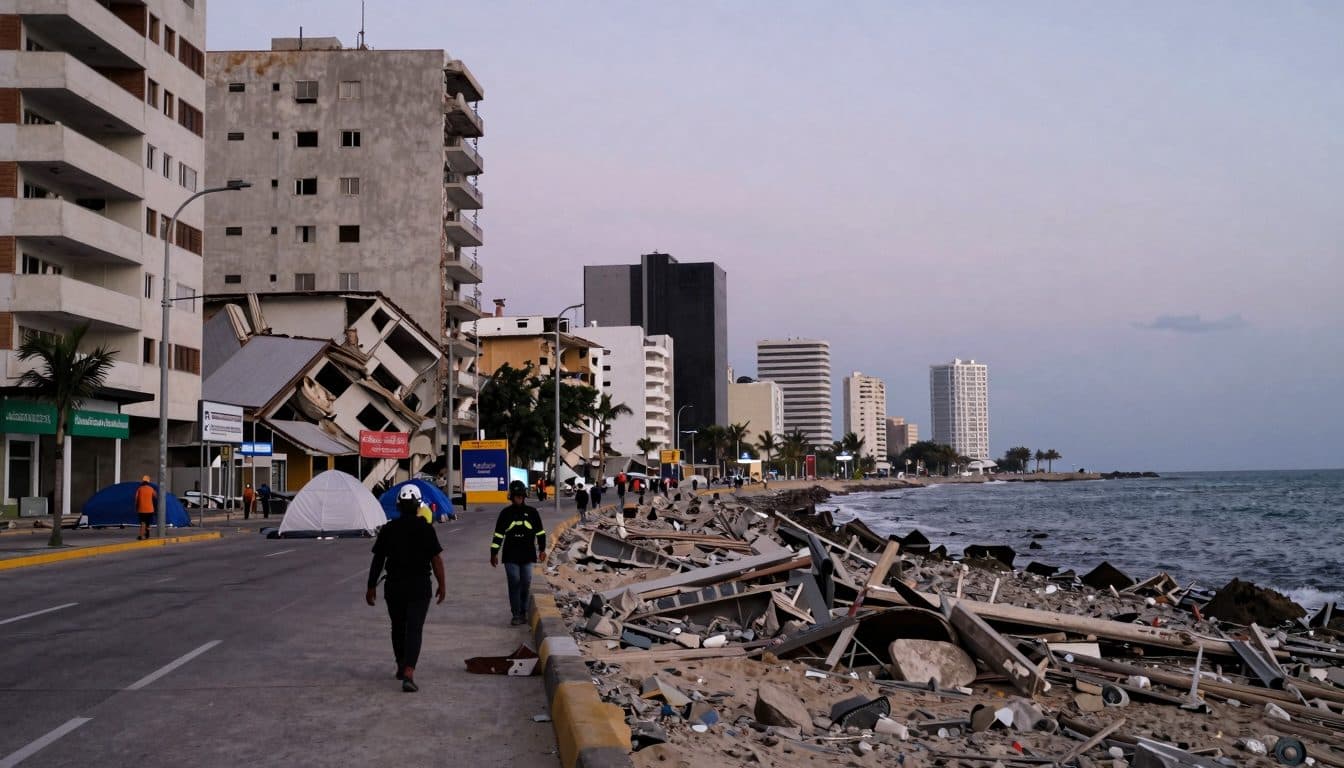
AI-generated image (z-image via Kie.ai)
Summary
Following the severe earthquakes of magnitude 7.2 and 7.5 in Venezuela, the official death toll has risen to more than 1,700, and tens of thousands of people are considered missing. International rescue teams continue to search for survivors amid the rubble of collapsed buildings, while the transitional government under Delcy Rodríguez faces criticism over its crisis management.
Caracas, June 30, 2026
After the two severe earthquakes of magnitude 7.2 and 7.5 on Wednesday evening, the official death toll in Venezuela has risen to at least 1,700, while according to UN figures, more than 50,000 people are still reported missing.
Destruction on the Coast
The two earthquakes, which struck in quick succession, leveled entire residential neighborhoods. Particularly hard hit is the coastal region of La Guaira with the cities of Catia La Mar and Caraballeda, where an estimated 30,000 people were present at the time of the earthquakes. Of those, according to authorities, some 13,500 were able to get themselves to safety.
The president of the National Assembly, Jorge Rodríguez, announced that the death toll has now risen to more than 1,700. More than 10,500 people were injured, around 3,200 of whom are being treated in hospitals, according to his statements. In the heavily affected region of La Guaira, there is no trace of around 10,000 people. He provided no information about the missing 10,000 people.
Casualty Figures and the Missing
According to the United Nations, more than 50,000 people are still reported missing. The unofficial platform for searching for missing persons has even recorded more than 47,000 open cases, after nearly 79,000 missing persons reports were filed. The actual numbers could be even higher, according to disaster relief workers. According to a model calculation by the US Earthquake Monitoring Agency USGS, the death toll could reach into the tens of thousands.
Rescue workers continue to search for those buried under the rubble. A total of around 30,000 Venezuelan emergency personnel and 2,700 rescue experts from 24 countries are deployed. According to UN figures, 27 countries had sent more than 2,200 aid workers to Venezuela by Saturday, including more than 500 from EU countries and Switzerland. In their luggage: field hospitals, medications – and 140 search dogs. The Jordanian and Turkish teams alone recovered several survivors, including, after 86 hours, a 60-year-old in Caraballeda, as well as a three-year-old boy who, according to Jordanian rescue workers, was rescued alive from the rubble. The boy received first aid on site and was taken to a hospital, the Jordanian civil defense reported.
International Rescue Operations
More than 70,000 families are dependent on humanitarian aid following the disaster. Shopping centers and other public buildings also collapsed – a total of around 2,500 residential buildings and other facilities. According to the latest damage assessment, around 780 residential buildings and 38 hospitals were destroyed or severely damaged. For the coastal region alone, including the cities of Catia La Mar, La Guaira, and Caraballeda, the UN emergency relief office estimates, using AI-supported analysis, more than 9,000 damaged or destroyed buildings.
According to the US space agency NASA, presumably more than 58,000 buildings have been damaged or destroyed. This is the result of a preliminary analysis of satellite data. The UN estimates that the earthquake disaster has left behind 1.2 million tons of debris. Satellite images show a crack in the runway extending for around 150 meters.
Criticism of the Government
The acting president, Delcy Rodríguez, had previously declared that rescue operations would not be halted. "Today we have recovered survivors, therefore the rescue operations will not be halted," she said on Sunday. In the days that followed, around 6,400 additional people were rescued by rescue teams, Rodríguez said. The transitional government, however, faces massive criticism. The government-critical journalist Orlando Avendano wrote on the platform X that the government is keeping rescue teams "from their work for a political act."
"There is a shortage of everything, above all of leadership and coordination." After long-time ruler Nicolás Maduro was arrested by the United States in January and taken out of the country, a structural reshuffle of the inner circle followed. Delcy Rodríguez, who was vice president under the Maduro government, is now the current head of state.
The desperation in the country is enormous: "People are sitting in front of building rubble because they know their family is buried underneath." How many people are buried is still unclear. "The smell is an indication that there are still bodies under the rubble," the human rights organization Provea wrote on the platform X over the weekend.
Humanitarian Situation and Aid
Almost one week after the quakes, hope of recovering survivors is fading. According to experts, the chances of survival for those buried drop sharply after 72 hours – that is, three days. "The critical time window of 72 to 96 hours, in which the probability of still rescuing living people from the rubble is highest, has now elapsed," says Christopher Bachtrog, disaster manager at the Austrian Red Cross.
In La Guaira, "food shortages are widespread, basic supply has broken down, and communications links are largely cut off," the UNHCR stated. UNHCR spokesperson Carlotta Wolf warned: "Tensions among the population are increasing because access to aid remains limited." According to estimates, approximately 13 million euros are needed for the protection, supply of relief goods, and emergency shelter for 30,000 earthquake victims for six months.
The World Health Organization (WHO) in Geneva stated that it fears the outbreak of diseases. Health services are under "extreme pressure," with facilities working "beyond their capacities given the influx of trauma patients," WHO spokesperson Christian Lindmeier told journalists in Geneva. Under the leadership of the UNHCR, a campaign for the protection of children has been launched to raise awareness and help with identification and the search for families.
Political Background
Anger among the population toward the government in Venezuela is growing. "There are more weapons here than shovels!" Since Friday, the coastal region of La Guaira, so severely devastated by the earthquakes, has been militarized. The fact that the government is not more quickly accepting the offered help from civil engineers at universities is "criminal," according to the architect and urban planner at Simón Bolívar University, Enrique Larranaga, speaking to the news agency Reuters.
Venezuela was already in a difficult situation before the earthquakes. For years, the country has suffered from political tensions, economic problems, and hyperinflation. Millions of people fled, and Venezuela is experiencing one of the largest migration crises in the world. After the change of power beginning in 2013, repression expanded significantly, and the economy collapsed – due in part, but not solely, to Western sanctions. Corruption became endemic, and the oil industry, nationalized by Chávez in 2007, lost profitability.
Outlook
More than 100 Venezuelans who were deported from the United States to the South American country shortly before the outbreak of the two devastating earthquakes are missing. According to the "ICE Flight Monitor," an initiative by "Human Rights First" that tracks deportation flights, 146 Venezuelans were aboard a deportation flight, including 19 women and seven children. Lisbeth Portillo, 58, reported that she had escaped from the rubble of a hotel together with about 20 other deportees and walked through the streets together with them looking for help.
Both political camps – opposition leader Machado as well as interim president Delcy Rodríguez – want to use the crisis politically to their own advantage. Phil Gunson of the Crisis Group Venezuela said: "There will certainly be further protests. But I do not think this is the right moment to exploit people's anger." The diaspora – some eight million Venezuelans who have fled abroad in recent years – have set up platforms where one can report missing persons or receive psychological help.
The two consecutive earthquakes on June 24 have devastated the coastal region. In addition to the 1,700 dead and more than 3,000 injured, at least 430 aftershocks have been recorded following the quakes of magnitude 7.2 and 7.5 on the early Wednesday evening, with another severe aftershock of magnitude 4.6 following on Monday. This report was broadcast on June 30, 2026 on the program Deutschlandfunk.
Questions & Answers
What is the current situation following the earthquakes in Venezuela?
After the quakes of magnitude 7.2 and 7.5 on June 24, 2026, the official death toll has risen to more than 1,700, and more than 10,500 people have been injured. According to UN figures, more than 50,000 people are still reported missing, and international rescue teams are searching through the rubble.
What role is the transitional government under Delcy Rodríguez playing?
Acting president Delcy Rodríguez has announced the continuation of rescue operations, but faces massive criticism over her crisis management. The opposition and aid workers accuse the government of blocking offers of help for political reasons.
What international aid is deployed?
Around 30,000 Venezuelan emergency personnel and 2,700 rescue experts from 24 countries are deployed, including teams from Jordan, Turkey, and China, as well as more than 500 aid workers from EU countries and Switzerland. The UNHCR has launched an appeal for approximately 13 million euros.
Earthquake Venezuela: Over 1,700 Dead, Relief Operation | allfacts360