ECB Leaves Key Interest Rate Unchanged at 2.25 Percent and Signals Further Rate Steps
Frankfurt am Main, 23 July 2026
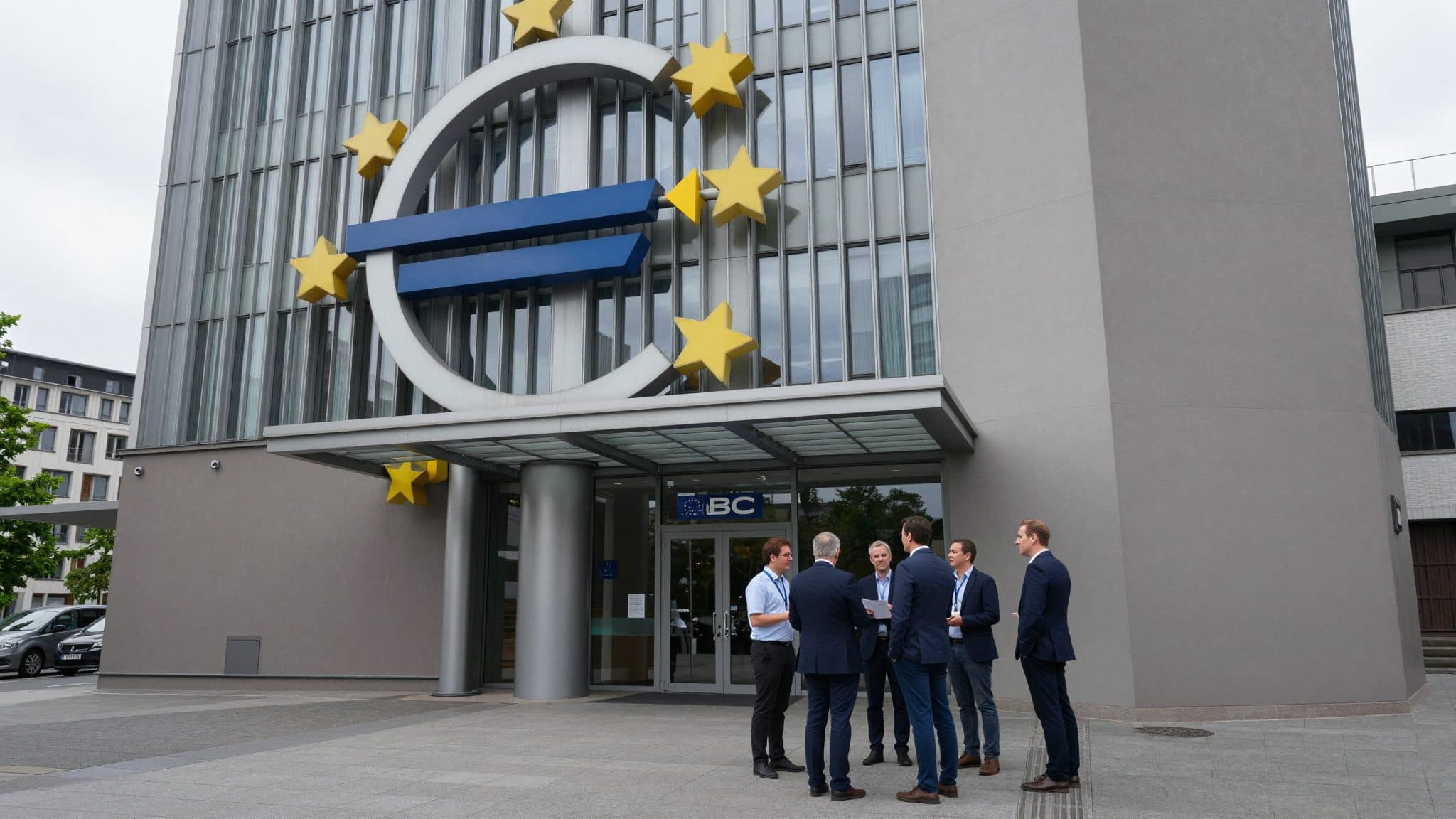
AI-generated image (z-image via Kie.ai)
Summary
The European Central Bank has left the key interest rate in the euro area unchanged at 2.25 percent, meeting economists' expectations. Given the uncertain situation surrounding the Iran conflict and rising energy prices, the central bank is keeping open the option of a rate move in September.
Frankfurt am Main, 23 July 2026
The European Central Bank (ECB) left the deposit rate — which is decisive for banks and savers — unchanged at 2.25 percent on Thursday and kept the door open for another rate hike at its next meeting on 10 September.
Expected Pause After June Hike
The decision by the ECB Council in Frankfurt am Main came as no surprise: economists had expected it almost unanimously. After the first rate increase in nearly three years in June, when the central bank raised the deposit rate by 0.25 percentage points to 2.25 percent, the body now took a pause to await further developments in inflation and the economy.
In a statement following the Council meeting, the ECB justified the move by pointing to ongoing uncertainty. „Die Unsicherheit ist nach wie vor hoch, und die Auswirkungen des Energieschocks auf die Inflation sind noch nicht vollständig zum Tragen gekommen“, the central bank said. It was firmly determined to calibrate monetary policy so that the inflation rate stabilizes at the target value of two percent over the medium term.
Inflation Development in the Euro Area
Inflation in the euro area eased slightly in June. Consumer prices were 2.8 percent above the level of the same month a year earlier, after the rate had stood at 3.2 percent in May. In Germany, a fuel discount dampened price increases further; the inflation rate there fell to 2.3 percent. Nonetheless, the ECB continues to see risks tilted to the upside.
Iran Conflict Drives Up Energy Prices
The background to the current hesitation is the war between the United States and Iran, which has reignited and is once again pushing oil prices higher. The price of a barrel of North Sea Brent crude is moving toward the symbolic mark of 100 US dollars after rising some 35 percent since the war began. Attacks by Iran-allied Houthi forces on oil tankers in the Red Sea have further aggravated the situation.
With an eye to the energy crisis that followed the start of the Ukraine war in February 2022, the central bank is determined to prevent another price spiral. At that time, an initially underestimated inflation surge forced the ECB into a series of drastic rate hikes. In ten consecutive steps, the deposit rate rose between July 2022 and September 2023 from minus 0.50 percent to 4.00 percent, before being brought back down to 2.00 percent through eight rate cuts.
Economists Majority in Favor of September Rate Move
Market analyst Maximilian Wienke of the trading platform eToro sees the ECB in a difficult position. „Hält sich der Ölpreis dauerhaft über 90 Dollar je Barrel, könnte das Inflationsgespenst schneller zurückkehren, als vielen lieb ist“, he said. It will be crucial how ECB President Christine Lagarde assesses the rise in oil prices.
The ECB President emphasized in the press conference that the risks to the inflation outlook were „aufwärts gerichtet". In the past, the 70-year-old had repeatedly stressed that the central bank does not need to react to every short-term supply shock.
Economists nevertheless predominantly expect another rate hike in September. „Aufgeschoben ist nicht aufgehoben", said Jörg Kramer, chief economist at Commerzbank. The deposit rate of 2.25 percent is too low to combat the increased inflation risks. Ulrich Kater, chief economist at Dekabank, warned: „Bei Rohölpreisen von wieder um die 100 US-Dollar werden die kommenden Inflationsraten wieder anziehen."
Martin Wolburg, economist at Generali Investments, also sees the tendency toward further tightening: „Wir sind uns jedoch bewusst, dass die Risiken weiterhin in Richtung einer abschließenden Zinserhöhung tendieren, die voraussichtlich im September erfolgen wird, insbesondere dann, wenn die jüngste Eskalation im Iran-Konflikt anhalten sollte."
Counterarguments from the Core Countries
Headwind is coming from the core countries of the eurozone. Roger Rüegg of asset manager Swisscanto pointed out that tighter monetary policy could choke off economic activity in Germany and France. „Heute stehen jedoch die Kernländer unter Druck", he stressed. If the Iran conflict does not escalate dramatically, he considers it unlikely that there will be any further tightening at all.
Friedrich Heinemann of the Leibniz Centre for European Economic Research (ZEW) backed the ECB's wait-and-see course: „Weil die Lage im Iran-Krieg so unübersichtlich ist, war es jetzt richtig, abzuwarten." For the September meeting, he pointed to the new inflation and economic data that would be available by then.
Florian Heider of the Leibniz Institute for Financial Market Research put it similarly: „Mit den neuen Inflations- und Konjunkturdaten nach der Sommerpause wird die EZB besser beurteilen können, ob der aktuelle Kostendruck eine weitere geldpolitische Straffung erforderlich macht."
A contrary position was taken by Konstantin Veit, portfolio manager at asset manager Pimco. „Die Energiepreise gesunken, die Inflationsrate im Juni schwächer als erwartet, das Lohnwachstum im Einklang mit dem Inflationsziel, das Wirtschaftswachstum verhalten – das alles spricht eher für weniger Zinserhöhungen, als die Märkte derzeit einpreisen", he said. For the remainder of the year, however, Pimco still expects a final rate hike in September.
Effects on Savers and Mortgage Financing
Andreas Bley, chief economist of the banking association BVR, considers the ECB well positioned with the current rate level „um nicht auf jede Preisschwankung reagieren zu müssen und die Entwicklungen vorerst beobachten zu können". According to observers, futures markets are already pricing in a 25-basis-point hike for September, which would bring the deposit rate to 2.5 percent.
The impact on consumers in Germany is limited. Following the June rate hike, according to an analysis by the comparison portal Verivox, only 17 percent of the 823 banks examined had raised their overnight deposit rates, by an average of 0.18 percentage points. Overnight deposit offers available nationwide currently yield an average of 1.38 percent interest, with some individual institutions temporarily enticing new customers with up to 4 percent. Mortgage rates have been moving sideways since spring and, depending on the fixed-rate period, range between roughly 3.3 and 3.65 percent.
The price increases of recent years continue to have an effect to this day: food is about a third more expensive than in 2019. The unemployment rate in the euro area currently stands at just 6.2 percent, the lowest level since the introduction of the euro in January 1999. In May, the EU Commission lowered its growth expectations for the EU from 1.4 to 1.1 percent.
In its latest June forecast, the ECB assumes that the inflation rate in the euro area will average 3.0 percent this year due to the Iran war. The growth forecast for the 21 eurozone states was reduced to 0.9 percent. For the September meeting, attention now shifts to the upcoming ECB projections and Lagarde's choice of words.
Questions & Answers
At what level did the ECB set the key interest rate in July 2026?
The ECB left the decisive deposit rate unchanged at 2.25 percent on 23 July 2026, after having raised it by 0.25 percentage points in June 2026.
Why did the ECB not raise rates again in July?
The central bank justified the pause by citing the ongoing uncertainty caused by the Iran conflict and rising energy prices; the effects of the energy shock on inflation are not yet fully foreseeable.
What rate decision do economists expect for the next ECB meeting in September 2026?
Many bank economists, including Jörg Kramer of Commerzbank and Martin Wolburg of Generali Investments, expect another hike of 0.25 percentage points to 2.5 percent, provided the Iran conflict keeps energy prices high.
ECB Key Rate 2.25 Percent: ECB Council Pauses in July 2026 | allfacts360