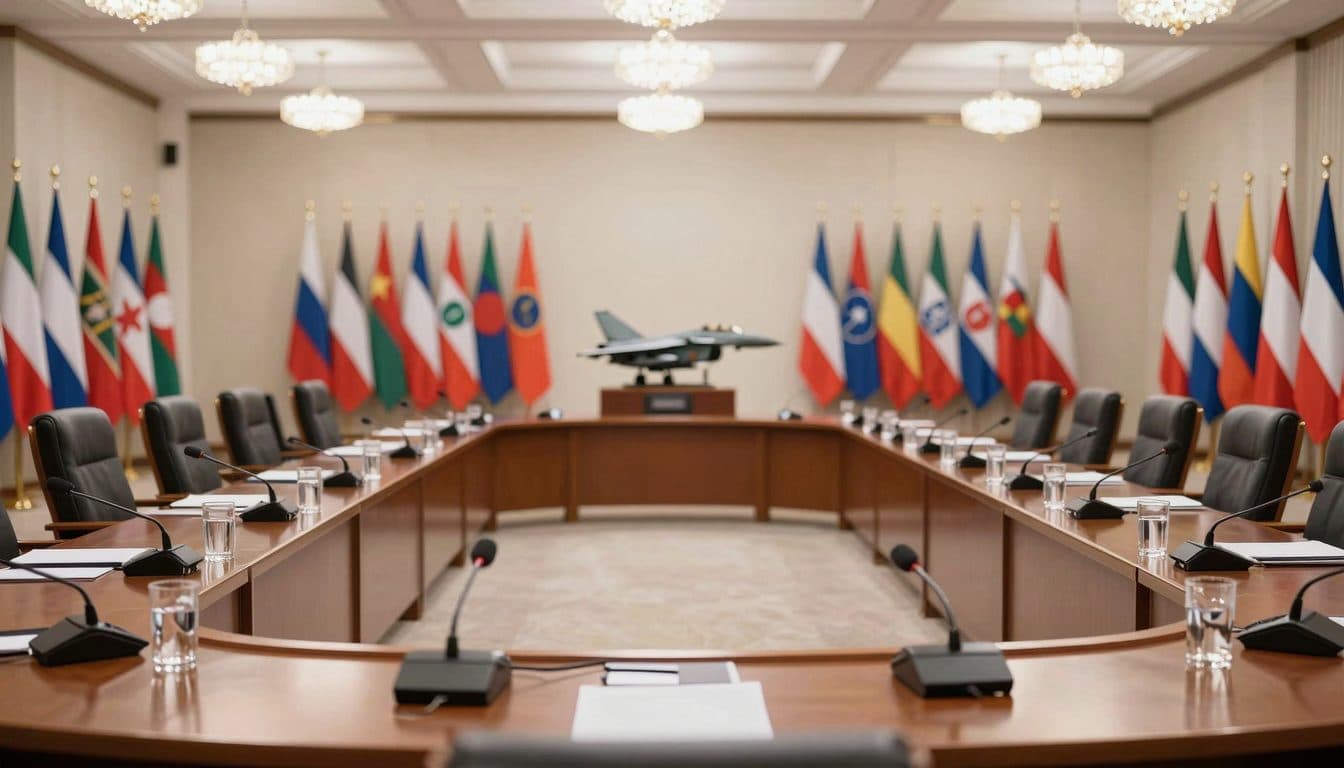
Erdogan Hosts NATO Summit in Ankara as Turkey Pushes for F-35 Return and Strategic Autonomy
Ankara, 05 July 2026
AI-generated image (z-image via Kie.ai)
Summary
The 32 NATO heads of state and government are meeting in Ankara on Tuesday and Wednesday at a summit hosted by Turkish President Recep Tayyip Erdogan. US President Donald Trump is attending, with hopes in Ankara that the meeting could revive the blocked F-35 jet deal and unlock other defense cooperation.
Ankara, 05 July 2026
The 32 heads of state and government of the Western defense alliance are gathering in Ankara on Tuesday and Wednesday for a NATO summit hosted by Turkish President Recep Tayyip Erdogan, with US President Donald Trump in attendance and Turkey pressing for a breakthrough on long-blocked F-35 fighter jets.
What's new since the previous update
Update 5 July 2026: Erdogan is hosting the alliance's leaders in Ankara for only the second time since Turkey joined NATO in 1952, with new signs that the United States is weighing whether to revive F-35 deliveries and supply engines for Turkey's own Kaan combat aircraft.
On the eve of the meeting, reports indicate that in December 2025, Erdogan asked Russian President Vladimir Putin to take back the S-400 air defense systems Ankara purchased from Russia, a step that could clear the way for Washington's trust. Last week, Trump gave Turkey new hope of returning to the F-35 program, and US officials are now studying whether to provide engines for the Turkish-built Kaan fighter and to lift the F-35 freeze that has lasted years.
Turkey's defense industry takes center stage
Trump framed his own attendance as a personal courtesy. "Ich komme nur aus Respekt für Präsident Erdoğan", he had announced, signaling that deliverables for Ankara were on the table, including Triebwerke für die türkischen Kaan-Kampfflugzeuge and movement on the F-35 file that Washington has held back since Ankara's purchase of the Russian S-400 system.
Turkey's defense industry is being marketed as a key asset of the summit. Turkish officials note that 56 Prozent der Exporte gehen Richtung westliche Staaten, and that the sector is now worth roughly 10 billion dollars. The country ranks eleventh among global arms producers and aims for the top ten, while high-tech drones such as the Bayraktar TB2 have become a flagship product used by countries including Ukraine. NATO Secretary General Mark Rutte praises the "Revolution" der türkischen Rüstungsindustrie.
Beyond jets, the gathering is shadowed by an unresolved spending question: how the allies will meet the agreed goal of spending five percent of GDP on defense by 2035. A presentation slide in golden letters simply labelled the target "The Trump Trillion", reflecting the scale of the increase allies are being asked to make. The infrastructure program alone is sized at around 28 billion US dollars and includes an underground fuel pipeline now under construction in Turkey to safeguard alliance supply lines. By 2028, a multinational NATO ground forces command center in Adana and a maritime hub in Istanbul are also planned.
Spending fight and the Trump Trillion
The political backdrop is tense. There is growing concern among allies that Trump is seeking conflict at the summit, and he is reportedly angry at European partners for not supporting him in the Iran war. At the same time, Trump has occasionally praised Germany's rising defense outlays, telling Chancellor Friedrich Merz: "Ich weiß, dass Sie jetzt mehr Geld für die Verteidigung ausgeben - und zwar ziemlich viel mehr." Yet Trump also recently renewed his criticism of European defense spending, calling it "lächerlich" and announcing the withdrawal of 5,000 US troops from Germany along with a halt to the delivery of Tomahawk cruise missiles that his predecessor Joe Biden had promised two years ago.
One of the loudest subplots involves Italian Prime Minister Giorgia Meloni. After the G7 summit in Évian, France, a social media dispute erupted following Trump's claim that Meloni had begged him for a photograph at the gathering. Meloni bezeichnete dies als "völlig erfunden". Spanish Prime Minister Pedro Sánchez added his own criticism of allies who defer to Washington, saying "blinder und unterwürfiger Gehorsam" sei kein Ausdruck von Führung.
Erdogan's strategic play: symbolism and mediators
For Erdogan, the Ankara meeting is a chance to consolidate his country's weight inside the alliance. The summit comes 22 years after Turkey hosted NATO for the first and only time since joining in 1952. Analysts say the symbolism matters. Cengiz Günay, director of the Austrian Institute for International Politics, argues that the gathering sends a message domestically that "wir spielen in der globalen Liga mit" while also signaling to neighbors less friendly to Ankara, including Israel and Greece, "dass man ein tragendes Mitglied der Allianz ist."
Turkey's role in regional conflicts has raised its profile inside the alliance. Ankara asserts that it can offer both military and diplomatic strength, "Die Türkei kann nicht nur mit militärischer, sondern auch diplomatischer Stärke aufwarten", and presents itself as a mediator in the war in Ukraine. The fall of Syrian President Bashar al-Assad's long-time rival to a former Islamist leader long supported by Turkey has also altered the regional balance in ways Turkish officials say underscore their relevance.
At the same time, friction with Washington over the S-400 purchase remains a defining feature of the bilateral relationship. The list of Turkish provocations inside the alliance is long: in 2009, Ankara opposed the appointment of Danish politician Anders Fogh Rasmussen as NATO Secretary General after a Danish newspaper printed cartoons of the Prophet Muhammad. The United States later removed Turkey from the F-35 program and at times restricted major arms deliveries.
Long history of friction with Washington
European leaders, for their part, appear to be hedging. Günay is convinced that "manche europäischen Regierungschef lieber das bekannte Übel in Kauf nehmen" als die Ungewissheit, die ein innenpolitisch instabiles oder geschwächtes Türkei mit sich bringen könnte. His summary of the European approach: "Man arrangiert sich mit Erdoğan." Within the alliance, Ankara has also carved out operating space it considers essential, "Freiräume geschaffen, die aus Sicht der Regierung für die eigenen nationalen Sicherheitsinteressen notwendig sind."
Symbolic gifts have already begun making the rounds. Merz took another stab at smoothing things over with a present at the G7 in Évian, this time a Germany jersey marking the country's 80th anniversary. At the Ankara summit, Trump has at times been defended in public by Rutte, who has courted him with lines such as "Europa wird kräftig zur Kassa gebeten werden - so wie es sein sollte - und es wird dein Sieg sein." Earlier this year, Rutte successfully mediated in the Greenland dispute that Trump had triggered.
Construction work around the summit venues has been heavy, with workers laboring into the night, as one man told Turkish television: "Wir machen bis in die Nacht hinein Überstunden." Below the surface, Turkey's military, the second-largest in NATO, and its expanding defense industry are central to Ankara's pitch that Erdoğan zeigt beim NATO-Gipfel, wie sehr Europa ihn braucht.
Construction and ceremony in Ankara
Turkey is also pitching what European governments have long debated under the label of "strategische Autonomie": the ability to act and equip itself without depending on outside suppliers. Whether the summit delivers on F-35s, Kaan engines and the broader defense spending question will indicate how much of that autonomy Ankara is now being offered by its allies.
The summit's political floor remains fragile. Trump's mixed signals on defense spending, the troop pullout from Germany, the stalled Tomahawk deliveries and his clash with Meloni all suggest that the Ankara meeting will blend ceremony, deal-making and open dispute. For Erdogan, however, hosting the alliance for only the second time in seven decades is itself a result, and one that the Turkish leader intends to use, "um in aller Bescheidenheit" die Bedeutung seines Landes im Bündnis zu festigen.
Questions & Answers
Why is Turkey pushing for F-35 jets at the Ankara summit?
Ankara was removed from the F-35 program after purchasing Russian S-400 air defense systems, and officials have cited reports that Erdogan asked Putin in December 2025 to take the systems back. A return to the F-35 line and possible US engines for Turkey's Kaan fighter would mark a major thaw in ties with Washington.
What is the 'Trump Trillion' and why does it matter?
The label refers to the scale of new defense spending NATO allies are being asked to reach under the goal of five percent of GDP by 2035, a target promoted by the US president. A summit slide displayed the phrase in golden letters, underlining how much money is at stake for every member state.
Why are European leaders prepared to work with Erdogan despite tensions?
Analyst Cengiz Günay argues that several European governments "man arrangiert sich mit Erdoğan" rather than risk the uncertainty of an internally unstable or weakened Turkey, given its second-largest army in NATO, its defense exports and its claimed diplomatic role in conflicts including Ukraine.
NATO Summit Ankara: Turkey Pushes for F-35 Return | allfacts360