Escalation in the Strait of Hormuz: Iran Fires on Emirati Tanker, US Expands Attacks
Dubai/Tehran, July 14, 2026
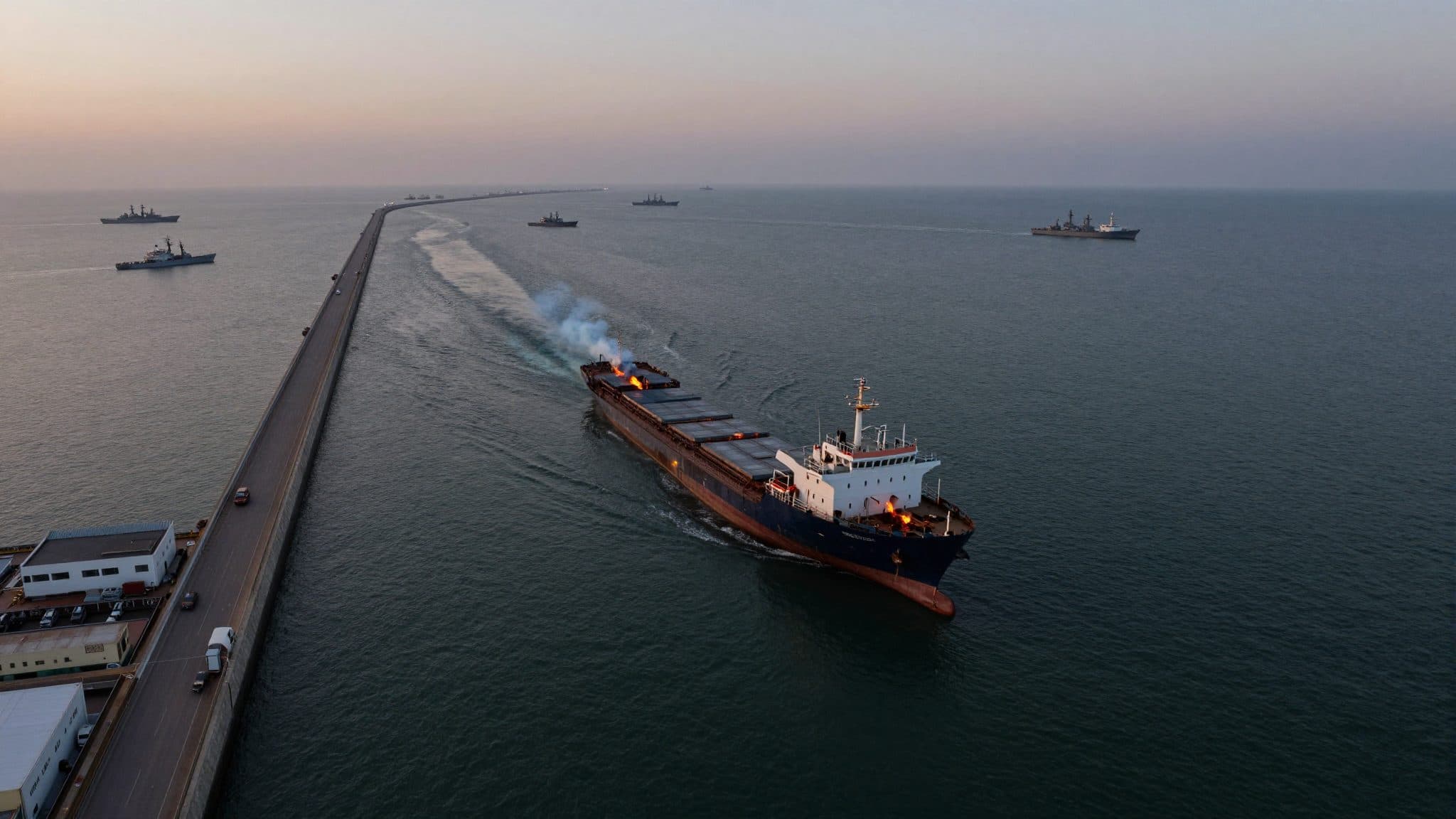
AI-generated image (z-image via Kie.ai)
Summary
Iran attacked two United Arab Emirates oil tankers in the Strait of Hormuz with cruise missiles, killing one Indian crew member. At the same time, the US expanded its airstrikes on Iranian targets and announced a naval blockade, while a 20 percent transit fee on shipping proposed by US President Trump has been met with international rejection.
Dubai/Tehran, July 14, 2026
Iran attacked two oil tankers sailing under the flag of the United Arab Emirates in the Strait of Hormuz with cruise missiles during the night into Tuesday, killing one Indian crew member and injuring eight people, while the US expanded its strikes on Iranian targets and air raid sirens once again wailed in the Gulf state of Bahrain.
According to the United Arab Emirates (UAE) Ministry of Defense, the two tankers were hit by two cruise missiles while transiting on the southern shipping route within Omani territorial waters. It said fires had broken out on both vessels but were later brought under control. The attack killed one Indian crew member, according to the UAE. Eight people were injured, including six Indian and two Ukrainian nationals.
As the Gulf state reported on X, the Emirates reserved the right to respond to this escalation. The attack constitutes a "serious violation and clear breach of international law," the Ministry of Defense stated. It is a serious violation of international law that endangers the security and stability in the region. The ships had been sailing under the UAE flag.
Background: Attack on the Tankers
The tensions in the strait are part of an intensifying conflict between the US and Iran. US President Donald Trump declared the ceasefire with Tehran ended just a few days ago. US forces have repeatedly struck Iranian targets in recent days. The military cited Iranian attacks on ships in the Strait of Hormuz as justification. During the night into Tuesday, the US once again bombed numerous locations across the country, according to the responsible US military regional command (Centcom).
Iranian state television reported explosions on Kish Island as well as in the port city of Bandar Abbas during the night into Tuesday (local time). Iranian media have again reported explosions along the southern coast. State radio reported five detonations in the west of the port city of Bandar Abbas. Shortly afterward, the city of Bushehr came under fire, the state news agency Irna reported. Four districts had been targeted, according to the report citing the vice governor of the province of the same name.
US Strikes on Iranian Targets
Centcom named several locations, including Bandar Abbas and Bushehr. Coastal defense facilities, missile and drone launchers, and naval targets were hit, the regional command said. Among the targets struck were, according to US accounts, missile sites, drone sites, and air defense systems. No details on damage or casualties were initially available. Centcom said the strikes had occurred "during the night into Tuesday" and constituted the "third consecutive nightly wave of attacks." At 10:45 pm CEST, US forces had struck targets in Iran for the third time in a row.
The multi-hour strikes were intended to further restrict Iran's ability to carry out attacks on innocent civilians and commercial shipping in the Strait of Hormuz, the US said. Iran in turn responded to the US strikes with retaliatory attacks — including on Gulf states. Air raid sirens once again wailed in the Gulf state of Bahrain. The interior ministry of the country, which is allied with the US, called on residents via the X platform during the night to remain calm and seek shelter.
Iran's Retaliation: Bahrain, Jordan, and the Persian Gulf
According to Iranian accounts as reported by a state broadcaster, Iran's Revolutionary Guard (IRGC) once again struck targets in Bahrain, hitting several weapons depots, a satellite communications center, and a residential building for US soldiers at a military base. Jordan reported on Tuesday that it had repelled new missile attacks from Iran; four missiles had been intercepted and shot down after entering Jordanian airspace.
Parallel to the military operations, Trump expanded the pressure on international shipping: the US president announced that the US would henceforth claim 20 percent of the cargo value for the safe passage through the Strait of Hormuz, citing fairness and the need to offset the costs of ensuring safe passage. Trump had also announced further US attacks on Iran shortly before. The country would be hit hard tonight — just like tomorrow, he said Monday afternoon (local time) in a radio interview. Iran cannot do anything about it, he emphasized.
Trump's 20 Percent Fee and the Backlash
Meanwhile, Iran fired on two United Arab Emirates oil tankers in the Strait of Hormuz, the Gulf state reported. Reacting to the proposal of a 20 percent fee, Iranian Foreign Minister Abbas Araqchi responded ironically on X, writing: "20 Prozent sind natürlich zu viel. Wir werden fair sein". Iran in turn announced a naval blockade, to take effect on July 14, 2026 at 10:00 pm CET and covering the entire Iranian coast including all ports and oil terminals.
The United Nations shipping organization also rejected the proposal: there was no legal basis for it. The US had previously rejected similar plans proposed by Iran as unacceptable. US Secretary of State Marco Rubio had stated at the end of June that no country had the right to charge money for the use of international waters, since they belonged to no state, and that such a demand would never be part of an acceptable agreement.
Blockade, Oil Price, and Military Buildup
Trump also hinted in the radio interview that the US could attack a deep underground facility in central Iran, known as "Pickaxe Mountain" and located near the Natanz nuclear facility. He described the site as "a possible target" for a "big, fat" strike that would "presumably come relatively soon." Trump also announced via his social network Truth Social that he would deliver an address to the nation on Friday at 3:00 pm CEST, without specifying a particular topic.
The dpa-AFX news agency reported that Iran's naval blockade was to take effect on July 14, 2026 at 10:00 pm CET. According to Tehran, the passage of neutral ships through the Strait of Hormuz to ports outside Iran would not be impeded by the blockade. The price of a barrel of crude oil rose by nearly eight percent amid the tensions. In view of the military escalation, more than 50,000 US soldiers are currently stationed in the Middle East.
Outlook and Unresolved Questions
The report was broadcast on July 14, 2026 on Deutschlandfunk. Iranian state radio had previously reported explosions on Qeshm Island in the Strait of Hormuz. Eyewitnesses described the situation in Bandar Abbas as confusing; details on damage and casualties were initially pending. The deadly attack on the two tankers is part of a series of escalations that are reinforcing fears of the conflict spreading to other states bordering the Persian Gulf.
Questions & Answers
What happened in the Strait of Hormuz?
According to the United Arab Emirates, Iran attacked two oil tankers sailing under its flag within Omani territorial waters with two cruise missiles, killing one Indian crew member and injuring eight people.
How did the US respond to the escalation?
The US struck Iranian targets such as coastal defense installations, missile sites, and naval facilities in Bandar Abbas and Bushehr for the third consecutive night, while also announcing a naval blockade and a 20 percent fee on shipping through the strait.
Why is the International Maritime Organization rejecting the US proposal?
The IMO rejected the plan for a 20 percent mandatory fee on the grounds that there is no legal basis for it, since international waters belong to no state.
Iran War: Tanker Attack and US Strikes Escalate Crisis | allfacts360