EU and China Agree on New Consultation Mechanism for Trade – October Set as Deadline for Results
Brussels, 30 June 2026
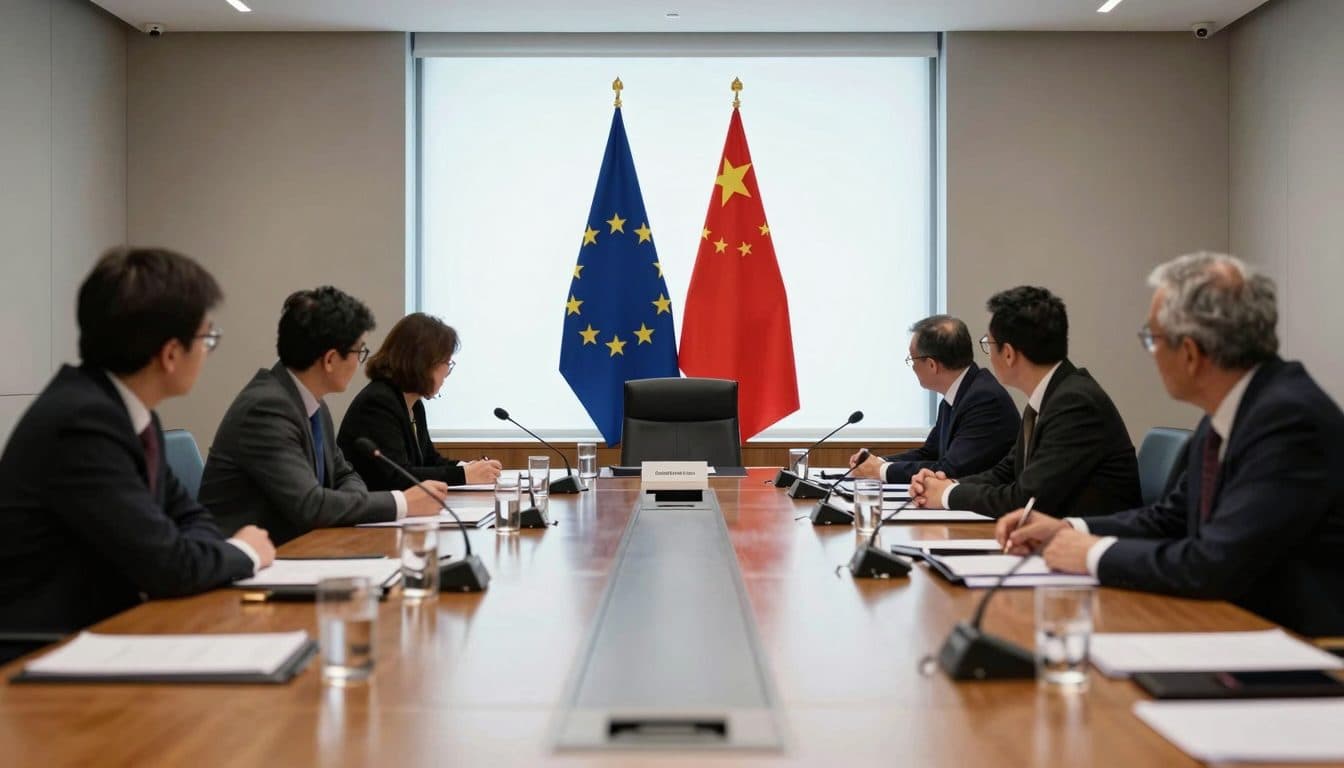
AI-generated image (z-image via Kie.ai)
Summary
The EU and China have agreed in Brussels on a new high-level consultation mechanism to address growing trade tensions and the daily trade deficit of one billion euros. EU Trade Commissioner Maroš Šefčovič announced he would travel to Beijing in October to present initial concrete results.
Brussels, 30 June 2026
The European Union and China agreed on Monday in Brussels on the establishment of a new high-level consultation mechanism to manage growing trade policy tensions and address the widening trade deficit.
The meeting between Chinese Trade Minister Wang Wentao and EU Trade Commissioner Maroš Šefčovič marks a new attempt by both sides to steer the conflicts in bilateral trade, which have been simmering for years, into orderly channels. Šefčovič subsequently spoke of "intensive, focused and constructive" talks, but at the same time warned that the EU would act if no tangible progress were achieved by autumn.
Marathon of Negotiations with a Warning Signal
As Šefčovič stressed, the current state of trade relations is not sustainable. The status quo is not an option, he said, adding that the EU would be forced to take measures if no substantial progress were achieved by autumn. At the core is the gap between rising Chinese exports to the EU and a shrinking European market share in China.
Quantitative dimensions illustrate the scale: As emphasized in the negotiations, there is "a trade deficit of one billion euros per day" between the EU and China. This figure, repeatedly invoked in Brussels as an argument, is intended to underpin the political pressure on both sides to find viable solutions.
A Billion Euros Deficit per Day
Chinese side rejects responsibility: Wang Wentao declared in Brussels, "China is not the cause of the EU's problem." He also hinted at possible concessions on rare earths and permanent magnets – raw materials that are strategically significant for European industries and in which China holds a globally dominant position.
Specifically agreed, according to sources from the negotiations, was the establishment of a "joint monitoring mechanism for trade flows." Both sides are to use the same trade data in the future to observe import increases that exceed a defined "red zone" and, in such cases, to escalate rapidly at the political level. Šefčovič announced he would travel to Beijing in October to present "the first tangible results" on this occasion.
Joint Monitoring Mechanism Agreed
In Brussels, the initiative is officially framed as a signal of stability: the EU and China jointly presented themselves as reliable actors committed to the rule of law and multilateralism. In background talks, US President Donald Trump was repeatedly described as a disruptive global factor whose policies had increased the pressure to adapt on both sides.
The backdrop to the rapprochement also includes a trip by Austrian Foreign Minister Beate Meinl-Reisinger to the People's Republic the week before. Bilateral trade issues were not directly resolved during that visit, it was said. Meinl-Reisinger stated that the People's Republic is met with a stance that is "consistent, pragmatic, European." Federal Chancellor Christian Stocker is in turn planning a trip to Beijing for the autumn.
Austria as a Bridge Builder
At the same time, the strategic differences are unmistakable. China expert Oliver Radtke of the University of Vienna and Shanghai International Studies University pointed out that China is not pursuing a hegemonic model along US lines, with military bases, alliance systems and an ideological mission – an assessment that was received in European capitals with interest but also with skepticism.
China's strategy is described by observers as a long-term plan to make China independent and self-sufficient while making other actors dependent. China's concerns are directed in particular against a planned EU cybersecurity law as well as against the proposed "Industrial Accelerator Act," which is intended to strengthen products "Made in EU." Wang Yi, Chinese Foreign Minister, emphasized that the correct positioning of China-Europe relations is to be "partners, not rivals."
Strategic Differences Remain
Despite such signals, the EU's classification of China in official documents remains unchanged: China is listed as a "partner, competitor and systemic rival." This triple categorization reflects the ambivalence that shapes the Brussels negotiations – cooperation where it appears possible, confrontation where European industries come under pressure.
Among the losers of recent trade developments, the German automotive industry is explicitly named in reports, suffering from Chinese market penetration in key sectors. According to sources from the negotiations, the EU has considered applying the so-called Anti-Coercion Instrument, which allows the EU to swiftly impose tariffs under pressure. The mere threat of this instrument, sometimes referred to as a "trade bazooka," has shown effect against the United States in the past.
Anti-Coercion Instrument as Leverage
Wang Wentao intends to travel to Scandinavia in the coming days; Wang Yi is expected in the region. The EU is thus counting on a broadly based dialogue that extends beyond the actual trade talks. Šefčovič told reporters: "There is much more understanding for the common challenges for the European situation from our Chinese counterparts than we had before" – but at the same time added that he would travel to Beijing again in autumn to assess progress.
Assessing the day of negotiations yields a cautiously positive picture: both sides have agreed on a procedure that provides for escalation mechanisms and works with clear deadlines. Whether this will yield a substantive solution to the structural problems depends largely on whether the concessions that have been signaled – for instance on rare earths – actually materialize, and on whether the EU is internally prepared to activate the Anti-Coercion Instrument as leverage.
October Becomes the Litmus Test
The next critical test is thus already scheduled: in October, Šefčovič is expected in Beijing. If no measurable progress is achieved by then, an escalation threatens that would call into question the cooperative course just adopted. The coming months will show whether the new mechanism is more than a diplomatic ritual.
The article was written by Anna Sawerthal and dated 30 June 2026. The negotiations in Brussels had already been a topic on Deutschlandfunk on 29 June 2026.
Reactions from the German federal government or concrete statements from German industry representatives on the Brussels results were not available at editorial deadline. Observers in Berlin and Brussels emphasized, however, that the German position continues to rely on a balanced mix of dialogue and protective measures.
Questions & Answers
Which new mechanism was agreed between the EU and China?
Both sides agreed in Brussels on the establishment of a high-level consultation and monitoring mechanism that uses joint trade data, observes import increases entering a "red zone," and provides for rapid political escalation in such cases.
Who is meeting whom in Beijing in October?
EU Trade Commissioner Maroš Šefčovič announced he would travel to Beijing in October to present initial tangible results of the talks and to assess progress.
Why is the EU warning of trade measures against China?
Šefčovič explained that the status quo is not an option; in the absence of progress by autumn, the EU would be forced to act, and is also considering the use of the so-called Anti-Coercion Instrument, which enables swift tariff measures.
EU-China Trade: New Mechanism by October | allfacts360