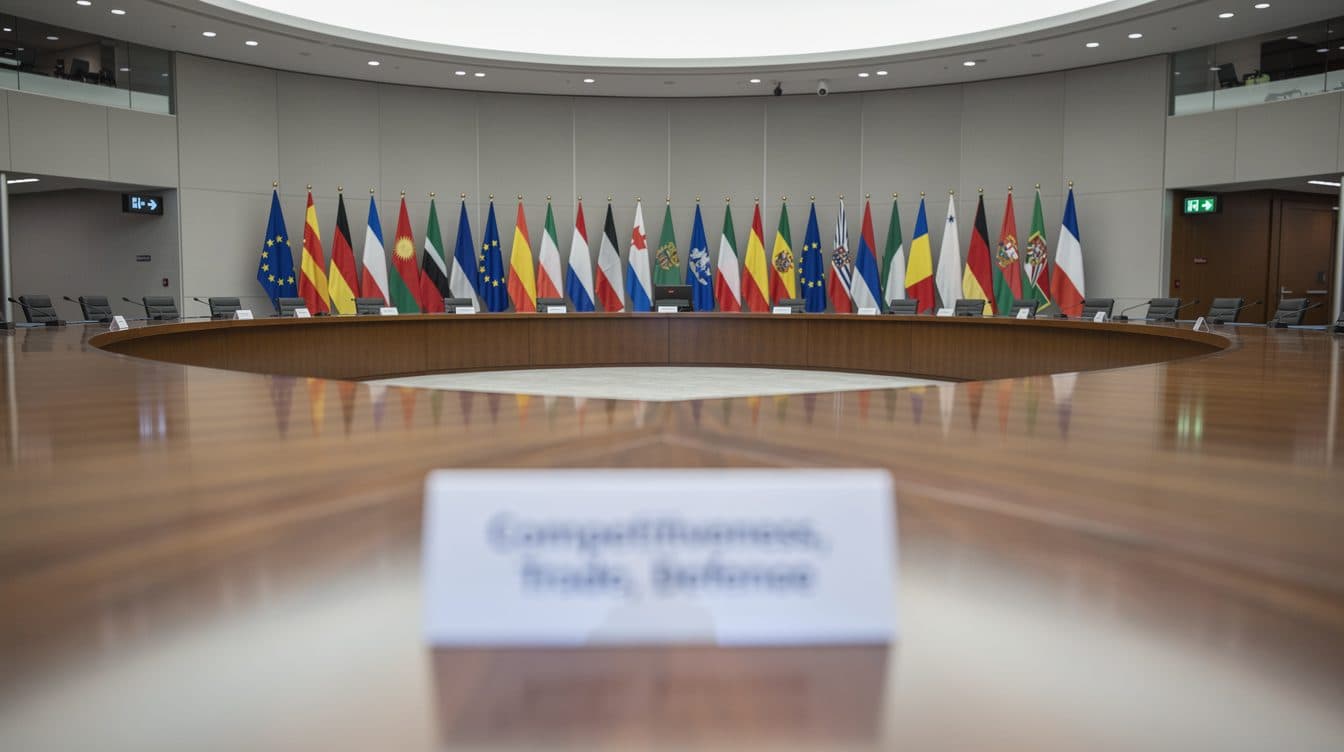
EU leaders gather in Brussels to debate tougher China stance and seven-year budget
Brussels, 17 June 2026
AI-generated image (flux-2/pro-text-to-image via Kie.ai)
Summary
EU leaders are meeting in Brussels for a two-day summit that will weigh a more confrontational approach toward China and decide how to allocate the bloc's next seven-year budget. The gathering, the first since leadership changes in four member states, will also hear from Volodymyr Zelenskyy and tackle defense, competitiveness and Ukraine.
Brussels, 17 June 2026
European Union leaders gathered in Brussels on Thursday for a two-day summit expected to produce a more confrontational China strategy and to set the political direction for the bloc's next seven-year budget, with Ukrainian President Volodymyr Zelenskyy also set to address the gathering.
A reshuffled European Council
European Union leaders gathered in Brussels on Thursday for a two-day summit expected to produce a more confrontational China strategy and to set the political direction for the bloc's next seven-year budget. The summit is the first since leadership changes in four EU countries, including Hungary and Bulgaria, a reshuffle that has altered the political arithmetic around the European Council table and shifted the room's center of gravity on trade and security questions.
The meeting's formal agenda, drawn up by officials in Brussels, opens with competitiveness and trade before pivoting to defense, Ukraine and the Middle East. Friday's program is dominated by the long-running fight over how to allocate spending in the bloc's next seven-year budget, where traditional priorities such as agriculture and regional funding are being weighed against newer demands including defense, competitiveness and economic security.
EU national leaders are using Thursday's working dinner to hold what officials involved in planning the meeting described as the first meaningful debate about China among EU heads of state or government in three years. Bureaucrats have avoided putting China on the agenda of leaders' meetings for some time prior to the upcoming meeting, despite growing pressure from several capitals to take a firmer line.
The China debate, finally on the table
The dinner discussion will be framed by an agenda item that, in Brussels-speak, functions as shorthand for the world's second-largest economy: "global macroeconomic imbalances and their implications for Europe's competitiveness and prosperity." Officials involved in planning the meeting said a lack of written outcomes from the meeting should not be "confused with inaction," and said the council intended to give the commission "very powerful" guidance on how best to move forward.
Beijing has pledged forceful retaliation in response to EU action on trade issues, raising the diplomatic stakes for any joint statement. EU member states hold competing interests in their relationships with China, with some governments reliant on Chinese demand for exports and others alarmed by industrial overcapacity, supply-chain dependence and the pace of Chinese investment in critical infrastructure across Europe.
The article characterizes China as a 'systemic threat' that the EU plans to confront with aggressive trade defences. Officials involved in planning the meeting said the council intended to give the commission "very powerful" guidance on how best to move forward, signaling that Brussels is preparing to translate political momentum into concrete instruments such as anti-dumping cases, foreign-subsidy reviews, investment screening and procurement rules.
There are concerns that European companies are losing ground in key industries, from electric vehicles and batteries to solar panels, steel and chemicals, sectors in which Chinese producers have rapidly expanded global market share. Leaders are expected to discuss ways to strengthen the single market and boost investment in critical sectors, an agenda item that diplomats say is aimed at closing the gap with Beijing's state-led industrial model.
Budget battle lines take shape
EU governments remain divided over how to allocate spending in the next seven-year budget. The budget debate involves traditional priorities such as agriculture and regional funding versus newer demands including defense, competitiveness and economic security, and EU leaders are gathering in Brussels for a two-day summit on Thursday in part to break that deadlock.
The summit's agenda includes economic and geopolitical challenges, starting with competitiveness and trade. Beyond China, the agenda reflects a broader anxiety that the European growth model is being squeezed between an industrializing China on one side and a more protectionist United States on the other, with European governments looking for ways to safeguard their own market without triggering a global trade war.
Kyiv is pushing to advance its EU membership bid at the summit, and Volodymyr Zelenskyy is set to address the EU leaders on Thursday. Ukraine is seeking to maintain support from European capitals at a moment when the war's trajectory and the future of US backing remain uncertain, and EU diplomats say the Kyiv file will be one of the most emotionally charged moments of the two days.
Ukraine, defense and the wider geopolitical frame
Ukraine, the Middle East and defense will feature prominently on the agenda, underscoring how the summit has been recast as a wider geopolitical gathering rather than a routine budget exercise. European governments are weighing how to respond to growing pressure from China while simultaneously sustaining support for Kyiv and managing fallout from conflicts in the Middle East.
The meeting includes leaders from the European Union's 27 member states, meeting under the chairmanship of the current European Council president. The European Council is the body that sets the bloc's overall political direction, and its conclusions, even when informal, send powerful signals to markets, to EU institutions and to Beijing about how far Europe is prepared to go in defending its industrial base.
Diplomats caution that the China discussion is unlikely to produce a single, joint communiqué, in part because EU member states hold competing interests in their relationships with China. Instead, officials involved in planning the meeting said the council intended to give the commission "very powerful" guidance on how best to move forward, leaving the European Commission to translate political will into legislation and trade-defense actions over the coming months.
What the leaders hope to deliver
The leadership changes include Hungary and Bulgaria and have reshuffled the political arithmetic around the European Council table, particularly on questions that had previously been blocked or softened by Budapest. Diplomats say the new configuration makes it easier to agree on tougher language on Beijing and on a more defense-heavy budget, even if final numbers will have to wait for Friday's negotiations.
This article is the last part of a three-part series examining EU-China policy, and follows reporting on the bloc's existing trade defenses and on the divisions among member states. Taken together, the series argues that the Brussels meeting is described as the first meaningful debate about China among EU leaders in three years, a signal that Europe's long internal argument over how to deal with Beijing is moving into a new, more confrontational phase.
Questions & Answers
Why is China back on the EU summit agenda?
EU national leaders are meeting in Brussels to discuss a possible new China policy, and officials describe the meeting as the first meaningful debate about China among EU leaders in three years after years in which EU bureaucrats avoided putting China on the agenda of leaders' meetings.
What is the EU expected to do about China?
Officials involved in planning the meeting said the council intended to give the commission "very powerful" guidance on how best to move forward, with the article characterizing China as a 'systemic threat' that the EU plans to confront with aggressive trade defences.
What else is on the agenda besides China?
The two-day gathering will address the EU's next seven-year budget, with EU governments divided over traditional priorities like agriculture and regional funding versus newer demands including defense, competitiveness and economic security, and Volodymyr Zelenskyy is set to address the EU leaders.
EU Brussels summit 2026: China policy and budget fight | allfacts360