EU Summit in Brussels: Struggle Over Budget, Ukraine Policy and China Strategy
Brussels, June 18, 2026
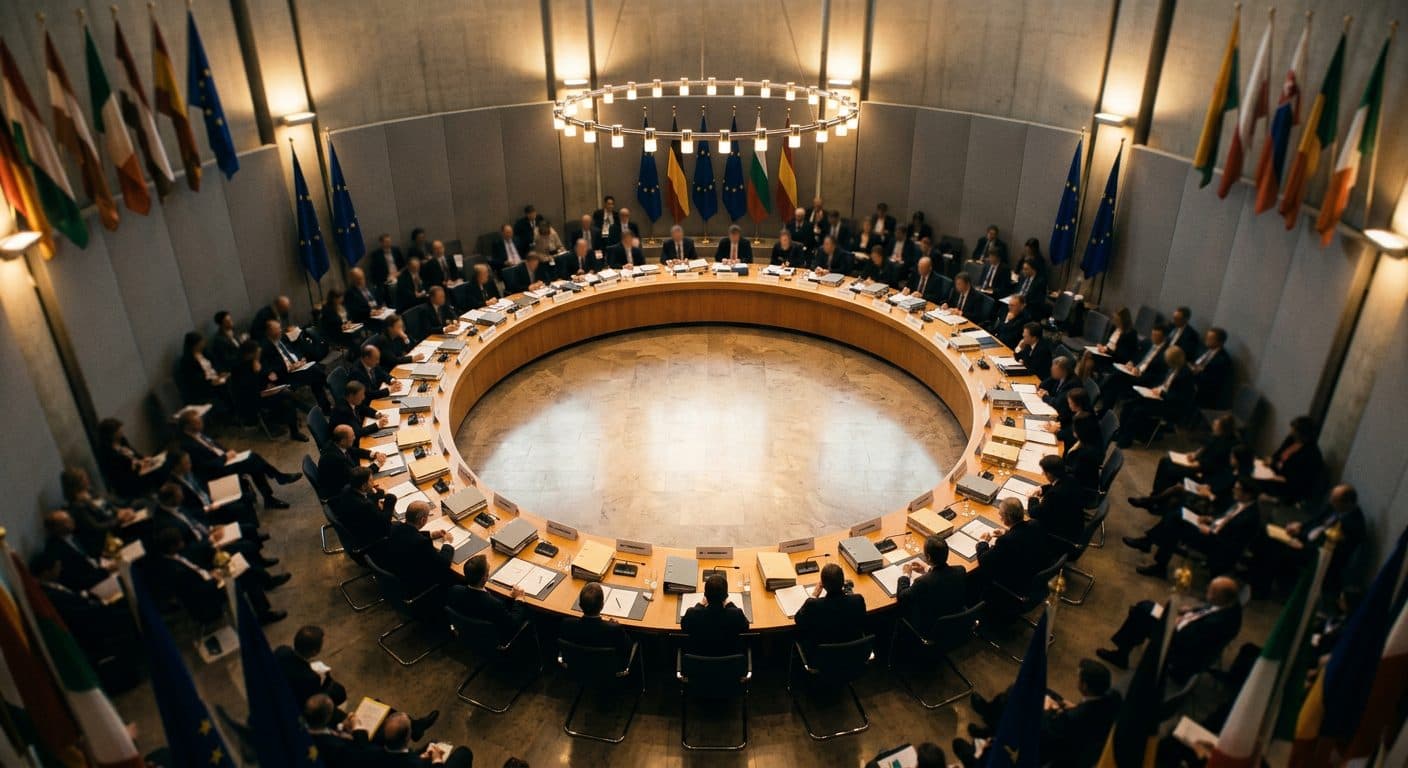
AI-generated image (google/gemini-3.1-flash-image-preview via OpenRouter)
Summary
The heads of state and government of the EU are meeting in Brussels on Thursday and Friday for a summit focused on the contested multiannual budget for 2028 to 2034, the accession negotiations with Ukraine, and the economic strategy toward China. While the EU Commission originally proposed 1.76 trillion euros, the current compromise proposal foresees a cut of around two percent.
Brussels, June 18, 2026
The heads of state and government of the 27 EU member states, including Federal Chancellor Christian Stocker (ÖVP), are meeting in Brussels on Thursday and Friday to discuss the contested multiannual budget for 2028 to 2034, the status of the EU accession negotiations with Ukraine, and the economic strategy toward China.
EU Budget: Two Trillion Euros Under Scrutiny
At the heart of the two-day summit is the European Union's multiannual financial framework (MFF) with a volume of just under two trillion euros. A compromise proposal presented last week by the Cypriot Council Presidency foresees a cut in spending of around two percent compared to the European Commission's original proposal from the summer of 2025. The negotiations are considered extremely difficult, as the member states have very different priorities – from agricultural subsidies to defense spending to climate protection.
In addition to the budget, Ukraine is on the agenda. With Ukrainian President Volodymyr Zelensky, the EU leaders want to discuss the situation in the war, possible peace negotiations with Russia, and the status of the accession negotiations. The first of six so-called "clusters" – the building blocks of the accession negotiations – was opened only recently. Diplomats on the sidelines of the summit said the Ukraine still has a "long, long way" to go and is only just at the beginning.
Federal Chancellor Christian Stocker (ÖVP) reaffirmed before the meeting that a "country at war" as an EU member was also "unthinkable" for him. Geopolitics aside, when it came to EU accession, there could be no "equals and more equal than others." For actual accession and a place as a full member of the EU, there was only one valid principle: "As long as the reforms have not been completed, there is no accession." The so-called "associated accession" would indeed give Ukraine a place in many institutions, but without voting rights on important decisions.
Ukraine Accession: First Negotiation Clusters Opened
Another focus is the economic strategy toward China. One day after the G-7 meeting in the French town of Évian, the EU heads of state and government are meeting – and again the topic is China. The gap between EU exports to China on the one hand and imports from there to Europe on the other is widening ever further – to China's advantage, according to many member states. "We all know that this is about China" is a frequently heard sentence ahead of the summit.
The G-7 had already agreed on Wednesday to introduce upper limits for the import of certain raw materials in order to reduce the risk of being blackmailed by countries such as China. The goal was to reduce the dependence on individual suppliers outside the G7 and its partner countries for rare earths and permanent magnets to below 60 percent by 2030, according to a joint declaration. This is intended to diversify the supply of critical raw materials.
Competitiveness Toward China in Focus
On the Ukraine question, the mood has recently changed. Since Hungary's new government under Péter Magyar lifted several vetoes against EU initiatives to support Ukraine, formal accession negotiations could be initiated and an aid loan of 90 billion euros could be adopted. Magyar, who is attending his first EU summit, does not want to continue his predecessor Viktor Orbán's blockade of Ukraine, but is thinking long-term: "In ten to fifteen years" the Hungarians would probably vote on accession.
At the same time, there is growing concern about a "discounted EU accession" for Ukraine. Diplomats on the sidelines of the summit say there must be no discount just because one wants to back the country. The discussion about "associated accession" is already considered by some observers to be largely settled – many diplomats describe the proposal behind the scenes as "done."
Hungary's New Course Under Prime Minister Magyar
For Austria, alongside the budget and the Ukraine issue, the topic of competitiveness is also a priority. Federal Chancellor Stocker had repeatedly stressed that Europe must gain technological sovereignty in global competition with China and the United States. The EU Commission had presented several initiatives in recent months to promote investment in key technologies such as artificial intelligence, semiconductors, and renewable energy.
Observers expect tough negotiations on the budget. The Cypriot compromise proposal foresees a volume of around 1.76 trillion euros and is thus significantly below the original demands of some member states. Some countries are insisting on more funds for defense and migration, while others are warning of cuts to cohesion and agricultural funds. The negotiations are likely to drag on into the night and possibly until Friday.
On the Middle East issue, the EU Commission will, according to diplomats, report on recent developments in the region, in particular on the situation in Iran and Gaza. A formal decision is not planned. The heads of state and government nevertheless want to follow the issue closely and task the EU High Representative with further reporting.
Defense and Middle East on the Sidelines of the Summit
The strengthening of the European defense industry is also on the agenda. In view of the ongoing Russian war of aggression against Ukraine and growing geopolitical tensions, several member states are pushing to better coordinate arms spending within the EU and to expand production capacities. The EU Commission had presented a corresponding proposal in the spring.
Overall, the summit is considered one of the most politically demanding of the year. The combination of the budget dispute, Ukraine policy, and China strategy makes agreement difficult. Diplomats expect that progress can be made at least in some areas, but a breakthrough on the budget is considered unlikely.
Outlook: Further Negotiations Expected
At the end of the summit, a press conference by EU Council President António Costa and EU Commission President Ursula von der Leyen is planned for Friday. An initial assessment of the negotiations is to be drawn up there. If no agreement is reached on the budget, further rounds of negotiations at expert level could follow.
For the coming weeks, the question of how the EU wants to readjust its relations with China as a whole is also on the table. While some member states are pushing for a stronger economic decoupling, others – including Germany and France – are warning against too sharp a demarcation that could severely affect the European economy. The EU High Representative is to present a strategy proposal by the next summit in July.
Observers also see the summit as a litmus test for the EU's ability to act in a time of multiple crises. Expectations of concrete results are muted, according to EU sources. Nevertheless, the summit is seen as an important signal of whether the 27 member states are able to find a common course on the major questions of the future – budget, Ukraine, and China.
Questions & Answers
Who is Christian Stocker and what role does he play at the EU summit?
Christian Stocker is Federal Chancellor of Austria (ÖVP) and is taking part in the EU summit in Brussels. Ahead of the meeting, he spoke out, among other things, against an EU accession of Ukraine during an ongoing war.
What is the EU multiannual budget 2028–2034 about?
At the EU summit, the heads of state and government are discussing the multiannual financial framework (MFF) with a volume of just under two trillion euros. A compromise proposal foresees a cut of around two percent compared to the European Commission's original proposal.
What progress is there in the EU accession negotiations with Ukraine?
The first of six negotiation clusters was opened only recently. At the same time, diplomats are warning against a "discounted EU accession" and emphasize that reforms remain a prerequisite for full membership.
EU Summit Brussels: Budget, Ukraine & China | allfacts360