
Brussels, July 16, 2026
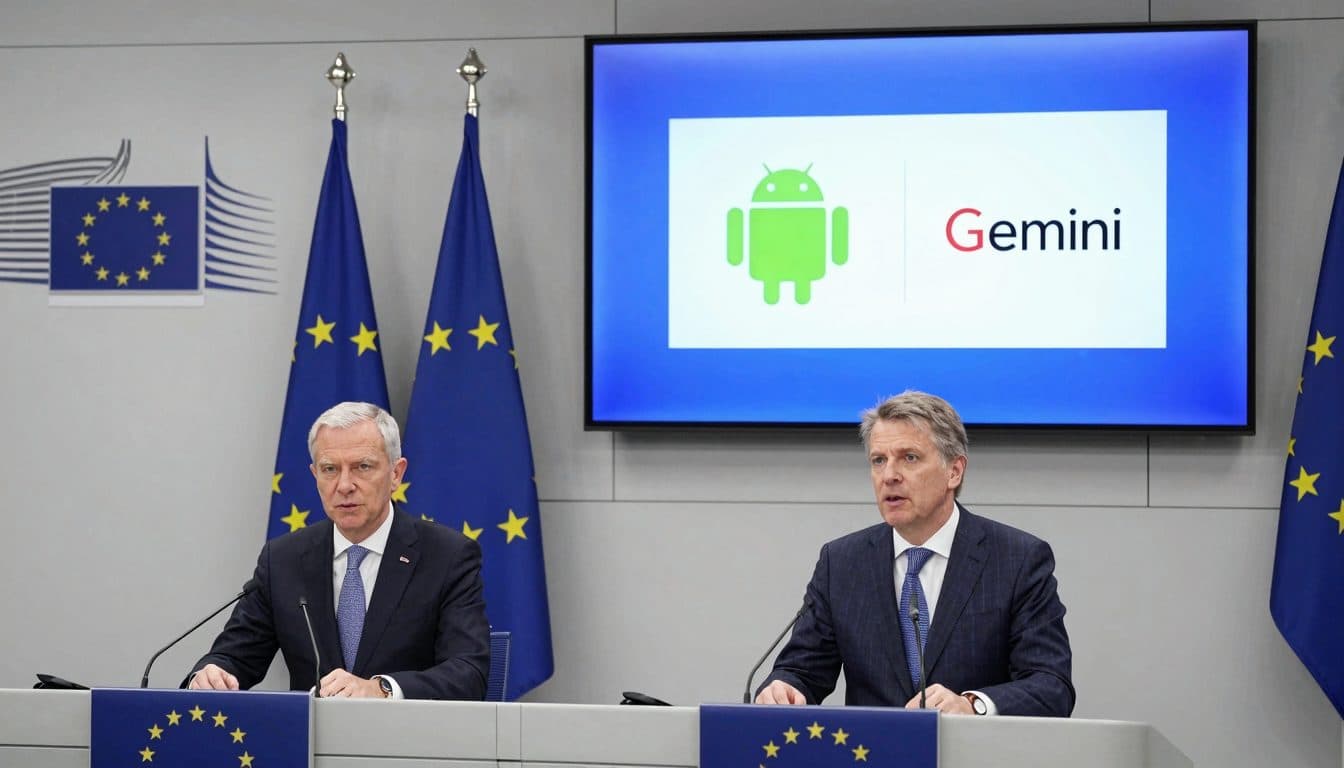
The European Commission on Thursday issued two binding specification decisions against Google under the Digital Markets Act (DMA), obliging the company to release eleven functions of its Android operating system to competitors' AI assistants and to share anonymized search data with competing search engines.
The orders aim to make it harder for the U.S. conglomerate Alphabet to leverage its dominant market position in Android and Google Search. As the Commission announced in Brussels, smaller competitors, alternative search engines, and external AI assistants are to receive equal access to central functions of the operating system in the future. According to the authority's assessment, around 60 percent of EU users own an Android device, underscoring the reach of the measure.
At the core, under the first decision, Google must grant competing AI assistants, such as those from OpenAI, access to eleven key Android functions. This includes, in particular, the ability to activate a third-party assistant via voice command, similar to the well-known activation command for the Google Assistant. This will enable users to perform tasks such as booking a taxi, suggesting replies in chat apps, or answering questions about recently visited places directly through the AI of their choice.
What the decision specifically requires
The second decision obliges Google to share anonymized data, which the company collects to optimize its own search services, with competing search engines as well as with AI chatbots that have search capabilities. To this end, the order includes a concrete pricing formula as well as a transparent access procedure. Google must begin this data sharing from January 2027.
The Commission pointed out that Google's previous data offering had been deemed ineffective under Article 6(11) of the DMA. The current specification turns the preliminary findings, which had already been communicated to Google at the beginning of the year, into binding requirements. The anonymization method was developed jointly with internal and external data protection experts and corresponds to the draft joint guidelines of the Commission and the European Data Protection Board on the interaction between the DMA and the GDPR.
Reasoning of the EU Commission
EU Commissioner for Digital Affairs Henna Virkkunen, who is responsible for technology sovereignty within the Commission, said: "Dank dieser Maßnahmen hoffen wir auf das Entstehen neuer Alternativen zur Google-Suche und zu Googles KI-Diensten wie Gemini, sodass Nutzer in der EU eine größere Auswahl an Diensten genießen können." She invited "alle großen und kleinen Entwickler" to explore the new opportunities. The Commission also stated that robust safeguards must be included to ensure that user privacy, device integrity, and security are protected.
Commission Executive Vice-President Teresa Ribera stressed: "Unsere Entscheidung wird kleineren Wettbewerbern, Suchmaschinen oder KI-Assistenten helfen, im Wettbewerb zu bestehen, und gleichzeitig die Privatsphäre der Nutzer schützen." The Commission reserves the right to adapt the decision later, particularly with regard to the anonymization measures, depending on market developments and based on an assessment by independent third parties.
Criticism from Google and security concerns
Google sharply criticized the decisions. Chief Legal Officer Kent Walker, who also serves as the company's President of Global Affairs, stated in an email: „Die heutigen Entscheidungen bergen das Risiko, wichtige Schutzvorkehrungen für die Privatsphäre und die Sicherheit von Millionen von Europäern zu untergraben." In a further statement, he said: „Wir haben wiederholt Lösungen angeboten, um die Nutzer zu schützen und gleichzeitig die Ziele des DMA zu erfüllen, aber diese Beschlüsse ignorieren umfassende Beweise für einen potenziellen Schaden für die Nutzer."
However, the Commission grants Google certain control rights. For example, the company may check before any data sharing whether the transfer to a specific third party poses serious risks to cybersecurity and data protection. In addition, Google is only required to offer the eleven Android functions to those competitors that meet the specified security and data protection requirements.
Background: DMA and previous measures
The measure complements a series of earlier interventions by the EU against the tech giant. Back in September 2023, Google had been designated as a gatekeeper under the DMA with eight services – including Google Search, Android, Chrome, Google Play, Maps, and YouTube. In addition, the EU had previously already imposed a fine of 4.1 billion euros on Google for favoring its own services on Android.
According to the Commission, the specification proceedings are not non-compliance investigations and do not provide for fines. However, they are subject to independent judicial review, meaning Google can lodge legal remedies. The underlying proceedings had been initiated at the end of January 2026, roughly six months before the decisions now announced.
According to the EU Commission, the Digital Markets Act is intended to ensure contestable and fair digital markets and regulates so-called gatekeepers. With the current decisions, the authority pursues the goal of strengthening competition in two central markets: mobile operating systems and search engines, including AI-powered search services.
Impact on consumers and markets
Investors reacted cautiously in the financial markets. The Alphabet stock rose temporarily by 0.7 percent to US$372.79 in premarket NASDAQ trading. Various analyst firms had rated the stock differently in the preceding weeks: Jefferies & Company rated it "Buy" on June 23, 2026, Barclays Capital rated it "Overweight" on May 29, 2026, and UBS rated it "Neutral" on May 22, 2026.
For consumers in the European Union, the changes will become fully visible with the next Android version in July 2027. From that point on, users should be able to activate their preferred AI assistant via voice command and use it for everyday tasks. Which concrete providers will then be available as alternatives depends, among other things, on which competitors meet the Commission's security and data protection requirements.
The EU Commission sees the decision as an important step toward strengthening Europe's digital sovereignty. It emphasizes that users should no longer be tied to Google's own services in the future but should be able to choose freely between various AI-powered assistants. Observers view the move as part of the EU's broader strategy to rein in the power of the major digital corporations and to foster innovation through more competition.
Overall, the decision illustrates the growing conflict between European regulators and U.S. tech giants. While the EU is focused on opening up existing platforms and providing more choice for consumers, the affected companies warn of possible risks and in some cases announce legal action. The coming months will show how Google shapes the concrete implementation and whether the new rules will actually lead to a broader diversity of AI services on European Android devices.