3-Euro Parcel Tax: What the New EU Fee Means | allfacts360
EU Parcel Tax: How the New Three-Euro Fee on Parcels from Third Countries Works
Brussels/Vienna, 30 June 2026
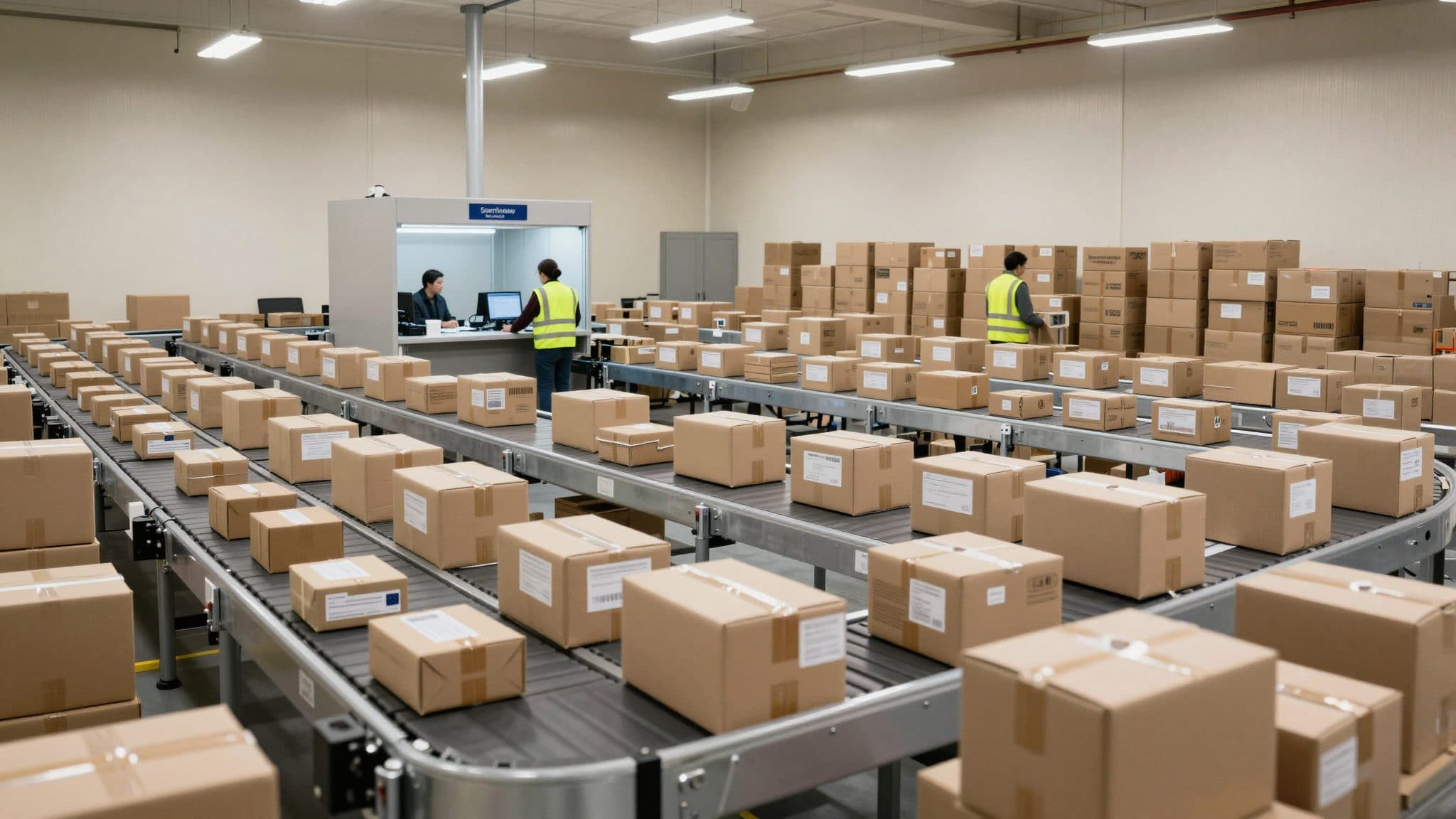
AI-generated image (z-image via Kie.ai)
Summary
Starting 1 July 2026, the EU will charge a flat fee of three euros per product category on e-commerce imports under 150 euros. According to the EU Council, it applies to around 93 percent of all online deliveries into the EU and hits cheap shipments from China hardest.
Brussels/Vienna, 30 June 2026
Starting 1 July 2026, a new flat fee of three euros per product category will apply to small imports into the EU. According to the EU Council, this affects about 93 percent of all e-commerce deliveries.
The fee is part of a multi-stage package from the European Union, with which the EU is responding to the explosively growing flood of small parcels from third countries. As the EU Council states, the three-euro flat rate applies to 93 percent of all e-commerce deliveries into the EU. The measure targets shipments with a goods value of up to 150 euros, which until now entered the Union largely duty-free. This abolishes a duty-free threshold dating back to the 1950s.
The volume is enormous: according to the EU Commission, 4.6 billion such parcels reached the EU market in 2024 – around twelve million per day. In 2025, 5.9 billion low-value shipments were already counted, with no customs duties due – four times as many as in 2022, when the figure was 1.39 billion. According to the EU Commission, around 90 percent of these parcels come from China. Of these, an estimated one million parcels per day are delivered to Austria alone.
Background: A 150-Euro Duty-Free Threshold from the 1950s
According to the member states, the flat-rate transitional solution is deliberately kept simple in order to act quickly against the flood of parcels. It is provisionally limited until 1 July 2028. From then on, under EU plans, a centrally coordinated EU customs authority is to, first, control the goods and, second, properly clear them through customs. In Brussels, it is expected that the customs platform will then apply to all goods imported into the EU.
The fee is levied not per parcel, but per product category – each so-called customs tariff line – contained in a shipment. This means that for three T-shirts shipped in one parcel at a value of 30 euros, a total of 3 euros in customs duties is due. If a cheap children's toy is added, a further three euros in customs fees are due, making 6 euros in total. A T-shirt, a stuffed animal, and a fragrance from a cheap retailer like Temu would then be charged a total of nine euros in fees. A phone case, a pair of jeans, and a lipstick would also come to nine euros.
How the Three-Euro Fee Is Calculated
Imports from the USA and Great Britain also fall under the new three-euro rule, the EU Commission emphasises. China is thus the main case, but not the only region of origin affected. Overall, according to Brussels, the measure is primarily intended to ensure fair competition with European companies.
The background is the rapid rise of Chinese online shopping platforms. Temu, Shein, and AliExpress account for an estimated ten percent – around 1.3 billion euros – of domestic e-commerce spending. According to the EU Commission, the volume of small parcels into the EU doubled every year from 2022 to 2024. At times, more than 60 percent of online-purchased cosmetics, electronics, toys, and food supplements came from third countries.
Consequences for Domestic Trade
The Austrian trade association warns of significant consequences for the domestic market. According to it, the damage in Austria alone amounts to up to 4.5 billion euros. The association refers to a current e-commerce study by KMU Forschung, according to which around half of online shopping spending in Austria is done with foreign online retailers, including Amazon and Zalando. This is putting increasing pressure on domestic trade.
Criticism also comes from academia. Lars Hofacker of the retail research institute EHI assumes that the additional costs will be passed on to consumers, at least in part: „Wir sehen bereits, dass die Preise auf den Plattformen steigen, die Kosten landen also überwiegend bei den Verbraucher:innen.“ The scope is particularly limited for very low-priced items. Hofacker therefore expects rather fewer individual shipments with low goods value from third countries.
Customs specialist eClear shares a similar assessment. Its chief, Roman Koidl, predicts: „Die Entscheidung der EU wird die Menge von über 5 Milliarden Kleinpaketen pro Jahr um zwei Drittel einbrechen lassen.“ Many Chinese customers would pay the fee or switch to alternative customs clearance methods. However, Koidl expects a drastic reduction in the range to top sellers: „Wir erwarten eine drastische Reduzierung des Sortiments auf die Top-Seller.“ This would eliminate a large part of the product variety that many consumers appreciate.
Reactions from Online Platforms
However, as other observers emphasise, the price pressure from Asia is unlikely to disappear. One expert says: „Allerdings werden die Preise auch uneinholbar niedrig bleiben, wenn asiatische Anbieter die neue Abgabe aufschlagen.“ For extremely cheap providers, it is hardly possible for sellers or importers to absorb the costs. Alien Mulyk of bevh also assumes that the fee will „wenig anhaben“ to cheap imports from Asia.
Large platforms are already preparing. As stated from Brussels: „Die Unternehmen haben bereits begonnen, ihre Logistik nach Europa zu holen und fallen durch Einfuhren per Container nicht mehr in den Anwendungsbereich der Abgabe.“ Specifically, this means they are building local warehouses and distribution centres in Europe to serve the market here. According to this, Shein has already opened a robot-assisted warehouse of 740,000 square metres in Poland.
The logistics industry is also adapting to the new situation. A spokesperson for German parcel market leader DHL expects that 85 to 90 percent of parcels from non-EU countries will be pre-cleared through two different systems and will reach the recipient normally. For 10 to 15 percent of shipments, this is not the case – here DHL initially goes into obligation and pays taxes and fees. The recipient must then pay a flat rate of 7.50 euros at the door, plus the previously paid taxes and fees. „Das kann sich auf die Transportprozesse auswirken“, according to DHL.
A spokesperson for industry association BPEX, which speaks for companies such as FedEx, UPS, Hermes, DPD, and GLS, warns: „Dies kann dazu führen, dass Zollfreigaben länger dauern, als es bisher der Fall ist, und somit Verzögerungen in der Abfertigung entstehen können“. BPEX represents a large part of European courier and parcel service providers and sees the transition above all as a technical challenge: „Die Marktteilnehmer müssen künftig die sogenannte Vorverzollung umsetzen.“ Large platforms can adapt their processes and logistics structures very quickly.
What Consumers Should Bear in Mind
According to the German customs authority, consumers are well advised, before ordering from a non-EU country, to check the seller's terms and conditions to see whether the flat customs fee is already included in the sales price or whether customs clearance is intended to be handled by the buyer. As a rule, the postal service or courier company takes care of customs clearance and advances import duties. Information can often be found in the shipping details, in the general terms and conditions, or in the ordering process. Unusually long delivery times can also be an indication that the goods are not coming from the EU.
In addition to the EU fee, Austria is also planning national steps. As early as October, the Austrian government wants to collect a two-euro fee per parcel; according to the trade association, 16 large online retailers and marketplaces with revenues of more than 100 million euros per year are affected. In November, an additional EU processing fee of two euros per parcel will then be added, which is priced in as a so-called own resource for the next EU budget. This means that in Austria there will temporarily be a total of six euros in fees per parcel.
Dispute over National Solo Efforts
This national approach is, however, controversial within the EU. High-ranking representatives of the EU Commission in Brussels have expressed concerns about national solo efforts: „aber in einem gemeinsamen europäischen Markt ist das nicht ideal“. An EU member state cannot levy customs duties on its own. That right belongs only to the EU central authority, which shares the revenues with the respective state. Should Austria not comply, a formal warning from Brussels is threatened, followed by proceedings before the European Court of Justice. The EU Commission expects countries to discontinue their fees once the EU processing fee is actually collected from November.
Other EU states are also trying to get the parcel flood under control. Besides Austria, these include France and Italy – they are trying on their own to bring the flood of parcels under control. In the long term, the conviction in Brussels is that the problem can only be solved centrally. As soon as the planned EU customs data platform is technically operational, duties will thus apply to all goods imported into the EU. Samina Sultan of the German Economic Institute (IW) puts it in a nutshell: „Auch Bestellungen bei redlichen Händlern im außereuropäischen Ausland werden sie jetzt deutlich mehr kosten.“ The fee fundamentally changes the market, but it is a necessary step toward more transparency and fairer competitive conditions.
It is undisputed that the new regulation makes the weaknesses of the previous system visible. At least 60 percent of the goods in the cheap