Explosions Shake Damascus During Macron's Visit to Syrian President al-Sharaa
Damascus, July 7, 2026
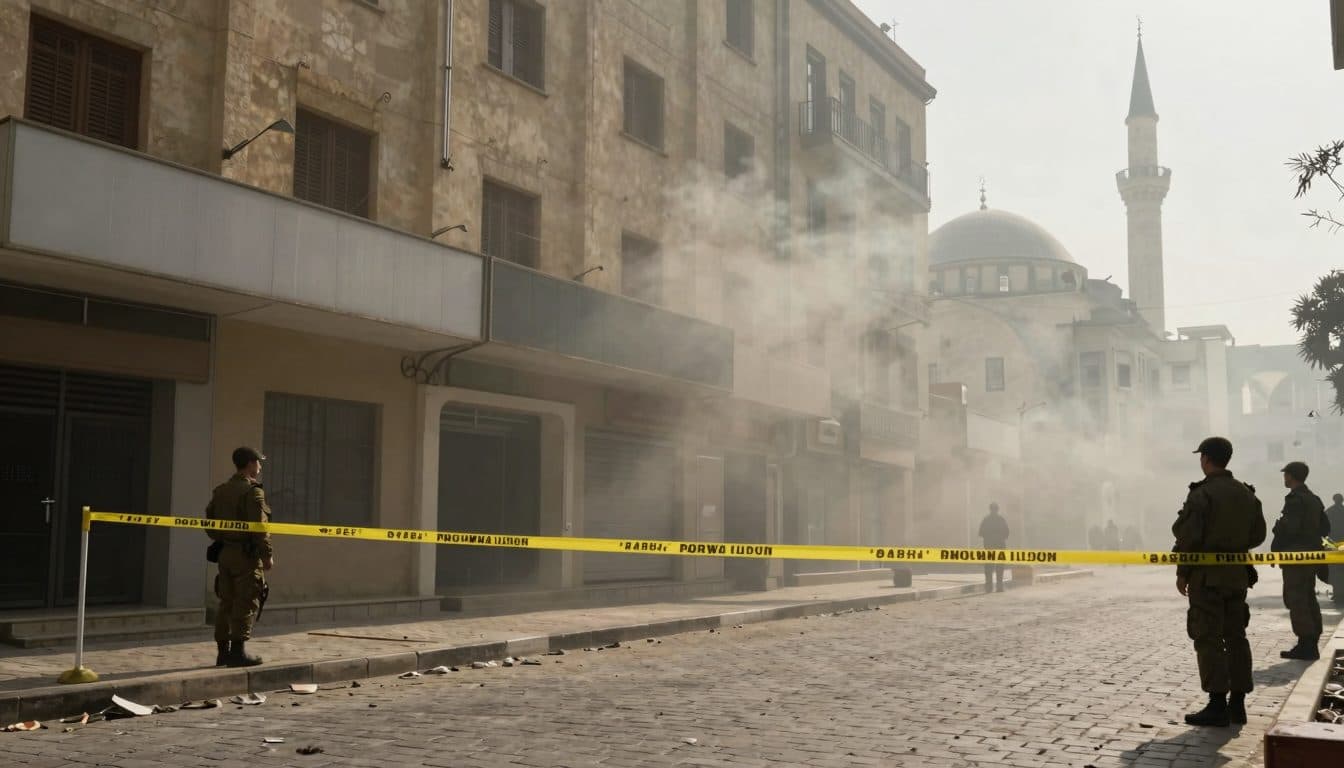
AI-generated image (z-image via Kie.ai)
Summary
While French President Emmanuel Macron met Syrian President Ahmed al-Sharaa in Damascus on Tuesday, two bomb attacks in the city center injured at least 18 people, according to official figures. The Élysée Palace said Macron was safe and that the meeting with al-Sharaa would continue. It is the first visit by a Western European head of state to Syria since the fall of ruler Bashar al-Assad in December 2024.
Damascus, July 7, 2026
French President Emmanuel Macron met with Syrian President Ahmed al-Sharaa in Damascus on Tuesday, while two bomb attacks in the city center injured at least 18 people.
The Élysée Palace said on Tuesday that Macron was safe. The planned meeting with Syrian President Ahmed al-Sharaa would continue. The state-run Syrian news agency Sana reported that Syrian security circles assumed two explosive devices, one of which had been placed in a trash bin and the other in a parked vehicle. According to the Syrian Interior Ministry, at least 18 people were injured in the explosions, including four police officers.
Macron had arrived in Damascus late on Monday evening with an economic delegation. It is the first visit by a Western European head of state to Syria since the fall of long-time ruler Bashar al-Assad in December 2024. The last time a French president visited Syria was in 2009, with Nicolas Sarkozy. In May 2025, Macron had already been the first Western leader to host al-Sharaa in Paris.
The attacks occurred near the Four Seasons Hotel, where Macron was staying according to Syrian media reports. Footage circulated on social networks showed a burning delivery van and a motorcycle, as well as bloodstains on the street. A bomb attack on a café in the city center carried out only last Thursday had killed ten people and injured more than 20 others.
Attacks Near the Four Seasons Hotel
The Élysée Palace said Macron would advocate "for a free, pluralistic Syria that respects all its population groups" – and for a country that "plays a moderating role in the tensions in the Middle East." At the same time, Macron reaffirmed on the online service X that he had come to "affirm France's commitment to the Syrian people."
At the center of the visit is the attempt to revitalize Syrian-French relations. Relations between the two countries were entering "a new phase" based on "mutual respect and a balanced partnership," Paris said. The aim was support "for a sovereign Syria, united in its diversity and living at peace with its neighbors."
The state-run Syrian news agency Sana wrote of a "historic visit" and a "decisive milestone in restoring Syria's international presence." The signing of several memoranda of understanding is planned, with which France aims to formalize economic and cultural aid. Among other things, 23 archaeological objects that had been lent to the Institut du monde arabe in Paris in 2010 and not returned because of the Syrian civil war are to be handed back to Syria.
Political Signals from Paris
Macron's visit comes amid a fragile security situation. Since Assad's overthrow by Islamist militias in December 2024, there have been several attacks in Damascus. Al-Sharaa, who came to power as a former rebel leader, had sought proximity to Western countries and to states in the Middle East in recent months, also to advance the reconstruction of Syria after 13 years of civil war.
Since taking power in December 2024, Syria's new Islamist leadership under Sharaa has repeatedly assured that it would protect the country's minorities. At the same time, France sets clear conditions: For Paris, it is "out of the question" that in Syria "one single-party rule replaces another single-party rule."
The humanitarian and economic consequences of the civil war are severe. According to UN figures, nearly half a million people were killed in the conflict in Syria, and millions were displaced. The country's infrastructure lies in ruins. While other states and companies have made extensive investment commitments, the country lacks – according to estimates by international organizations – hundreds of billions of dollars to finance reconstruction and lift millions out of poverty.
The capital had remained comparatively quiet during the turbulent phase after the change of power, although Syria's new rulers had to contend with violence between different groups to consolidate their control. The latest explosions are, in the assessment of international observers, a setback for al-Sharaa, whose government is courting international recognition and investment.
Economic and Cultural Agreements
The attack throws a spotlight on the risks associated with the gradual international rapprochement with Damascus. Macron's visit is seen as a signal that France is ready to politically and economically support the Syrian transitional government – provided it delivers on its pledges regarding a pluralistic state that protects minorities. At the same time, the bombs show that armed groups in the country remain capable of striking in the capital.
The situation in Damascus remained tense on Tuesday evening. Security forces cordoned off parts of the city center while the French delegation continued its program. Observers interpreted the swift continuation of the meeting as a deliberate signal that Paris did not intend to be deterred from its engagement by the attack. Al-Sharaa and Macron wanted to adopt a joint declaration in the evening.
The day before the visit was marked by a further escalation of the security situation. On Thursday, a bomb explosion in a café in the city center had killed ten people and injured 21 others. The Syrian transitional government subsequently announced reinforced security measures in the capital but has so far neither identified the perpetrators nor confirmed a motive.
Fragile Security Situation in Damascus
International reactions to the attack during Macron's visit were initially restrained. Several European capitals said they were closely monitoring the situation. In diplomatic circles, the incident was said to illustrate that stabilization of Syria would be hardly possible without a comprehensive security architecture and political reconciliation between the various groups in the country.
Macron traveled to Syria late on Monday evening as the first head of state of an EU member state since 2010. With his trip, he sets a political accent that is being assessed in Paris as a fresh start in relations with Damascus. Whether the planned economic agreements and the return of the archaeological objects can be signed as planned despite the tense security situation remained unclear as of Tuesday evening.
International Observers and Reactions
The wave of attacks in Damascus has reignited the debate over the stability of the Syrian transitional government. While supporters of the new leadership point to progress in government formation and the return of refugees, critics warn that Islamist groups, criminal networks, and unresolved regional conflicts endanger the stabilization of the country. Macron's visit is regarded in this field of tension as a litmus test for the West's readiness to engage more strongly in Syria.
In the evening, Macron intended to leave Damascus again. In his luggage he carries the political signals for a deepening of relations – but the images of burning vehicles and injured people in the Syrian capital will shape the perception of the visit. For the Syrian transitional government and its President al-Sharaa, much is at stake: if it fails to ensure security in the capital on a lasting basis, the cautious international rapprochement with Syria risks stalling.
Questions & Answers
Who is Ahmed al-Sharaa?
Ahmed al-Sharaa is the Syrian president who came to power through Islamist militias after the overthrow of ruler Bashar al-Assad in December 2024 and has since led the Syrian transitional government.
What was the goal of Macron's visit to Syria?
Macron intended his visit to revitalize relations between France and Syria, sign several memoranda of understanding, and prepare the return of 23 archaeological objects from the Institut du monde arabe in Paris.
How did the attacks affect Macron's visit?
Despite the explosions near his hotel, the Élysée Palace said Macron was safe and the meeting with al-Sharaa continued; the planned agreements were to be signed if possible.
Macron in Damascus: Explosions During Syria Visit | allfacts360